Results by title
244 books match the query 'Crime' and 8 start with p
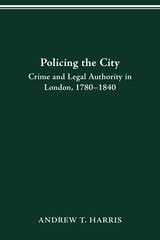
POLICING THE CITY
CRIME & LEGAL AUTHORITY IN LONDON, 1780-1840ANDREW T. HARRIS
The Ohio State University Press, 2004

Perverzion
Yuri Andrukhovych
Northwestern University Press, 2005
Or, then again, it may not.
Perverzion constructs Perfetsky's final days using a mishmash of relics, from official documents to recorded interviews to scraps of paper. Perfetsky, the personification of the Ukrainian artistic superman—he used his masterful musicianship in a collaboration with Elton John during the pop star's secret sojourn in Ukraine—is bound for Venice to participate in a seminar to save the world from absurdity. On the way he becomes a Ukrainian Orpheus descending into the decadence of the West, navigating through surrealistic adventures and no less surrealistic seminar topics as he charges head up (and pants down) toward his fate.
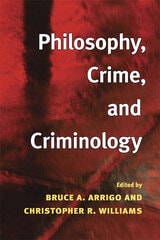
Philosophy, Crime, and Criminology
Edited by Bruce A. Arrigo and Christopher R. Williams
University of Illinois Press, 2006
Charting a provocative and original direction, editors Bruce A. Arrigo and Christopher R. Williams couple theoretically oriented chapters with those centered on application and case study. In doing so, they develop an insightful, sensible, and accessible approach for a philosophical criminology in step with the political and economic challenges of the twenty-first century. Revealing the ways in which philosophical conceits inform prevailing conceptions of crime, Philosophy, Crime, and Criminology is required reading for any serious student or scholar concerned with crime and its impact on society and in our lives.
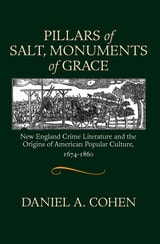
Pillars of Salt, Monuments of Grace
New England Crime Literature and the Origins of American Popular Culture, 1674-1860Daniel A. Cohen
University of Massachusetts Press, 2006
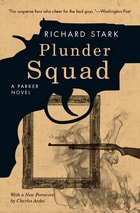
Plunder Squad
A Parker NovelRichard Stark
University of Chicago Press, 2010
An action-packed entry in the classic hard-boiled crime series starring Parker, the heister who will not quit until he's landed the score--and cleared the decks
Richard Stark’s Parker novels are the hardest of hard-boiled, classic crime novels where the heists are huge, the body counts are high, and the bad guys usually win.
The Parker novels have been a huge influence on countless writers and filmmakers, including Quentin Tarantino, Stephen King, George Pelecanos, Colson Whitehead, Lucy Sante, John Banville, and many more. Their stripped-down language and hard-as-nails amorality create an unforgettable world where the next score could be the big one, but your next mistake could also be your last. There’s nothing else like them.
“Hearing the click behind him, Parker threw his glass straight back over his right shoulder, and dove off his chair to the left.” When a job looks like amateur hour, Parker walks away. But even a squad of seasoned professionals can’t guarantee against human error in a high-risk scam. Can an art dealer with issues unload a truck of paintings with Parker’s aid? Or will the heist end up too much of a human interest story, as luck runs out before Parker can get in on the score?
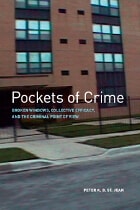
Pockets of Crime
Broken Windows, Collective Efficacy, and the Criminal Point of ViewPeter K. B. St. Jean
University of Chicago Press, 2007
Why, even in the same high-crime neighborhoods, do robbery, drug dealing, and assault occur much more frequently on some blocks than on others? One popular theory is that a weak sense of community among neighbors can create conditions more hospitable for criminals, and another proposes that neighborhood disorder—such as broken windows and boarded-up buildings—makes crime more likely. But in his innovative new study, Peter K. B. St. Jean argues that we cannot fully understand the impact of these factors without considering that, because urban space is unevenly developed, different kinds of crimes occur most often in locations that offer their perpetrators specific advantages.
Drawing on Chicago Police Department statistics and extensive interviews with both law-abiding citizens and criminals in one of the city’s highest-crime areas, St. Jean demonstrates that drug dealers and robbers, for example, are primarily attracted to locations with businesses like liquor stores, fast food restaurants, and check-cashing outlets. By accounting for these important factors of spatial positioning, he expands upon previous research to provide the most comprehensive explanation available of why crime occurs where it does.

Poets and Murder
A Judge Dee MysteryRobert van Gulik
University of Chicago Press, 1968
Judge Dee, the master detective of seventh-century China, sets out to solve a puzzling double murder and discovers complex passions lurking beneath the placid surface of academic life. A mild-mannered student is rumored to have been slain by a fox-demon, while a young dancer meets her death as she dresses to perform for the magistrate's illustrious dinner guests—an obese Zen monk revered for his calligraphy, a beautiful poetess accused of murder, and the past president of the imperial academy. To connect the present crimes with betrayals and adulteries from decades past, the clever judge must visit a high-class brothel and the haunted shrine of the Black Fox. From the moment the young scholar is found dead on the eve of the Autumn Festival, the pace never lets up.

Prisons of Poverty
Loïc Wacquant
University of Minnesota Press, 2009
An international best seller dissects the globalization of penal policies “made in U.S.A.” as part of the spread of neoliberalism
In the early 1990s, Mayor Rudolph Giuliani launched a zero-tolerance campaign aimed at street disorders and petty offenders, incarnated in the infamous “squeegee man.” New York City soon became a planetary showcase for an aggressive approach to law enforcement that, despite its extravagant costs and the absence of connection to the crime drop, came to be admired and imitated by other cities in the United States, Western Europe, and Latin America.
In Prisons of Poverty, Loïc Wacquant tracks the incubation and internationalization of the slogans, theories, and measures composing this new punitive “common sense,” fashioned to curb mounting urban inequality and marginality in the metropolis. He finds that a network of Reagan-era conservative think tanks (led by the Manhattan Institute) forged them as weapons in their crusade to dismantle the welfare state and, in effect, to criminalize poverty. He traces their import and export through the agency of the media and the pro-market policy institutes that have mushroomed across the European Union, particularly in Tony Blair’s Britain. And he shows how academics helped smuggle U.S. techniques of penalization into their countries by dressing them up in scholarly garb.Now available in English for the first time in an expanded edition, Prisons of Poverty reveals how the Washington consensus on economic deregulation and welfare retrenchment was extended to encompass punitive crime control because the invisible hand of the market necessitates and calls forth the iron fist of the penal state.