Results by title
143 books match the query 'Crisis' and 9 start with p
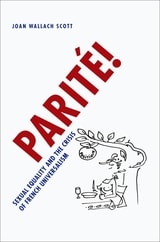
Parité!
Sexual Equality and the Crisis of French UniversalismJoan Wallach Scott
University of Chicago Press, 2005
During the 1990s, le mouvement pour la parité successfully campaigned for women's inclusion in elective office with an argument that is unprecedented in the annals of feminism. The paritaristes insisted that if the abstract individual were thought of as sexed, then sexual difference would no longer be a relevant consideration in politics. Scott insists that this argument was neither essentialist nor separatist; it was not about women's special qualities or interests. Instead, parité was rigorously universalist—and for that reason was both misunderstood and a source of heated debate.
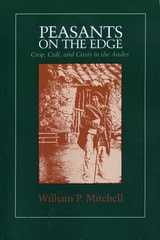
Peasants on the Edge
Crop, Cult, and Crisis in the AndesBy William P. Mitchell
University of Texas Press, 1991
Throughout Latin America and the rest of the Third World, profound social problems are growing in response to burgeoning populations and unstable economic and political systems. In Peru, terrorist acts by the Shining Path guerilla movement are the most visible manifestation of social discontent, but rapid economic and religious changes have touched the lives of almost everyone, radically altering traditional lifeways. In this twenty-year study of the community of Quinua in the Department of Ayacucho, William Mitchell looks at changes provoked by population growth within a severely limited ecological and economic setting, including increasing conversion to a cash economy and out-migration, the decline of the Catholic fiesta system and the rise of Protestantism, and growing poverty and revolution.
When Mitchell first began his field studies in Quinua in 1966, farming was still the Quinueños' principal means of livelihood. But while the population was increasing rapidly, the amount of arable land in the community remained the same, creating increased food shortfalls. At the same time, government controls on food prices and subsidies of cheap food imports drove down the value of rural farm production. These ecological and economic factors forced many people to enter the nonfarm economy to feed themselves.
Using a materialist approach, Mitchell charts the new economic strategies that Quinueños use to confront the harsh pressures of their lives, including ceramic production, wage labor, petty commerce, and migration to cash work on the coat and in the eastern tropical forests. In addition, he shows how the growing conversion from Catholicism to Protestantism is also an economic strategy, since Protestant ideology offers acceptable reasons for redirecting the money that used to be spent on elaborate religious festivals to household needs and education.
The twenty-year span of this study makes it especially valuable for students of social change. Mitchell's unique, interdisciplinary approach, considering ecological, economic, and population factors simultaneously, offers a model that can be widely applied in many Third World areas. Additionally, the inclusion of an entire chapter of family histories reveals how economic and ecological forces are played out at the individual level.

Polarizing Development
Alternatives to Neoliberalism and the CrisisEdited by Lucia Pradella and Thomas Marois
Pluto Press, 2015
The global economic crisis has exposed the limits of neoliberalism and dramatically deepened social polarization. Yet, despite increasing social resistance and opposition, neoliberalism prevails globally.
Radical alternatives, moreover, are only rarely debated. And if they are, such alternatives are reduced to new Keynesian and new developmental agendas, which fail to address existing class divisions and imperialist relations of domination.
This collection of essays polarizes the debate between radical and reformist alternatives by exploring head-on the antagonistic structure of capitalist development. The contributors ground their proposals in an international, non-Eurocentric and Marxian inspired analysis of capitalism and its crises. From Latin America to Asia, Africa to the Middle East and Europe to the US, social and labour movements have emerged as the protagonists behind creating alternatives.
This book’s new generation of scholars has written accessible yet theoretically informed and empirically rich chapters elaborating radical worldwide strategies for moving beyond neoliberalism, and beyond capitalism. The intent is to provoke critical reflection and positive action towards substantive change.
Popular Sovereignty and the Crisis of German Constitutional Law
The Theory and Practice of Weimar ConstitutionalismPeter C. Caldwell
Duke University Press, 1997
Caldwell makes accessible the rich literature in German constitutional thought of the Weimar period, most of which has been unavailable in English until now. On the liberal left, Hugo Preuss and Hans Kelsen defended a concept of democracy that made the constitution sovereign and, in a way, created the "Volk" through constitutional procedure. On the right, Carl Schmitt argued for a substantial notion of the "Volk" that could overrule constitutional procedure in a state of emergency. Rudolf Smend and Heinrich Triepel located in the constitution a set of inviolable values of the political community, while Hermann Heller saw in it a guarantee of substantial social equality. Drawing on the work of these major players from the 1920s, Caldwell reveals the various facets of the impassioned constitutional struggles that permeated German legal and political culture during the Weimar Republic.
Presidents, Populism, and the Crisis of Democracy
William G. Howell and Terry M. Moe
University of Chicago Press, 2020
The most visible cause is Donald Trump, who has used his presidency to attack the nation’s institutions and violate its democratic norms. Yet Trump is but a symptom of causes that run much deeper: social forces like globalization, automation, and immigration that for decades have generated economic harms and cultural anxieties that our government has been wholly ineffective at addressing. Millions of Americans have grown angry and disaffected, and populist appeals have found a receptive audience. These are the drivers of Trump’s dangerous presidency. And after he leaves office, they will still be there for other populists to weaponize.
What can be done to safeguard American democracy? The disruptive forces of modernity cannot be stopped. The solution lies, instead, in having a government that can deal with them—which calls for aggressive new policies, but also for institutional reforms that enhance its capacity for effective action.
The path to progress is filled with political obstacles, including an increasingly populist, anti-government Republican Party. It is hard to be optimistic. But if the challenge is to be met, we need reforms of the presidency itself—reforms that harness the promise of presidential power for effective government, but firmly protect against the fear that it may be put to anti-democratic ends.

Priests
A Calling in CrisisAndrew M. Greeley
University of Chicago Press, 2004
No stranger to controversy himself, Greeley here challenges those analysts and the media who parrot them in placing the blame for recent Church scandals on the mandate of celibacy or a clerical culture that supports homosexuality. Drawing upon reliable national survey samples of priests, Greeley demolishes current stereotypes about the percentage of homosexual priests, the level of personal and professional happiness among priests, the role of celibacy in their lives, and many other issues. His findings are more than surprising: they reveal, among other things, that priests report higher levels of personal and professional satisfaction than doctors, lawyers, or faculty members; that they would overwhelmingly choose to become priests again; and that younger priests are far more conservative than their older brethren.
While the picture Greeley paints should radically reorient the public perception of priests, he does not hesitate to criticize the Church's significant shortcomings. Most priests, for example, do not think the sexual abuse problems are serious, and they do not think that poor preaching or liturgy is a problem, though the laity give them very low marks on their ministerial skills. Priests do not listen to the laity, bishops do not listen to priests, and the Vatican does not listen to any of them. With Greeley's statistical evidence and provocative recommendations for change—including a national "Priest Corps" that would offer young men a limited term of service in the Church—Priests offers a new vision for American Catholics, one based on real problems and solutions rather than on images of a depraved, immature, and frustrated priesthood.
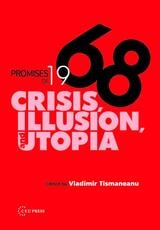
Promises of 1968
Crisis, Illusion and UtopiaVladimir Tismaneanu
Central European University Press, 2011
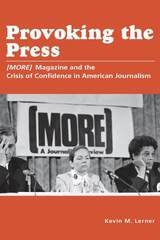
Provoking the Press
(MORE) Magazine and the Crisis of Confidence in American JournalismKevin M. Lerner
University of Missouri Press, 2023
Two of these new journalists, a Pulitzer Prize—winning, Harvard-educated New York Times reporter named J. Anthony Lukas, and a former Newsweek media writer named Richard Pollak, founded a journalism review called (MORE) in 1971, with its pilot issue appearing the same month that the Times began publishing the Pentagon Papers. (MORE) covered the press with a critical attitude that blended seriousness and satire—part New York Review of Books, part underground press. In the eight years that it published, (MORE) brought together nearly every important American journalist of the 1970s, either as a writer, a subject of its critical eye, or as a participant in its series of raucous "A.J. Liebling Counter-Conventions"—meetings named after the outspoken press critic—the first of which convened in 1974. In issue after issue the magazine considered and questioned the mainstream press's coverage of explosive stories of the decade, including the Watergate scandal; the "seven dirty words" obscenity trial; the debate over a reporter's constitutional privilege; the rise of public broadcasting; the struggle for women and minorities to find a voice in mainstream newsrooms; and the U.S. debut of press baron Rupert Murdoch.
In telling the story of (MORE) and its legacy, Kevin Lerner explores the power of criticism to reform and guide the institutions of the press and, in turn, influence public discourse.

Psychoanalysis--A Theory in Crisis
Marshall Edelson
University of Chicago Press, 1988