191 books match the query 'Critical theory' and 13 start with p
cover of Parables for the Virtual: Movement, Affect, Sensation

Parables for the Virtual

Movement, Affect, Sensation

Brian Massumi

Duke University Press, 2021

Since its publication twenty years ago, Brian Massumi's pioneering Parables for the Virtual has become an essential text for interdisciplinary scholars across the humanities. Massumi views the body and media such as television, film, and the internet as cultural formations that operate on multiple registers of sensation. Renewing and assessing William James's radical empiricism and Henri Bergson's philosophy of perception through the filter of the postwar French philosophy of Deleuze, Guattari, and Foucault, Massumi links a cultural logic of variation to questions of movement, affect, and sensation. Replacing the traditional opposition of literal and figural with distinctions between stasis and motion and between actual and virtual, Massumi tackles related theoretical issues by applying them to cultural mediums as diverse as architecture, body art, the digital art of Stelarc, and Ronald Reagan's acting career. The result is an intriguing combination of cultural theory, science, and philosophy that asserts itself in a crystalline and multifaceted argument.

This twentieth anniversary edition includes a new preface in which Massumi situates the book in relation to developments since its publication and outlines the evolution of its main concepts. It also includes two short texts, “Keywords for Affect” and “Missed Conceptions about Affect,” in which Massumi explicates his approach to affect in ways that emphasize the book's political and philosophical stakes.
[more]
cover of Periodizing Jameson: Dialectics, the University, and the Desire for Narrative

Periodizing Jameson

Dialectics, the University, and the Desire for Narrative

Phillip E. Wegner

Northwestern University Press, 2014

For a half century, the American intellectual Fredric Jameson has been a driving force in literary and cultural theory. In Periodizing Jameson, Phillip E. Wegner builds upon Jameson’s unique dialectical method to demonstrate the value of Jameson’s tools—periodization, the fourfold hermeneutic, and the Greimasian semiotic square, among others—and to develop virtuoso readings of Jameson’s own work and the history of the contemporary American university in which it unfolds.

Wegner shows how Jameson’s work intervenes in particular social, cultural, and political situations, using his scholarship both to develop original explorations of nineteenth-century fiction, popular films, and other promiment theorists, and to examine the changing fortunes of theory itself. In this way, Periodizing Jameson casts new light on the potential of and challenges to humanist intellectual work in the present.
 

[more]
cover of Personal Demons: Possession Narratives of Late Liberalism

Personal Demons

Possession Narratives of Late Liberalism

Grace Lavery

Duke University Press, 2026
Personal Demons offers a new theory of the relation between sex, desire, and personhood, asking what we should make of the many contemporary instances when bodies seem to want different things from the consciousnesses within them. Grace Lavery maps the negative energies—demonic, incoherent, resistant—through which liberalism produces and disciplines its scapegoats. Through an examination of modern possession narratives, from racialized spectacles of bodily transformation and disguise to the liturgy of the Church of Scientology, Lavery unspools the knot of body, affect, and representation at the end of liberalism. In the face of the uneasy bargains queer and trans liberal organizations made with the phobic state, Personal Demons elaborates a vision of queer collective living that does not assume a shared concept of interiority, taking the incompatibility of such concepts as the founding axiom for a coalition against the ideological regulation of bodies and minds.
[more]
cover of Phenomenal Blackness: Black Power, Philosophy, and Theory

Phenomenal Blackness

Black Power, Philosophy, and Theory

Mark Christian Thompson

University of Chicago Press, 2022

This unorthodox account of 1960s Black thought rigorously details the field’s debts to German critical theory and explores a forgotten tradition of Black singularity. 
 
Phenomenal Blackness examines the changing interdisciplinary investments of key mid-century Black writers and thinkers, including the growing interest in German philosophy and critical theory. Mark Christian Thompson analyzes this shift in intellectual focus across the post-war decades, placing Black Power thought in a philosophical context.

Prior to the 1960s, sociologically oriented thinkers such as W. E. B. Du Bois had understood Blackness as a singular set of socio-historical characteristics. In contrast, writers such as Amiri Baraka, James Baldwin, Angela Y. Davis, Eldridge Cleaver, and Malcolm X were drawn to notions of an African essence, an ontology of Black being. With these perspectives, literary language came to be seen as the primary social expression of Blackness. For this new way of thinking, the works of philosophers such as Adorno, Habermas, and Marcuse were a vital resource, allowing for continued cultural-materialist analysis while accommodating the hermeneutical aspects of Black religious thought. Thompson argues that these efforts to reimagine Black singularity led to a phenomenological understanding of Blackness—a “Black aesthetic dimension” wherein aspirational models for Black liberation might emerge.
[more]
cover of Pierre Bourdieu's Political Economy of Being

Pierre Bourdieu's Political Economy of Being

Ghassan Hage

Duke University Press, 2025
In Pierre Bourdieu’s Political Economy of Being, Ghassan Hage explores the great French social theorist’s work and revitalizes conventional and undertheorized aspects of his thinking. Hage focuses on Bourdieu’s concern with social being and what constitutes a worthwhile and fulfilling life. Such a life is not something that one either has or does not have; rather, society distributes and assigns values to ways of living. These values are structured by relations of power and domination and are subject to the outcome of political conflicts. Hage elucidates this political economy of being by reworking Bourdieu’s key concepts of habitus, illusio, symbolic capital, and field. In this political economy, people enjoy a worthwhile life to the degree that they are able to orient and deploy themselves practically in the world that surrounds them, have a sense of purpose, and achieve a level of social recognition. For Hage, the project of theorizing and understanding how people struggle to define, legitimize, and live a viable life in the face of symbolic domination permeates all of Bourdieu’s work.
[more]
cover of Points of Departure: Samuel Weber between Spectrality and Reading

Points of Departure

Samuel Weber between Spectrality and Reading

Edited by Peter Fenves, Kevin McLaughlin, and Marc Redfield

Northwestern University Press, 2016
Since the late 1960s, when he introduced Theodor Adorno’s work on literature and cultural critique to an English-speaking public, Samuel Weber has stimulated the discovery of new and unexpected links within a broad spectrum of humanistic disciplines, including critical theory and psychoanalysis, media studies and literary analysis, continental philosophy and theater studies. The international group of scholars who contribute to Points of Departure demonstrate the persistent fecundity of Weber’s work. Centered around his essay on the Ghost of Hamlet, as reflected in the writings of Walter Benjamin and Carl Schmitt, the volume is broadly divided into explorations of the nature of spectrality, on the one hand, and the dynamics of reading, on the other. Each of the twelve essays thus takes its point of departure from “Weber’s singular path between languages, cultures, and traditions”—to quote Jacques Derrida, whose fictive “interview with a passing journalist” is published here for the first time.
[more]
cover of Political Myth: On the Use and Abuse of Biblical Themes

Political Myth

On the Use and Abuse of Biblical Themes

Roland Boer

Duke University Press, 2009

In this provocative and necessary work, Roland Boer, a leading biblical scholar and cultural theorist, develops a political myth for the Left: a powerful narrative to be harnessed in support of progressive policy. Boer focuses on foundational stories in the Hexateuch, the first six books of the Bible, from Genesis through Joshua. He contends that the “primal story” that runs from Creation, through the Exodus, and to the Promised Land is a complex political myth, one that has been appropriated recently by the Right to advance reactionary political agendas. To reclaim it in support of progressive political ends, Boer maintains, it is necessary to understand the dynamics of political myth.

Boer elaborates a theory of political myth in dialogue with Ernst Bloch, Theodor Adorno, Alain Badiou, Jacques Lacan, and Slavoj Žižek. Through close readings of well-known biblical stories he then scrutinizes the nature of political myth in light of feminism, psychoanalysis, and Marxism. Turning to contemporary politics, he examines the statements of prominent American and Australian politicians to show how the stories of Creation, conquest, Paradise, and the Promised Land have been distorted into a fantasy of Israel as a perpetual state in the making and a land in need of protection. Boer explains how this fantasy of Israel shapes U.S. and Australian foreign and domestic policies, and he highlights the links between it and the fantasy of unfettered global capitalism. Contending that political myths have repressed dimensions which if exposed undermine the myths’ authority, Boer urges the Left to expose the weakness in the Right’s mythos. He suggests that the Left make clear what the world would look like were the dream of unconstrained capitalism to be realized.
[more]
cover of Political Theology Reimagined

Political Theology Reimagined

Alex Dubilet and Vincent W. Lloyd, editors

Duke University Press, 2025

Political theology has emerged as an enormously energetic, creative way of exploring the complex relationships between religion, politics, and culture around the world. Political Theology Reimagined centers decolonial, Black, queer, feminist, and Marxist modes of critical practice to offer a cutting-edge vision of the field that foregrounds a political theology animated by both a fascination with and a suspicion of the secular. Among other things, contributors explore how religious ideas, practices, and imaginations are inflected by anti-Blackness, patriarchy, and colonial histories; theorize anew the status of secularization narratives; probe the universality and translatability of conceptual abstractions; and experiment with the powers of genealogy and speculation. In short, they grapple with religion and critique in all their complexity, opening new itineraries in political theology by transforming its fundamental theoretical coordinates. Traversing diverse sites, from South Asia to the Middle East to Indigenous North America, and working across diverse scales, from the national to the planetary to the cosmic, this volume models the future of political theology by pairing rigorous critique with a commitment to collective liberation.

Contributors. Prathama Banerjee, Agata Bielik-Robson, Kirill Chepurin, Alex Dubilet, James Edward Ford III, Lucia Hulsether, Basit Kareem Iqbal, Ada S. Jaarsma, Siobhan Kelly, David Kline, Adam Kotsko, Dana Lloyd, Vincent W. Lloyd, Beatrice Marovich, Aseel Najib, Milad Odabaei, Inese Radzins, George Shulman, Martin Shuster, Rafael Vizcaíno
[more]
cover of Porous Becomings: Anthropological Engagements with Michel Serres

Porous Becomings

Anthropological Engagements with Michel Serres

Andreas Bandak and Daniel M. Knight, editors

Duke University Press, 2024

One of the foremost intellectuals of his generation, French philosopher of science Michel Serres (1930–2019) broke free from disciplinary dogmas. His reflections on science, culture, technology, art, and religion have proved foundational to scholars across the humanities. The contributors to Porous Becomings bring the inspirational and enigmatic world of Serres to the attention of anthropology. Through ethnographic encounters as diverse as angels and religious conversion in Ethiopia, the percolation of war in Bosnia, and incarcerated bodies crossing the Atlantic, the contributors showcase how Serres’s interrogation of the fundamentals of human existence opens new pathways for anthropological knowledge. Proposing the notion of "porosity" to characterize permeability across boundaries of time, space, literary genre, and academic discipline, they draw on Serres to map the constellations that connect humans, time, technology, and planet Earth. The volume concludes with a conversation between the editors and Vibrant Matter author Jane Bennett.

Contributors. Andreas Bandak, Jane Bennett, Tom Boylston, Steven D. Brown, Matei Candea, Alberto Corsín Jiménez, David Henig, Michael Jackson, Daniel M. Knight, Celia Lowe, Morten Nielsen, Stavroula Pipyrou, Elizabeth Povinelli, Andrew Shryock, Arpad Szakolczai
[more]
cover of Post-Personal Romanticism: Democratic Terror, Prosthetic Poetics, and the Comedy of Modern Ethical Life

Post-Personal Romanticism

Democratic Terror, Prosthetic Poetics, and the Comedy of Modern Ethical Life

Bo Earle

The Ohio State University Press, 2017

Post-Personal Romanticism: Democratic Terror, Prosthetic Poetics, and the Comedy of Modern Ethical Life by Bo Earle offers a broad recasting of Romantic lyric’s formal innovations in terms of Hegel’s historical ethics. These innovations attempt to come to terms with the Enlightenment’s paradoxical legacy: industrial and consumerist modernity depends on the Enlightenment norm of rationally autonomous individuality even as it makes this norm ever more implausible. In turn, a key insight of the Romantics is that modernity depends most crucially upon the very elusiveness of this norm of autonomous individuality. The Romantics emphasize that modernity is constitutively a culture of fantasy, a culture self-conscious about the impossibility of its own organizing values and goals.
  
Tracing this insight to Hegel’s suggestion that modern subjectivity is in some sense post-individual or even posthumous, Earle argues that signature Romantic lyrics offer a way forward that avoids postmodernism’s wholesale rejection of autonomous selfhood. With chapters on Wordsworth, Blake, Byron, Shelley, and Keats, Earle traces how Romantic lyrics mine this interminability to recover figurative emblems or masks of selfhood from experiences of its inevitable normative failure. This model is of particularly urgent value today when the costs of modern narcissism, economic exploitation, and political imperialism have come to include the normalization of torture, signature drone strikes, and climate change.
 
[more]
cover of Postclassicisms

Postclassicisms

The Postclassicisms Collective

University of Chicago Press, 2020

Made up of nine prominent scholars, The Postclassicisms Collective aims to map a space for theorizing and reflecting on the values attributed to antiquity. The product of these reflections, Postclassicisms takes up a set of questions about what it means to know and care about Greco-Roman antiquity in our turbulent world and offers suggestions for a discipline in transformation, as new communities are being built around the study of the ancient Greco-Roman world.

Structured around three primary concepts—value, time, and responsibility—and nine additional concepts, Postclassicisms asks scholars to reflect upon why they choose to work in classics, to examine how proximity to and distance from antiquity has been—and continues to be—figured, and to consider what they seek to accomplish within their own scholarly practices. Together, the authors argue that a stronger critical self-awareness, an enhanced sense of the intellectual history of the methods of classics, and a greater understanding of the ethical and political implications of the decisions that the discipline makes will lead to a more engaged intellectual life, both for classicists and, ultimately, for society. A timely intervention into the present and future of the discipline, Postclassicisms will be required reading for professional classicists and students alike and a model for collaborative disciplinary intervention by scholars in other fields.
[more]
cover of Poverty and Antitheatricality: Form and Formlessness in Latin American Literature, Art, and Theory

Poverty and Antitheatricality

Form and Formlessness in Latin American Literature, Art, and Theory

Stephen Buttes

Rutgers University Press, 2025
Poverty and Antitheatricality argues that many major analytical approaches today misunderstand the problem of poverty by emphasizing its status as an experience. These experiential models transform poverty from a specific socioeconomic status lived in a particular historical sequence into a transhistorical presence of marginality that is not only inevitable but necessary. Embedded in capitalist, socialist, and populist forms of socioeconomic organization, these models paradoxically suggest that if we want to have a world free of poverty, we must always have the poor and their experience of formlessness. Taking up the paired terms—form and formlessness—Stephen Buttes demonstrates how they sustain not only debates about poverty and its political role within modernity but also the idea of the work of art within the history of modernism. Offering critiques of critical theory alongside new readings of both canonical and little-studied Latin American authors and artists, Poverty and Antitheatricality makes a compelling case that understanding the kind of problem the work of art is opens up overlooked but essential pathways to understanding poverty and the kind of problem it is.
[more]
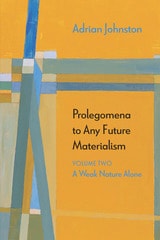
cover of Prolegomena to Any Future Materialism: A Weak Nature Alone

Prolegomena to Any Future Materialism

A Weak Nature Alone

Adrian Johnston

Northwestern University Press, 2019

Adrian Johnston’s trilogy Prolegomena to Any Future Materialism aims to forge a thoroughly materialist yet antireductive theory of subjectivity. In this second volume, A Weak Nature Alone, Johnston focuses on the philosophy of nature required for such a theory. This volume is guided by a fundamental question: How must nature be rethought so that human minds and freedom do not appear to be either impossible or inexplicable within it? Asked differently: How must the natural world itself be structured such that sapient subjects in all their distinctive peculiarities emerged from and continue to exist within this world?

In A Weak Nature Alone, Johnston develops his transcendental materialist account of nature through engaging with and weaving together five main sources of inspiration: Hegelian philosophy, Marxist materialism, Freudian-Lacanian metapsychology, Anglo-American analytic neo-Hegelianism, and evolutionary theory and neurobiology. Johnston argues that these seemingly (but not really) strange bedfellows should be brought together so as to construct a contemporary ontology of nature. Through this ontology, nonnatural human subjects can be seen to arise in an immanent, bottom-up fashion from nature itself. 

[more]