87 books match the query 'Criticism, Textual' and 3 start with p
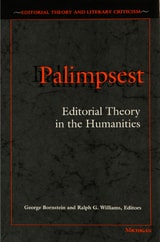
cover of Palimpsest: Editorial Theory in the Humanities

Palimpsest

Editorial Theory in the Humanities

George Bornstein and Ralph G. Williams, Editors

University of Michigan Press, 1993

In the last decade, editorial theory and practice have begun to generate some of the most interesting issues and problems in the humanities. The discovery of plagiarism in Martin Luther King, Jr.'s dissertation and debates over editions of James Joyce's Ulysses appeared on the front pages of newspapers. The practice of editing has challenged our conceptions both of works themselves and of the principles by which art, meaning, and tradition are constituted.Palimpsest is the first volume to consider the impact of the new editorial work and theory on a wide range of humanistic disciplines. It assembles an extraordinarily distinguished group of leading practitioners and theorists, who examine editing in a variety of contexts: literature, music, art, history, religion, and correspondence. Contributors: Betty Bennett, George Bornstein, Kathleen Weil-Garris Brandt, Clayborne Carson, David Noel Freedman, Hans Walter Gabler, Philip Gossett, David Greetham, Jerome J. McGann, Barbara Oberg, Peter Shillingsburg, Gary Taylor, Ralph G. Williams, and James E. G. Zetzel.
[more]
cover of Philology and Its Histories

Philology and Its Histories

Sean Gurd

The Ohio State University Press, 2010
There has never been any shortage of interest in philology, its status, its history, or its origins. Today, after more than twenty years of serial “returns to philology” under the banner of deconstruction, the new medieval studies, critical bibliography, and a particular kind of globally aware activist criticism, philology has again become available as a respectable posture for contemporary literary scholars. But what is “philology,” and how can we attend to it, either as a contemporary practice or as an age-old object of endorsement and critique?
 
In this volume, edited by Sean Gurd, noted scholars discuss the history of philology from antiquity to the present. This book addresses a wide variety of authors, documents, and movements, among them Greek papyri, Latin textual traditions, the Renaissance, eighteenth-century antiquarianism, and deconstruction.
 
It is too easy to see philology as the bearer of an antiquated but forceful authority. When philologists take up the tools of textual criticism, they contribute to the very form of texts; seeking to articulate the protocols of correct interpretation, they aspire to be the legislators of reading practice. Nonetheless, Philology and Its Histories argues that philology is not a conservative or ideologically loaded master-discourse, but a tradition of searching, fundamentally ungrounded, dealing with the insecurity of questions rather than the safety of answers. For good or ill, philology is where literature happens; we do well to pay heed to it and to its changes over the course of millennia.
[more]
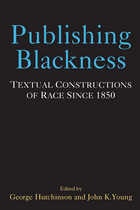
cover of Publishing Blackness: Textual Constructions of Race Since 1850

Publishing Blackness

Textual Constructions of Race Since 1850

George Hutchinson and John K. Young, Editors

University of Michigan Press, 2013

From the white editorial authentication of slave narratives, to the cultural hybridity of the Harlem Renaissance, to the overtly independent publications of the Black Arts Movement, to the commercial power of Oprah's Book Club, African American textuality has been uniquely shaped by the contests for cultural power inherent in literary production and distribution. Always haunted by the commodification of blackness, African American literary production interfaces with the processes of publication and distribution in particularly charged ways. An energetic exploration of the struggles and complexities of African American print culture, this collection ranges across the history of African American literature, and the authors have much to contribute on such issues as editorial and archival preservation, canonization, and the "packaging" and repackaging of black-authored texts. Publishing Blackness aims to project African Americanist scholarship into the discourse of textual scholarship, provoking further work in a vital area of literary study.

[more]