Results by title
51 books match the query 'Cultural Politics' and 2 start with p
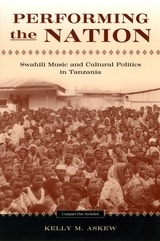
Performing the Nation
Swahili Music and Cultural Politics in TanzaniaKelly Askew
University of Chicago Press, 2002
Since its founding in 1964, the United Republic of Tanzania has used music, dance, and other cultural productions as ways of imagining and legitimizing the new nation. Focusing on the politics surrounding Swahili musical performance, Kelly Askew demonstrates the crucial role of popular culture in Tanzania's colonial and postcolonial history.
As Askew shows, the genres of ngoma (traditional dance), dansi (urban jazz), and taarab (sung Swahili poetry) have played prominent parts in official articulations of "Tanzanian National Culture" over the years. Drawing on over a decade of research, including extensive experience as a taarab and dansi performer, Askew explores the intimate relations among musical practice, political ideology, and economic change. She reveals the processes and agents involved in the creation of Tanzania's national culture, from government elites to local musicians, poets, wedding participants, and traffic police. Throughout, Askew focuses on performance itself—musical and otherwise—as key to understanding both nation-building and interpersonal power dynamics.
As Askew shows, the genres of ngoma (traditional dance), dansi (urban jazz), and taarab (sung Swahili poetry) have played prominent parts in official articulations of "Tanzanian National Culture" over the years. Drawing on over a decade of research, including extensive experience as a taarab and dansi performer, Askew explores the intimate relations among musical practice, political ideology, and economic change. She reveals the processes and agents involved in the creation of Tanzania's national culture, from government elites to local musicians, poets, wedding participants, and traffic police. Throughout, Askew focuses on performance itself—musical and otherwise—as key to understanding both nation-building and interpersonal power dynamics.
[more]
Postsocialism and Cultural Politics
China in the Last Decade of the Twentieth CenturyXudong Zhang
Duke University Press, 2008
In Postsocialism and Cultural Politics, Xudong Zhang offers a critical analysis of China’s “long 1990s,” the tumultuous years between the 1989 Tiananmen Square crackdown and China’s entry into the World Trade Organization in 2001. The 1990s were marked by Deng Xiaoping’s market-oriented reforms, the Taiwan missile crisis, the Asian financial crisis, and the end of British colonial rule of Hong Kong. Considering developments including the state’s cultivation of a market economy, the aggressive neoliberalism that accompanied that effort, the rise of a middle class and a consumer culture, and China’s entry into the world economy, Zhang argues that Chinese socialism is not over. Rather it survives as postsocialism, which is articulated through the discourses of postmodernism and nationalism and through the co-existence of multiple modes of production and socio-cultural norms. Highlighting China’s uniqueness, as well as the implications of its recent experiences for the wider world, Zhang suggests that Chinese postsocialism illuminates previously obscure aspects of the global shift from modernity to postmodernity.
Zhang examines the reactions of intellectuals, authors, and filmmakers to the cultural and political conflicts in China during the 1990s. He offers a nuanced assessment of the changing divisions and allegiances within the intellectual landscape, and he analyzes the postsocialist realism of the era through readings of Mo Yan’s fiction and the films of Zhang Yimou. With Postsocialism and Cultural Politics, Zhang applies the same keen insight to China’s long 1990s that he brought to bear on the 1980s in Chinese Modernism in the Era of Reforms.
[more]