Results by title
744 books match the query 'Culture' and 29 start with p

Palestinian Music
Modernity, Culture, and Identity from the Arab Revolt to Black SeptemberIssa Boulos
University of Texas Press, 2027
An exploration of how Palestinian music—from village songs to urban broadcasts—adapted to political upheaval, colonial pressure, and diaspora life, serving as both a cultural anchor and a vehicle for regional identity during the mid-twentieth century.
Palestinian music has long been embedded in everyday life, shaping and reflecting social, cultural, and political identities. It has served as a means of storytelling and news-sharing, a part of ritual and community life, and a connection to the broader musical traditions of the Near East. As displacement scattered Palestinians across Lebanon, Syria, Jordan, and beyond, musicians carried folk and urban musical traditions into new political and cultural contexts, blending them with various modernities and transforming the process of music-making. In the decades that followed, music and dance were increasingly folklorized and mobilized as symbols of Palestinian identity.
Palestinian Music traces these transformations from the British Mandate through the rise of the Palestine Liberation Organization in the 1970s. Drawing on rare recordings, oral histories, archival materials, and original musical transcriptions, ethnomusicologist Issa Boulos examines two dozen artists across five countries and follows the composers, producers, and performers whose innovations helped shape the musical scene of the entire region. Palestinian music emerges as a dynamic medium through which Palestinians continually negotiated identity, solidarity, and hope—balancing preservation and innovation, rootedness and displacement.
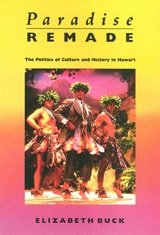
Paradise Remade
The Politics of Culture and History in Hawai'iElizabeth Buck
Temple University Press, 1994
This is a book about the politics of competing cultures and myths in a colonized nation. Elizabeth Buck considers the transformation of Hawaiian culture focusing on the indigenous population rather than on the colonizers. She describes how Hawaii's established religious, social, political, and economic relationships have changed in the past 200 years as a result of Western imperialism. Her account is particularly timely in light of the current Hawaiian demands for sovereignty 100 years after the overthrow of the monarchy in 1893.
Buck examines the social transformation Hawaii from a complex hierarchical, oral society to an American state dominated by corporate tourism and its myths of paradise. She pays particular attention to the ways contemporary Hawaiians are challenging the use of their traditions as the basis for exoticized entertainment.
Buck demonstrates that sacred chants and hula were an integral part of Hawaiian social life; as the repository of the people's historical memory, chants and hula practices played a vital role in maintaining the links between religious, political, and economic relationships. Tracing the ways in which Hawaiian culture has been variously suppressed and constructed by Western explorers, New England missionaries, the tourist industry, ethnomusicologists, and contemporary Hawaiians, Buck offers a fascinating "rereading" of Hawaiian history.
Parascientific Revolutions
The Science and Culture of the ParanormalDerek Lee
University of Minnesota Press, 2025
Unraveling the hidden influence of the paranormal on science, literature, and belief
Telepathy, clairvoyance, precognition, and telekinesis: these attributes of the paranormal mind are widely dismissed as nonsense, but what can an exploration of such pseudoscientific phenomena tell us about accepted scientific and cultural thought? In Parascientific Revolutions, Derek Lee traces the evolution of psi epistemologies across the twentieth and twenty-first centuries to uncover how these ideas have migrated into scientific fields such as quantum physics and neurology, as well as diverse literary genres including science fiction, ethnic literature, and even government training manuals.
Lee introduces the groundbreaking concept of “parascience,” a dynamic cultural space where ideas rejected by the scientific establishment blend with alternative strains of literary, mythic, and philosophical thought to regenerate and return to mainstream discourse. From early modernist works by James Joyce to postwar speculative fiction by Philip K. Dick to ethnofuturist narratives by Ruth Ozeki, Parascientific Revolutions demonstrates how cultural and intellectual currents reshape paranormal ideas over time. Examining psychic surveillance programs like Project Stargate and bizarre particles of extrasensory perception such as the psitron, Lee illustrates the ways paranormal concepts persist and evolve to influence culture.
Presenting pseudoscience as an inevitable by-product of the scientific process, Parascientific Revolutions offers fresh insight into how the paranormal mind continually challenges our understanding of knowledge and belief. It invites readers to reconsider the boundaries between science and the unknown, revealing a world where speculative thought and empirical investigation are deeply intertwined.
Retail e-book files for this title are screen-reader friendly with images accompanied by short alt text and/or extended descriptions.
Passages
Moving beyond Liminality in the Study of Literature and CultureEdited by Elizabeth Kovach, Jens Kugele, and Ansgar Nünning
University College London, 2022
The study of literature and culture is marked by various distinct understandings of passages—as both phenomena and critical concepts. These include the anthropological notion of rites of passage, the shopping arcades (Passagen) theorized by Walter Benjamin, the Middle Passage of the Atlantic slave trade, present-day forms of migration and resettlement, and understandings of translation and adaptation. This book explores passages as contexts and processes within which liminal experiences and encounters are situated. Based on the premise that concepts travel through times, contexts, and discursive settings, the volume enables a meaningful exchange regarding passages across disciplinary, national, and linguistic boundaries. Contributions from senior scholars and early-career researchers whose work focuses on areas such as cultural memory, performativity, space, media, (cultural) translation, ecocriticism, gender, and race utilize specific understandings of passages and liminality, reflecting on their value and limits for their research.
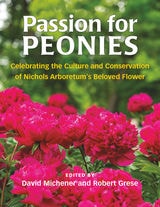
Passion for Peonies
Celebrating the Culture and Conservation of Nichols Arboretum's Beloved FlowerDavid Michener and Robert Grese, Editors
University of Michigan Press, 2020
Originally planted in 1922, the Nichols Arboretum Peony Garden now boasts North America’s largest public collection of heirloom herbaceous peonies. The Peony Garden has become a sacred space for the Ann Arbor community, a not-to-be-missed sensation when it erupts each season, as the Ann Arbor Observer once wrote, in “a riot of color, of crimson, rose and shell pink intermingled with fluffy pompoms of creamy white.” The rather short period of peak bloom—about two fleeting weeks each year—only seems to intensify the garden’s appeal, drawing thousands of visitors annually to this spectacular “living museum” on campus that showcases upwards of 10,000 blossoms.
Richly illustrated with hundreds of striking color photos, Passion for Peonies collects twenty short essays that celebrate the story of the Nichols Arboretum Peony Garden as well as the rich social history of peony gardening that it is an integral part of. Together these pieces comprise a love letter both to a magical public space at the University of Michigan and to the broader history and culture of peony gardening. The book will appeal to readers interested in the University of Michigan, the history of public gardens, and of course peonies!
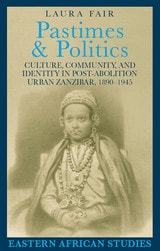
Pastimes and Politics
Culture, Community, and Identity in Post-Abolition Urban Zanzibar, 1890–1945Laura Fair
Ohio University Press, 2001
The first decades of the twentieth century were years of dramatic change in Zanzibar, a time when the social, economic, and political lives of island residents were in incredible flux, framed by the abolition of slavery, the introduction of colonialism, and a tide of urban migration. Pastimes and Politics explores the era from the perspective of the urban poor, highlighting the numerous and varied ways that recently freed slaves and other immigrants to town struggled to improve their individual and collective lives and to create a sense of community within this new environment. In this study Laura Fair explores a range of cultural and social practices that gave expression to slaves’ ideas of emancipation, as well as how such ideas and practices were gendered.
Pastimes and Politics examines the ways in which various cultural practices, including taarab music, dress, football, ethnicity, and sexuality, changed during the early twentieth century in relation to islanders’ changing social and political identities. Professor Fair argues that cultural changes were not merely reflections of social and political transformations. Rather, leisure and popular culture were critical practices through which the colonized and former slaves transformed themselves and the society in which they lived.
Methodologically innovative and clearly written, Pastimes and Politics is accessible to specialists and general readers alike. It is a book that should find wide use in courses on African history, urbanization, popular culture, gender studies, or emancipation.
People and Culture in Ice Age Americas
New Dimensions in Paleoamerican ArchaeologyRafael Suarez and Ciprian F. Ardelean
University of Utah Press, 2018
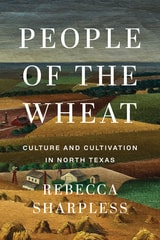
People of the Wheat
Culture and Cultivation in North TexasRebecca Sharpless
University of Texas Press, 2026
How wheat growing, milling, and baking shaped the people and culture of North Texas.
In the national imaginary, America’s amber fields of grain lie in the country’s center, but for more than a century, they also grew across one pocket of the South: North Texas. From the 1840s to the 1970s, the state's agriculture, dominated in lore by cotton in the east and livestock in the open range, was heavily invested in the cultivation, processing, sale, and consumption of wheat. Recalling a forgotten history, Rebecca Sharpless shows how the rhythms of the wheat harvest—and the evolution of the milling, distribution, and baking industries—governed daily life in what is now known as the Dallas–Fort Worth Metroplex.
In the 1840s, Anglo settlers discovered that grain flourished in North Texas and quickly built an economy that included wheat in fields, mills, and kitchens. After the Civil War, hand labor gave way to mechanization, greatly increasing production. Commercial bakeries churned out novel confections, and big cities were built on the bounty of the countryside. In the second half of the twentieth century, as production moved northward, industrial milling and baking declined, but home baking boomed, flour advertising supported regional music, and wheat fortunes financed the region’s cultural life. Sharpless covers 150 years of wheat’s very human history and shows how the labor that cultivated it, the sustenance it provided, and the prosperity it generated left an indelible mark on the people and institutions of Texas.
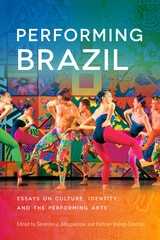
Performing Brazil
Essays on Culture, Identity, and the Performing ArtsEdited by Severino J. Albuquerque and Kathryn Bishop-Sanchez
University of Wisconsin Press, 2015
The contributors to the volume are Maria José Somerlate Barbosa, Eric A. Galm, Annie McNeill Gibson, Ana Paula Höfling, Benjamin Legg, Bryan McCann, Simone Osthoff, Fernando de Sousa Rocha, Cristina F. Rosa, Alessandra Santos, and Lidia Santos.
Perilous States
Conversations on Culture, Politics, and NationEdited by George E. Marcus
University of Chicago Press, 1993
politics, history, comparative literature, and
philosophy—the unprecedented annual publication Late
Editions exposes unsettling dilemmas and unprecedented
challenges facing cultural studies on the brink of the
twenty-first century. Successive volumes will appear
annually until the year 2000, each engaging the predicaments
of particular institutions, nations, and persons at this
point of social, cultural, and political change. The
project will test the limits of scholarly conventions by
finding new ways to expose cultural formations emerging from
the maturation or exhaustion of once-powerful ideas whose
validity is now deeply in question.
Perilous States, the first volume of Late
Editions, presents conversations between American
scholars, most of whom are anthropologists, and individuals
situated amidst political and social upheaval. Pimarily but
not exclusively from Eastern Europe, the cast includes
Russian writers, Hungarian scientists and academics, Armenian
politicians, Siberian religious and medical leaders, a Gypsy
leader, a Polish poet, a French politician, and a white South
African musician who is a self-styled Zulu. Their voices
unite around themes of democracy, market economy, individual
rights, and the reawakened force of suppressed ethnic and
racial identities.
To obtain fresh perspectives on these cultural and social
transformations, the volumes will consist of in-depth
conversations, relayed in essay form, between scholars and
individuals in other cultures with whom they share
affinities. This novel approach blends the immediacy of
interviews, the objectivity of journalism, and the
intellectual rigor of scholarship.
Contributors to this volume are Marjorie Balzer, Sam
Beck, David B. Coplan, Michael M. J. Fischer, Nia Georges,
Bruce Grant, Douglas R. Holmes, Stella Gregorian, George E.
Marcus, Kathryn Milun, Eleni Papagaroufali, Paul Rabinow,
Julie Taylor, and Tom White.

Personal Names in Asia
History, Culture and IdentityEdited by Yangwen Zheng and Chales J-H MacDonald
National University of Singapore Press, 2009
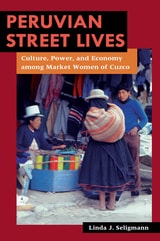
Peruvian Street Lives
Culture, Power, and Economy among Market Women of CuzcoLinda J. Seligmann
University of Illinois Press, 2004
In Peruvian Street Lives, Seligmann argues that the sometimes invisible and informal economic, social, and political networks market women establish may appear disorderly and chaotic, but in fact often keep dysfunctional economies and corrupt bureaucracies from utterly destroying the ability of citizens to survive from day to day. Seligmann asks why the constructive efforts of market women to make a living provoke such negative social perceptions from some members of Peruvian society, who see them as symbols and actual catalysts of social disorder. At the same time, Seligmann shows how market women eke out a living, combat discrimination, and transgress racial and gender ideologies within the rich and expressive cultural traditions they have developed.
Pink and Blue
Gender, Culture, and the Health of ChildrenElena Conis
Rutgers University Press, 2021
Points of Contact
Disability, Art, and CultureSusan Crutchfield and Marcy Epstein, Editors
University of Michigan Press, 2000
Politics, Culture, and Sociability in the Basque Nationalist Party
Roland Vazquez
University of Nevada Press, 2010
Until now, social scientists studying Spanish politics have focused on party systems, regime transition, and election analysis, and anthropologists studying Spain have largely neglected its political parties. This book is a pathbreaking work of political anthropology and an ethnographic study of the Basque Nationalist Party (PNV). Author Roland Vazquez studies Basque nationalism as not merely a political phenomenon but as a cultural and social one as well. He examines the forces that have shaped the Basque political panorama, the nature of Basque political campaigns, Basque cultural and social movements both inside and outside the explicitly partisan milieu, and the role of other parties in the Basque Country. The study is enhanced by extensive interviews and broad fieldwork among Basque contacts of diverse backgrounds and loyalties. The result is a vivid portrait of political life in the contemporary Basque Country, of the tensions between various nationalist parties and philosophies, and of the way politics are influenced by Basque notions of community, social connections, and national identity. The book also serves as a model for studies of other political and nationalist movements and the cultural and social ties and values that drive them.
Pornography
Film and CultureLehman, Peter
Rutgers University Press, 2006
In this collection of path-breaking essays, thirteen respected scholars bring critical insights to the reality of porn and what it can tell us about ourselves sexually, culturally, and economically. Moving beyond simplistic feminist and religious positions that cast these films as categorical evils-a collective preserve of sexual perversion, misogyny, pedophilia, and racism-the contributors to this volume raise the bar of the debate and push porn studies into intriguing new territory.
The essays are divided into two sections. The first reprints important debates on the topic and traces the evolution of pornographic film, including comparing its development to that of Hollywood cinema. The second part presents new essays that consider current trends in the field, including pornography's expansion into new technologies.
This book separates this compelling genre from the sensation and shame that have long surrounded and obscured it. It will be of interest to general readers and film scholars alike.
Porous Becomings
Anthropological Engagements with Michel SerresAndreas Bandak and Daniel M. Knight, editors
Duke University Press, 2024
Contributors. Andreas Bandak, Jane Bennett, Tom Boylston, Steven D. Brown, Matei Candea, Alberto Corsín Jiménez, David Henig, Michael Jackson, Daniel M. Knight, Celia Lowe, Morten Nielsen, Stavroula Pipyrou, Elizabeth Povinelli, Andrew Shryock, Arpad Szakolczai
Postmodern Education
Politics, Culture, and Social CriticismStanley Aronowitz
University of Minnesota Press, 1991
This book offers and opinionated analysis of today’s polemics surrounding the topic of education and society. Aronowitz and Giroux present a conceptual framework for charting the future directions educational theory and practice might take and continue the debate begun in their previous book, Education Under Siege, which was named one of the most significant books in education by the American Educational Studies Association in 1986.
"In Postmodern Education Aronowitz and Giroux are architects of the imagination, presenting essays of political, social, and cultural criticism aimed at altering the ways we understand the existing social order and act to change the conditions of our lives.” Afterimage
Postmodernism and Cultural Identities
Conflicts and CoexistenceVirgil Nemoianu
Catholic University of America Press, 2010
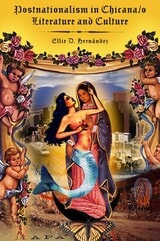
Postnationalism in Chicana/o Literature and Culture
By Ellie D. Hernández
University of Texas Press, 2009
In recent decades, Chicana/o literary and cultural productions have dramatically shifted from a nationalist movement that emphasized unity to one that openly celebrates diverse experiences. Charting this transformation, Postnationalism in Chicana/o Literature and Culture looks to the late 1970s, during a resurgence of global culture, as a crucial turning point whose reverberations in twenty-first-century late capitalism have been profound.
Arguing for a postnationalism that documents the radical politics and aesthetic processes of the past while embracing contemporary cultural and sociopolitical expressions among Chicana/o peoples, Hernández links the multiple forces at play in these interactions. Reconfiguring text-based analysis, she looks at the comparative development of movements within women's rights and LGBTQI activist circles. Incorporating economic influences, this unique trajectory leads to a new conception of border studies as well, rethinking the effects of a restructured masculinity as a symbol of national cultural transformation. Ultimately positing that globalization has enhanced the emergence of new Chicana/o identities, Hernández cultivates important new understandings of borderlands identities and postnationalism itself.
Power, Culture and Place
Essays on New York CityJohn H. Mollenkopf
Russell Sage Foundation, 1988
Present Tense
Rock & Roll and CultureAnthony DeCurtis, ed.
Duke University Press, 1992
In this collection, Greil Marcus creates a collage of words and pictures that evokes and explores Elvis Presley's grisly fate as an American cultural image, while Robert Palmer tells the gripping tale of the origins and meanings of the electric guitar. Rap music, MTV, and the issue of gender identity in the work of Bruce Springsteen all undergo thorough examination; rock & roll's complex relationship with the forces of censorship gets a remarkably fresh reading; and the mainstreaming of rock & roll in the 1980s is detailed and analyzed. And, in an interview with Laurie Anderson and an essay by Atlanta musician Jeff Calder, the artists speak for themselves.
Contributors. Jeff Calder, Anthony DeCurtis, Mark Dery, Paul Evans, Glenn Gass, Trent Hill, Michael Jarrett, Alan Light, Greil Marcus, Robert Palmer, Robert B. Ray, Dan Rubey, David R. Shumway, Martha Nell Smith, Paul Smith

Producing Success
The Culture of Personal Advancement in an American High SchoolPeter Demerath
University of Chicago Press, 2009
Middle- and upper-middle-class students continue to outpace those from less privileged backgrounds. Most attempts to redress this inequality focus on the issue of access to financial resources, but as Producing Success makes clear, the problem goes beyond mere economics. In this eye-opening study, Peter Demerath examines a typical suburban American high school to explain how some students get ahead.
Demerath undertook four years of research at a Midwestern high school to examine the mercilessly competitive culture that drives students to advance. Producing Success reveals the many ways the community’s ideology of achievement plays out: students hone their work ethics and employ various strategies to succeed, from negotiating with teachers to cheating; parents relentlessly push their children while manipulating school policies to help them get ahead; and administrators aid high performers in myriad ways, even naming over forty students “valedictorians.” Yet, as Demerath shows, this unswerving commitment to individual advancement takes its toll, leading to student stress and fatigue, incivility and vandalism, and the alienation of the less successful. Insightful and candid, Producing Success is an often troubling account of the educationally and morally questionable results of the American culture of success.
Professions
Conversations on the Future of Literary and Cultural StudiesEdited by Donald E. Hall
University of Illinois Press, 2001
This volume bares professional concerns, relationships, ambitions, and insecurities about working in academe. Professions provides hard-to-get insider information for students contemplating an academic career. It also challenges professional scholars to retrieve the intellectual curiosity that drew them to scholarship in the first place while demonstrating how disagreement on controversial issues can be conducted with respect, good humor, and an open mind.
Professions features:
Jane Tompkins and Gerald Graff
John McGowan and Regenia Gagnier
James Phelan and James Kincaid
Marjorie Perloff and Robert von Hallberg
Judith Jackson Fossett and Kevin Gaines
Dennis W. Allen and Judith Roof
Niko Pfund, Gordon Hutner, and Martha Banta
Geoffrey Galt Harpham
Donald E. Hall and Susan S. Lanser
J. Hillis Miller, Herbert Lindenberger, Sandra Gilbert, Bonnie Zimmerman, Nellie Y. McKay, and Elaine Marks
Profile of Man and Culture in Mexico
By Samuel Ramos
University of Texas Press, 1962
Profile of Man and Culture in Mexico, originally written in 1934, is addressed to the author’s compatriots, but it speaks to people, wherever they are, who are interested in enriching their own lives and in elevating the cultural level of their countries. And it speaks with a peculiar timeliness to citizens of the United States who would understand their neighbors to the south.
Samuel Ramos’s avowed purpose is to assist in the spiritual reform of Mexico by developing a theory that might explain the real character of Mexican culture. His approach is not flattering to his fellow citizens. After an analysis of the historical forces that have molded the national psychology, Ramos concludes that the Mexican sense of inferiority is the basis for most of the Mexican’s spiritual troubles and for the shortcomings of the Mexican culture.
Ramos subscribes to neither of the two major opposing schools of thought as to what norms should direct the development of Mexican culture. He agrees neither with the nationalists, who urge a deliberate search for originality and isolation from universal culture, nor with the “Europeanizers,” who advocate abandonment of the life around them and a withdrawal into the modes of foreign cultures. Ramos thinks that Mexico’s hope lies in a respect for the good in native elements and a careful selection of those foreign elements that are appropriate to Mexican life. Such a sensible choice of foreign elements will result not in imitation, but in assimilation. Combined with the nurturing of desirable native elements, it will result in an independent cultural unit, “a new branch grafted onto world culture.”
Ramos finds in Mexico no lack of intelligence or vitality: “It needs only to learn.” And he believes that the future is Mexico’s, that favorable destinies await a Mexico striving for the elevation of humanity, for the betterment of life, for the development of all the national capacities.
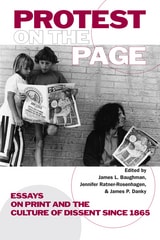
Protest on the Page
Essays on Print and the Culture of Dissent since 1865Edited by James L. Baughman, Jennifer Ratner-Rosenhagen, and James P. Danky
University of Wisconsin Press, 2015
Psychology of the Mexican
Culture and PersonalityBy R. Díaz-Guerrero
University of Texas Press, 1975
In his quest to understand and describe the behavior of the Mexican, the distinguished Mexican psychologist R. Díaz-Guerrero combines a strong theoretical interest in the relationship of culture to personality with a pragmatic concern for methodology. This collection of essays is rooted both in studies of Mexican psychology as an independent phenomenon and in cross-cultural comparisons of Mexicans, Mexican-Americans, and Anglo-Americans.
Dr. Díaz-Guerrero discusses Mexican attitudes toward sex roles and the family, motivations of the Mexican worker, and other topics. He compares Mexican and American concepts of respect and analyzes the relation between neurosis and the Mexican family structure. He attempts to determine the degree of mental, personal, and social health of urban Mexicans. The importance of basic sociocultural premises, such as "The mother is the dearest person in existence," and "The stricter the parents are, the better the children turn out," is explored. In one essay, Díaz-Guerrero notes the differences in typical reactions to stress in Mexico and the United States, concluding that the American pattern involves active response to stress, whereas the Mexican response tends to be more passive.
Psychology of the Mexican deals with a variety of historical, psychological, biological, social, economic, and anthropological variables, attempting to treat them in a scientific way through the use of carefully constructed questionnaires, with detailed statistical analyses of the results. On the basis of data obtained in this way, the author formulates broad conceptual schemes with immediate application to the understanding of human behavior in real situations. He is particularly intrigued by the way the individual relates to the significant people in his environment. For the Mexican, he says, such interpersonal relationships are the most important part of life; in contrast to the American insistence on liberty and equality, Mexican culture emphasizes affiliation and love.

Public Lettering
Script, Power, and CultureArmando Petrucci
University of Chicago Press, 1993
buildings, commercial graphics, signs, epitaphs on tombstones,
graffiti—is a fixture of urban life. In Public
Lettering, Armando Petrucci reconstructs the history of
public writing in the West and traces its social functions
from the eleventh century through the modern period.
Taking the city of Rome as a case study, Petrucci begins
with a consideration of the first civic inscriptions after
ancient times. Substantial chapters on the uses of public
writing in the industrial revolution and the early twentieth
century prepare the way for his provocative discussions of
public lettering in the the contexts of fascism, post-war
radicalism, and the student revolutions of 1968 and 1977.
Throughout, Petrucci is concerned with the relations
between the functions and styles of letters and the places
where they appear. Writing, he argues, is one of the
instruments of public power; display lettering is often the
image and mirror of power itself, making the social use of
written forms a type of conquest. Because of Rome's role as
a “World-City,” Petrucci's interdisciplinary study has
wide-ranging implications for our understanding of the social
function of graphic design.
Punishment and Culture
Philip Smith
University of Chicago Press, 2008
Punishment and Culture traces three centuries of the history of punishment, looking in detail at issues ranging from public executions and the development of the prison to Jeremy Bentham’s notorious panopticon and the invention of the guillotine. Smith contends that each of these attempts to achieve sterile bureaucratic control was thwarted as uncontrollable cultural forces generated alternative visions of heroic villains, darkly gothic technologies, and sacred awe. Moving from Andy Warhol to eighteenth-century highwaymen to Orwell’s 1984, Smith puts forward a dazzling account of the cultural landscape of punishment. His findings will fascinate students of sociology, history, criminology, law, and cultural studies.