Results by title
50 books match the query 'Culture in motion pictures' and 5 start with p
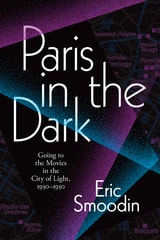
Paris in the Dark
Going to the Movies in the City of Light, 1930–1950Eric Smoodin
Duke University Press, 2020
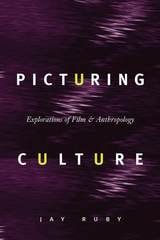
Picturing Culture
Explorations of Film and AnthropologyJay Ruby
University of Chicago Press, 2000
The book begins with analyses of key filmmakers (Robert Flaherty, Robert Garner, and Tim Asch) who have striven to generate profound statements about human behavior on film. Ruby then discusses the idea of research film, Eric Michaels and indigenous media, the ethics of representation, the nature of ethnography, anthropological knowledge, and film and lays the groundwork for a critical approach to the field that borrows selectively from film, communication, media, and cultural studies. Witty and original, yet intensely theoretical, this collection is a major contribution to the field of visual anthropology.
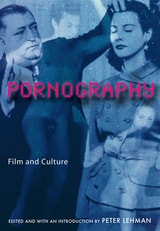
Pornography
Film and CultureLehman, Peter
Rutgers University Press, 2006
In this collection of path-breaking essays, thirteen respected scholars bring critical insights to the reality of porn and what it can tell us about ourselves sexually, culturally, and economically. Moving beyond simplistic feminist and religious positions that cast these films as categorical evils-a collective preserve of sexual perversion, misogyny, pedophilia, and racism-the contributors to this volume raise the bar of the debate and push porn studies into intriguing new territory.
The essays are divided into two sections. The first reprints important debates on the topic and traces the evolution of pornographic film, including comparing its development to that of Hollywood cinema. The second part presents new essays that consider current trends in the field, including pornography's expansion into new technologies.
This book separates this compelling genre from the sensation and shame that have long surrounded and obscured it. It will be of interest to general readers and film scholars alike.
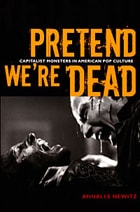
Pretend We're Dead
Capitalist Monsters in American Pop CultureAnnalee Newitz
Duke University Press, 2006
Newitz looks at representations of serial killers, mad doctors, the undead, cyborgs, and unfortunates mutated by their involvement with the mass media industry. Whether considering the serial killer who turns murder into a kind of labor by mass producing dead bodies, or the hack writers and bloodthirsty actresses trapped inside Hollywood’s profit-mad storytelling machine, she reveals that each creature has its own tale to tell about how a freewheeling market economy turns human beings into monstrosities.
Newitz tracks the monsters spawned by capitalism through b movies, Hollywood blockbusters, pulp fiction, and American literary classics, looking at their manifestations in works such as Norman Mailer’s “true life novel” The Executioner’s Song; the short stories of Isaac Asimov and H. P. Lovecraft; the cyberpunk novels of William Gibson and Marge Piercy; true-crime books about the serial killers Ted Bundy and Jeffrey Dahmer; and movies including Modern Times (1936), Donovan’s Brain (1953), Night of the Living Dead (1968), RoboCop (1987), The Silence of the Lambs (1991), and Artificial Intelligence: AI (2001). Newitz shows that as literature and film tell it, the story of American capitalism since the late nineteenth century is a tale of body-mangling, soul-crushing horror.

Pulping Fictions
Consuming Culture Across the English/Media DivideEdited by Deborah Cartmell, Heidi Kaye, I.Q. Hunter, and Imelda Whelehan
Pluto Press, 1996