Results by title
289 books match the query 'Dance' and 15 start with p
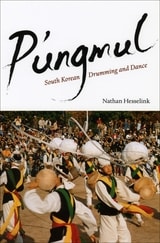
P'ungmul
South Korean Drumming and DanceNathan Hesselink
University of Chicago Press, 2006
The first book to introduce Korean drumming and dance to the English-speaking world, Nathan Hesselink’s P’ungmul offers detailed descriptions of its instrumentation, dance formations, costuming, actors, teaching lineages, and the complexities of training. Hesselink also evaluates how this tradition has taken on new roles and meanings in the twentieth and early-twenty-first centuries, investigating the interrelated yet contested spheres of history, memory, government policy, grassroots politics, opportunities for musical transmission, and performance practices and aesthetics.
P’ungmul offers those interested in ethnomusicology, world music, anthropology, sociology, and Asian studies a special glimpse into the inner workings of a historically rich, artistically complex, and aesthetically and aurally beautiful Korean musical and dance tradition.

Paper Tangos
Julie Taylor
Duke University Press, 1998
Taylor, born in the United States, has lived much of her adult life in Latin America. She has spent years studying the tango in Buenos Aires, dancing during and after the terror of military dictatorships. This book is at once an account of a life lived crossing the borders of two distinct and complex cultures and an exploration of the conflicting meanings of tango for women who love the poetry of its movement yet feel uneasy with the roles it bestows on the male and female dancers. Drawing parallels among the violences of the Argentine Junta, the play with power inherent in tango dancing, and her own experiences with violence both inside and outside the intriguing tango culture, Taylor weaves the line between engaging memoir and insightful cultural critique. Within the contexts of tango’s creative birth and contemporary presentations, this book welcomes us directly into the tango subculture and reveals the ways that personal, political, and historical violence operate in our lives.
The book’s experimental design includes photographs on every page, which form a flip-book sequence of a tango. Not simply a book for tango dancers and fans, Paper Tangos will reward students of Latin American studies, cultural studies, anthropology, feminist studies, dance studies, and the art of critical memoir.

Performance Generating Systems in Dance
Dramaturgy, Psychology, and PerformativityPil Hansen
Intellect Books, 2022
Performance-generating systems are systematic and task-based dramaturgy that generate performance for or with an audience. In dance, such systems differ in ways that matter from more closed choreographed scores and more open forms of structured improvisation. Dancers performing within these systems draw on predefined and limited sources while working on specific tasks within constraining rules. The generating components of the systems provide boundaries that enable the performance to self-organize into iteratively shifting patterns instead of becoming repetitive or chaotic.
This book identifies the generating components and dynamics of these works and the kinds of dramaturgical agency they enable. It explains how the systems of these creations affect the perception, cognition, and learning of dancers and why that is a central part of how they work. It also examines how the combined dramaturgical and psychological effects of the systems performatively address individual and social conditions of trauma that otherwise tend to remain unchangeable and negatively impact the human capacity to learn, relate, and adapt. The book provides analytical frameworks and practical insights for those who wish to study or apply performance-generating systems in dance within the fields of choreography and dance dramaturgy, dance education, community dance, or dance psychology.
Performance and the Afterlives of Injustice
Catherine M. Cole
University of Michigan Press, 2020
Performing Brazil
Essays on Culture, Identity, and the Performing ArtsEdited by Severino J. Albuquerque and Kathryn Bishop-Sanchez
University of Wisconsin Press, 2015
The contributors to the volume are Maria José Somerlate Barbosa, Eric A. Galm, Annie McNeill Gibson, Ana Paula Höfling, Benjamin Legg, Bryan McCann, Simone Osthoff, Fernando de Sousa Rocha, Cristina F. Rosa, Alessandra Santos, and Lidia Santos.
Performing Process
Sharing Dance and Choreographic PracticeEdited by Emma Meehan and Hetty Blades
Intellect Books, 2018
Performing Queer Latinidad
Dance, Sexuality, PoliticsRamón H. Rivera-Servera
University of Michigan Press, 2012
Performing Queer Latinidad highlights the critical role that performance played in the development of Latina/o queer public culture in the United States during the 1990s and early 2000s, a period when the size and influence of the Latina/o population was increasing alongside a growing scrutiny of the public spaces where latinidad could circulate. Performances---from concert dance and street protest to the choreographic strategies deployed by dancers at nightclubs---served as critical meeting points and practices through which LGBT and other nonnormative sex practitioners of Latin American descent (individuals with greatly differing cultures, histories of migration or annexation to the United States, and contemporary living conditions) encountered each other and forged social, cultural, and political bonds. At a time when latinidad ascended to the national public sphere in mainstream commercial and political venues and Latina/o public space was increasingly threatened by the redevelopment of urban centers and a revived anti-immigrant campaign, queer Latinas/os in places such as the Bronx, San Antonio, Austin, Phoenix, and Rochester, NY, returned to performance to claim spaces and ways of being that allowed their queerness and latinidad to coexist. These social events of performance and their attendant aesthetic communication strategies served as critical sites and tactics for creating and sustaining queer latinidad.
Performing Temporality in Contemporary European Dance
Unbecoming RhythmsJonas Rutgeerts
Intellect Books, 2023
Performing Temporality in Contemporary European Dance probes rhythm, offbeats, and other patterns to examine how twenty-first-century choreographers perform time. Jonas Rutgeerts calls on the philosophical writings of Henri Bergson, Gilles Deleuze, and Gaston Bachelard to theorize work by choreographers renowned for their productively idiosyncratic approaches to dance: Jonathan Burrows, Matteo Fargion, Ivana Müller, Mette Edvardsen, and Mårten Spångberg. Rutgeerts analyzes syncopation in the work of Burrows and Fargion, hesitation in Müller’s While We Were Holding It Together, repetition in pieces by Edvardsen, and the audience’s experience of the present in Spångberg’s Natten.
Performing the Greek Crisis
Navigating National Identity in the Age of AusterityNatalie Zervou
University of Michigan Press, 2024
Winner of the 2025 Dance Studies Association de la Torre Bueno Book Prize
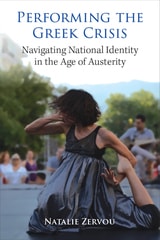
Performing the Greek Crisis explores the impact of the Greek financial crisis (2009–19) on the performing arts sector in Greece, and especially on contemporary concert dance. When Greece became the first European Union member to be threatened with default, the resulting budget cuts pushed dance to develop in unprecedented directions. The book examines the repercussions that the crisis had on artists’ daily lives and experiences, weaving the personal with the political to humanize a phenomenon that, to date, had been examined chiefly through economic and statistical lenses. Informed by the author’s experience of growing up in Greece and including interviews and rich descriptions of performances, the book offers a glimpse into a pivotal moment in Greek history.
In Greece, dance (and, by extension, the body) has historically held a central role in the process of national identity construction. When the crisis broke out, artists had to navigate through a precariously fluctuating landscape, with their bodies as their only stable referent. By centering the analysis of the Greek crisis on the dancing bodies, Performing the Greek Crisis is able to examine the various ways that artists reconceptualized their history and reframed ideas of national belonging, race, citizenship, and immigration.
Perpetual Motion
Dance, Digital Cultures, and the CommonHarmony Bench
University of Minnesota Press, 2020
A new exploration of how digital media assert the relevance of dance in a wired world
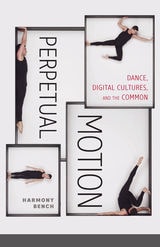
How has the Internet changed dance? Dance performances can now be seen anywhere, can be looped endlessly at user whim, and can integrate crowds in unprecedented ways. Dance practices are evolving to explore these new possibilities. In Perpetual Motion, Harmony Bench argues that dance is a vital part of civil society and a means for building participation and community. She looks at how, after 9/11, it became a crucial way of recuperating the common character of public spaces. She explores how crowdsourcing dance contributes to the project of performing a common world, as well as the social relationships forged when we look at dance as a gift in the era of globalization. Throughout, she asks how dance brings people together in digital spaces and what dance’s digital travels might mean for how we experience and express community.
From original research on dance today to political economies of digital media to the philosophy of dance, Perpetual Motion provides an ambitious, invigorating look at a commonly shared practice.
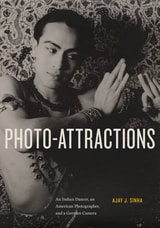
Photo-Attractions
An Indian Dancer, an American Photographer, and a German CameraAjay Sinha
Rutgers University Press, 2022
Art historian Ajay Sinha uses these hitherto unpublished photographs and archival research to raise provocative and important questions about photographic technology, colonial histories, race, sexuality and transcultural desires. Challenging the assumption that Gopal was merely objectified by Van Vechten’s Orientalist gaze, he explores the ways in which the Indian dancer co-authored the photos. In Sinha’s reading, Van Vechten’s New York studio becomes a promiscuous contact zone between world cultures, where a “photo-erotic” triangle is formed between the American photographer, Indian dancer, and German camera.
A groundbreaking study of global modernity, Photo-Attractions brings scholarship on American photography, literature, race and sexual economies into conversation with work on South Asian visual culture, dance, and gender. In these remarkable historical documents, it locates the pleasure taken in cultural difference that still resonates today.
Physical Expression and the Performing Artist
Moving Beyond the PlateauJerald Schwiebert
University of Michigan Press, 2011
All performers know that "tuning up the body" is necessary to maximize performance. A person's mannerisms, habitual patterns of movement, and posture can block the capacity for expression, often without the performer even noticing. Physical Expression and the Performing Artist offers an organized approach to movement for actors, conductors, dancers, singers, musicians---for performers of any kind.
Capturing the energy of the popular workshops presented by master movement teacher Jerald Schwiebert, the book draws from the wisdom of hatha yoga, tai chi, and Pilates as well as from the teachings of Stanislavski, Structural Integration (Rolfing), Alexander, Feldenkrais, and Laban to provide a fresh and accessible approach to movement. More than 300 anatomical drawings help readers pinpoint specific muscles, joints, and actions as they explore the capacity of the performer's physical instrument, the components of dynamic movement, and the anatomy of expression. The book's many detailed exercises bring awareness of habitual and inefficient movement and introduce the steps necessary for more efficient movement patterns in all parts of the body. This book will prove indispensable in movement courses and as a resource guide for professionals seeking to take their performances to the next level.

Polka Heartland
Why the Midwest Loves to PolkaRick March
Wisconsin Historical Society Press, 2015
"Polka Heartland" captures the beat that pulses in the heart of Midwestern culture--the polka--and offers up the fascinating history of how "oompah-pah" came to be the sound of middle America. From the crowded dance tent at Pulaski Polka Days to an off-the-grid Mexican polka dance in small-town Wisconsin, "Polka Heartland" explores the people, places, and history behind the Midwest's favorite music.
From polka's surprising origin story as a cutting-edge European fad to an exploration of the modern-day polka scene, author Rick March and photographer Dick Blau take readers on a joyful romp through this beloved, unique, and richly storied genre. "Polka Heartland" describes the artists, venues, instruments, and music-makers who have been pivotal to polka's popularity across the Midwest and offers six full-color photo galleries to immerse readers in today's vibrant polka scene.

Poor Dancer's Almanac
Managing Life & Work in the Performing ArtsDavid R. White, Lise Friedman, and Tia Tibbitts Levinson, eds.
Duke University Press, 1993
Organized and compiled by Dance Theater Workshop in New York and authored by more than fifty leading professionals in the field, Poor Dancer's Almanac offers in-depth discussions of everything from personal livelihood to professional career development, from medical care, housing, and unemployment insurance to management, touring, and legal issues. Each chapter is followed by an appendix containing extensive and varied listings, giving names and addresses for finding internship programs, videotaping, flooring, grant-writing, and reference publications. Although centered on New York the Almanac includes lists of resources and contacts for many other states—California, Washington D.C, Illinois, Minnesota, North Carolina, Texas, Florida, and Ohio. An entirely new section has been added dealing with health issues and the crisis of AIDS.
In personal anecdotes and essays various performers offer their own insights and stories—both of struggles and of successes—to bring to life the practical realities of working in the arts. We hear from Merce Cunningham, Eric Bogosian, Karen Finley, Paul Zaloom, and Bill T. Jones, among others. Illustrated with original drawings by Janie Geiser, this thoroughly revised and updated edition of the Poor Dancer's Almanac will continue to serve as one of the leading sources for those concerned with managing life and work in the performing arts.
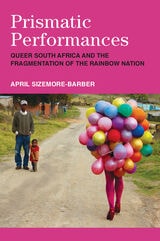
Prismatic Performances
Queer South Africa and the Fragmentation of the Rainbow NationApril Sizemore-Barber
University of Michigan Press, 2021
Listed as one of Lambda Literary's Most Anticipated LGBTQ Books for September 2020
At his 1994 inauguration, South African president Nelson Mandela announced the “Rainbow Nation, at peace with itself and the world.” This national rainbow notably extended beyond the bounds of racial coexistence and reconciliation to include “sexual orientation” as a protected category in the Bill of Rights. Yet despite the promise of equality and dignity, the new government’s alliance with neoliberal interests and the devastation of the AIDS epidemic left South Africa an increasingly unequal society.
Prismatic Performances focuses on the queer embodiments that both reveal and animate the gaps between South Africa’s self-image and its lived realities. It argues that performance has become a key location where contradictions inherent to South Africa’s post-apartheid identity are negotiated. The book spans 30 years of cultural production and numerous social locations and includes: a team of black lesbian soccer players who reveal and redefine the gendered and sexed limitations of racialized “Africanness;” white gay performers who use drag and gender subversion to work through questions of racial and societal transformation; black artists across the arts who have developed aesthetics that place on display their audiences’ complicity in the problem of sexual violence; and a primarily heterosexual panAfrican online soap opera fandom community who, by combining new virtual spaces with old melodramatic tropes allow for extended deliberation and new paradigms through which African same-sex relationships are acceptable.
Prismatic Performances contends that when explicitly queer bodies emerge onto public stages, audiences are made intimately aware of their own bodies’ identifications and desires. As the sheen of the New South Africa began to fade, these performances revealed the inadequacy and, indeed, the violence, of the Rainbow Nation as an aspirational metaphor. Simultaneously they created space for imagining new radical configurations of belonging.