Results by title
114 books match the query 'Decision Making' and 10 start with p
Paradigms and Conventions
Uncertainty, Decision Making, and EntrepreneurshipYoung Back Choi
University of Michigan Press, 1993
An innovative approach to the analysis of decision making under uncertainty
[more]
Policy & Politics Japan
T. Pempel
Temple University Press, 1982
"This is a masterful, well-written examination of Japanese politics."
--Choice
In a comparative framework, Pempel analyzes six major areas of domestic policy-making in Japan--administrative reform, economic policy, labor relations, social welfare, environmental policy, and higher education. Each case is accompanied by selected readings translated from official government documents and the writings of critics of official policy. The book offers an unusually strong point of view, one that is sure to invite debate.
Pemple attempts to unravel the intertwined issues of the autonomy of the Japanese bureaucracy and the strength of the conservative coalition. He describes the weaknesses of opposition politics and labor but goes on to suggest how protest movements can be effective and how change can occur in the face of a powerful conservative consensus. The "economic miracle" of Japan, like the other policy areas, is realistically assessed in the context of events in other industrialized countries.
[more]
Politics and Economics in the Eighties
Edited by Alberto Alesina and Geoffrey Carliner
University of Chicago Press, 1991
Is the federal budget deficit a result of congressional deadlocks, gross miscalculation of economic trends, or a Republican strategy to tie the budgetary hands of future Democratic leadership? To what extend does the partisan split between Congress and the executive branch constrain the president's agenda? In this volume, political scientists and economists tackle these and many other contentious issues, offering a variety of analytical perspectives.
Certain to provoke controversy, this interdisciplinary volume brings together policy experts to provide a coherent analysis of the most important economic policy changes of the 1980s. Through a detailed examination of voting patterns, monetary and fiscal policies, welfare spending, tax reform, minimum wage legislation, the savings and loan collapse, and international trade policy, the authors explore how politics can influence the direction of economic policymaking.
Certain to provoke controversy, this interdisciplinary volume brings together policy experts to provide a coherent analysis of the most important economic policy changes of the 1980s. Through a detailed examination of voting patterns, monetary and fiscal policies, welfare spending, tax reform, minimum wage legislation, the savings and loan collapse, and international trade policy, the authors explore how politics can influence the direction of economic policymaking.
[more]
Positive Political Theory I
Collective PreferenceDavid Austen-Smith and Jeffrey S. Banks
University of Michigan Press, 2000
Positive Political Theory I is concerned with the formal theory of preference aggregation for collective choice. The theory is developed as generally as possible, covering classes of aggregation methods that include such well-known examples as majority and unanimity rule and focusing in particular on the extent to which any aggregation method is assured to yield a set of "best" alternatives. The book is intended both as a contribution to the theory of collective choice and a pedagogic tool.
Austen-Smith and Banks have made the exposition both rigorous and accessible to people with some technical background (e.g., a course in multivariate calculus). The intended readership ranges from more technically-oriented graduate students and specialists to those students in economics and political science interested less in the technical aspects of the results than in the depth, scope, and importance of the theoretical advances in positive political theory.
"This is a stunning book. Austen-Smith and Banks have a deep understanding of the material, and their text gives a powerfully unified and coherent perspective on a vast literature. The exposition is clear-eyed and efficient but never humdrum. Even those familiar with the subject will find trenchant remarks and fresh insights every few pages. Anyone with an interest in contemporary liberal democratic theory will want this book on the shelf." --Christopher Achen, University of Michigan
David Austen-Smith is Professor of Political Science, Professor of Economics, and Professor of Management and Strategy, Northwestern University. Jeffrey S. Banks is Professor of Political Science, California Institute of Technology.
[more]
Positive Political Theory II
Strategy and StructureDavid Austen-Smith and Jeffrey S. Banks
University of Michigan Press, 2005
“A major piece of work . . . a classic. There is no
other book like it.”
—Norman Schofield, Washington University
“The authors succeed brilliantly in tackling a large
number of important questions concerning the
interaction among voters and elected representatives
in the political arena, using a common, rigorous
language.”
—Antonio Merlo, University of Pennsylvania
Positive Political Theory II: Strategy and Structure
is the second volume in Jeffrey Banks and David
Austen-Smith’s monumental study of the links
between individual preferences and collective choice.
The book focuses on representative systems, including
both elections and legislative decision-making
processes, clearly connecting individual preferences to
collective outcomes. This book is not a survey. Rather,
it is the coherent, cumulative result of the authors’
brilliant efforts to indirectly connect preferences to
collective choice through strategic behaviors such as
agenda-selection and voting.
The book will be an invaluable reference and teaching
tool for economists and political scientists, and an
essential companion to any scholar interested in the
latest theoretical advances in positive political theory.
[more]
Post-Realism
The Rhetorical Turn in International RelationsFrancis A. Beer
Michigan State University Press, 1996
The end of the Cold War encourages new perspectives on international relations. Beer and Hariman provide a comprehensive set of essays that challenge and reinterpret the tradition of realism which has dominated the thinking of academics and foreign policy makers. Post-Realism: The Rhetorical Turn in International Relations systematically discusses the major realist writers of the Post-War era, the foundational concepts of international politics, and representative case studies of foreign policy discourse.
These essays demonstrate how realism operates rhetorically and point the way toward a richer understanding of world politics.
These essays demonstrate how realism operates rhetorically and point the way toward a richer understanding of world politics.
[more]
Principled University Leadership
Critical Decision-Making in AcademiaMarc A. Johnson
University of Nevada Press, 2025
Principled University Leadership: Critical Decision-Making in Academia is a personal account by university president Marc A. Johnson that draws on his extensive experience in academic administration. The book delves into four major themes: traits that lead individuals into leadership roles; economic principles influencing university decision-making; practical leadership strategies for fostering institutional progress; and approaches to navigating today’s critical challenges, including DEI and free speech.
Rooted in Johnson’s small-town origins and passion for civic engagement, this narrative offers unique insights into the path to university leadership and the key decisions leaders face. It is an invaluable resource for aspiring and current academic leaders seeking guidance in navigating the complexities of higher education.
Rooted in Johnson’s small-town origins and passion for civic engagement, this narrative offers unique insights into the path to university leadership and the key decisions leaders face. It is an invaluable resource for aspiring and current academic leaders seeking guidance in navigating the complexities of higher education.
[more]
Prisms of the People
Power & Organizing in Twenty-First-Century AmericaHahrie Han, Elizabeth McKenna, and Michelle Oyakawa
University of Chicago Press, 2021
Grassroots organizing and collective action have always been fundamental to American democracy but have been burgeoning since the 2016 election, as people struggle to make their voices heard in this moment of societal upheaval. Unfortunately much of that action has not had the kind of impact participants might want, especially among movements representing the poor and marginalized who often have the most at stake when it comes to rights and equality. Yet, some instances of collective action have succeeded. What’s the difference between a movement that wins victories for its constituents, and one that fails? What are the factors that make collective action powerful?
Prisms of the People addresses those questions and more. Using data from six movement organizations—including a coalition that organized a 104-day protest in Phoenix in 2010 and another that helped restore voting rights to the formerly incarcerated in Virginia—Hahrie Han, Elizabeth McKenna, and Michelle Oyakawa show that the power of successful movements most often is rooted in their ability to act as “prisms of the people,” turning participation into political power just as prisms transform white light into rainbows. Understanding the organizational design choices that shape the people, their leaders, and their strategies can help us understand how grassroots groups achieve their goals.
Linking strong scholarship to a deep understanding of the needs and outlook of activists, Prisms of the People is the perfect book for our moment—for understanding what’s happening and propelling it forward.
[more]
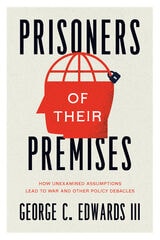
Prisoners of Their Premises
How Unexamined Assumptions Lead to War and Other Policy DebaclesGeorge C. Edwards III
University of Chicago Press, 2022
A timely look at the real costs of leaders not examining their assumptions.
Why do accomplished and stable leaders frequently make calamitous decisions with devastating consequences for their countries—and other nations? We debate debacles such as the American involvement in Vietnam, seeking to understand why leaders pursued disastrous policies. In Prisoners of Their Premises, George C. Edwards III argues that the failure of leaders to examine their premises—the assumptions they make about the world and situation they are dealing with—cause them to ignore real problems or pursue policies that, in costly ways, deal with problems that are different than they think or simply don’t exist. Edwards looks at the role of premises in identifying (or ignoring) a problem in a series of case studies that range from strategic decisions in World War I and the Korean War to the wars in Vietnam and Iraq. Too often, unexamined premises color initial decisions to pursue a policy and shape the strategies leaders employ to achieve their goals, with grave consequences for their countries, organizations, and potentially the world. Timely and important, Prisoners of Their Premises demonstrates the real costs leaders incur by failing to question their assumptions.
Why do accomplished and stable leaders frequently make calamitous decisions with devastating consequences for their countries—and other nations? We debate debacles such as the American involvement in Vietnam, seeking to understand why leaders pursued disastrous policies. In Prisoners of Their Premises, George C. Edwards III argues that the failure of leaders to examine their premises—the assumptions they make about the world and situation they are dealing with—cause them to ignore real problems or pursue policies that, in costly ways, deal with problems that are different than they think or simply don’t exist. Edwards looks at the role of premises in identifying (or ignoring) a problem in a series of case studies that range from strategic decisions in World War I and the Korean War to the wars in Vietnam and Iraq. Too often, unexamined premises color initial decisions to pursue a policy and shape the strategies leaders employ to achieve their goals, with grave consequences for their countries, organizations, and potentially the world. Timely and important, Prisoners of Their Premises demonstrates the real costs leaders incur by failing to question their assumptions.
[more]
Purchasing Population Health
Paying for ResultsDavid A. Kindig
University of Michigan Press, 1997
The fundamental assertion of this book is that population health improvement will not be achieved until appropriate financial incentives are designed for this outcome.This one sentence summarizes the message of David Kindig’s book, which directly addresses the current turbulence in health care and the lack of focus on value for all public and private investments to improve health. This proposal for a new health outcome purchasing standard is derived from Dr. Kindig’s training as a physician and his experience in public and private health care management. While intended to address the cost, quality, and access goals of the failed federal reform effort of 1994, it envisions using health outcomes as a public- and private-sector purchasing standard for medical care as well as other health-promoting sectors such as educationand the environment.In language accessible to public and corporate policymakers, Kindig summarizes the vast technical literature in the areas of health outcomes and quality measurement, the determinants of health, health economics, rationing, and vertical integration. Drawing from the literature familiar to faculty and students in the health professions and business, this book will serve to inform a lay readership concerned about health care quality and expenditures.While based on research evidence, the final two chapters, “Making It Happen” and “The Case for Action, the Price of Inertia” outline how the ideas in this book can actually be put to work for the health and benefit of all in the twenty-first century.
[more]