Results by title
126 books match the query 'Decolonization' and 5 start with p
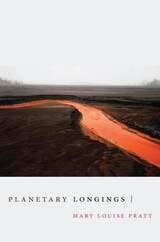
Planetary Longings
Mary Louise Pratt
Duke University Press, 2022
In Planetary Longings eminent cultural theorist Mary Louise Pratt posits that the last decade of the twentieth century and the first decades of the twenty-first mark a turning point in the human and planetary condition. Examining the forces of modernity, neoliberalism, coloniality, and indigeneity in their pre- and postmillennial forms, Pratt reflects on the crisis of futurity that accompanies the millennial turn in relation to environmental disaster and to the new forms of thinking it has catalyzed. She turns to 1990s Latin American vernacular culture, literary fiction, and social movements, which simultaneously registered neoliberalism’s devastating effects and pursued alternate ways of knowing and living. Tracing the workings of colonialism alongside the history of anticolonial struggles and Indigenous mobilizations in the Americas, Pratt analyzes indigeneity both as a key index of coloniality, neoliberal extraction, and ecological destruction, and as a source for alternative modes of thought and being. Ultimately, Pratt demonstrates that the changes on either side of the millennium have catalyzed new forms of world-making and knowledge-making in the face of an unknowable and catastrophic future.
[more]
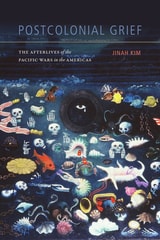
Postcolonial Grief
The Afterlives of the Pacific Wars in the AmericasJinah Kim
Duke University Press, 2019
In Postcolonial Grief Jinah Kim explores the relationship of mourning to transpacific subjectivities, aesthetics, and decolonial politics since World War II. Kim argues that Asian diasporic subjectivity exists in relation to afterlives because the deaths of those killed by U.S. imperialism and militarism in the Pacific remain unresolved and unaddressed. Kim shows how primarily U.S.-based Korean and Japanese diasporic writers, artists, and filmmakers negotiate the necropolitics of Asia and how their creative refusal to heal from imperial violence may generate transformative antiracist and decolonial politics. She contests prevalent interpretations of melancholia by engaging with Frantz Fanon's and Hisaye Yamamoto's decolonial writings; uncovering the noir genre's relationship to the U.S. war in Korea; discussing the emergence of silenced colonial histories during the 1992 Los Angeles riots; and analyzing the 1996 hostage takeover of the Japanese ambassador's home in Peru. Kim highlights how the aesthetic and creative work of the Japanese and Korean diasporas offers new insights into twenty-first-century concerns surrounding the state's erasure of military violence and colonialism and the difficult work of remembering histories of war across the transpacific.
[more]
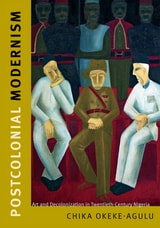
Postcolonial Modernism
Art and Decolonization in Twentieth-Century NigeriaChika Okeke-Agulu
Duke University Press, 2015
Written by one of the foremost scholars of African art and featuring 129 color images, Postcolonial Modernism chronicles the emergence of artistic modernism in Nigeria in the heady years surrounding political independence in 1960, before the outbreak of civil war in 1967. Chika Okeke-Agulu traces the artistic, intellectual, and critical networks in several Nigerian cities. Zaria is particularly important, because it was there, at the Nigerian College of Arts, Science and Technology, that a group of students formed the Art Society and inaugurated postcolonial modernism in Nigeria. As Okeke-Agulu explains, their works show both a deep connection with local artistic traditions and the stylistic sophistication that we have come to associate with twentieth-century modernist practices. He explores how these young Nigerian artists were inspired by the rhetoric and ideologies of decolonization and nationalism in the early- and mid-twentieth century and, later, by advocates of negritude and pan-Africanism. They translated the experiences of decolonization into a distinctive "postcolonial modernism" that has continued to inform the work of major Nigerian artists.
[more]
Postcoloniality-Decoloniality-Black Critique
Joints and FissuresEdited by Sabine Broeck and Carsten Junker
Campus Verlag, 2014
Can Western modernity be analyzed and critiqued through the lens of enslavement and colonial history? As this volume reveals, such analysis is not only possible, it is essential to our understanding of contemporary race relations and society generally. Drawing from the fields of postcolonial, decolonial, and black studies, this book assembles contributions from renowned scholars that offer timely and critical perspectives from a variety of disciplines, including history, sociology, political science, gender studies, cultural and literary studies, and philosophy.
[more]
Prince Charoon et al
South East AsiaAndrew Dalby
Haus Publishing, 2010
Southeast Asia needs to be dealt with as a whole, because, although the one national delegation from the region (Siam) took a minor part, nationalist movements in several Southeast Asian countries reached an early climax - significant though inconclusive - in the years 1919-1920. The planned Peace Conference, Wilson's Fourteen Points, and the victory of Communism in Russia, all contributed to this activity, and in spite of national differences it needs to be seen as a whole. The focus of the book will be on developments around 1919; thus it will bring out for the first time the unexpected significance for South-east Asia of the 1919 milestone. It will also have a biographical bias - taking a special interest in the personalities of major figures in this important period, in order to show the influences and the patterns of thought that underlie their activities at the time of the Peace Conference. Following a brief introduction making the link between world events in 1919 and South-east Asia, the book sets the scene in the region. Succeeding chapters deal with the five countries - Siam, Vietnam, Burma, Indonesia, Philippines - in which the years 1919-21 were of special significance, as well as the impact of the peace conferences in relationships with their neighbours, the growth of international Communism and global politics in later years.
[more]