Results by title
104 books match the query 'Deconstruction' and 10 start with p

Perjury and Pardon, Volume I
Jacques Derrida
University of Chicago Press, 2022
“One only ever asks forgiveness for what is unforgivable.” From this contradiction begins Perjury and Pardon, a two-year series of seminars given by Jacques Derrida at the École des hautes études en sciences sociales in Paris in the late 1990s. In these sessions, Derrida focuses on the philosophical, ethical, juridical, and political stakes of the concept of responsibility. His primary goal is to develop what he calls a “problematic of lying” by studying diverse forms of betrayal: infidelity, denial, false testimony, perjury, unkept promises, desecration, sacrilege, and blasphemy.
Although forgiveness is a notion inherited from multiple traditions, the process of forgiveness eludes those traditions, disturbing the categories of knowledge, sense, history, and law that attempt to circumscribe it. Derrida insists on the unconditionality of forgiveness and shows how its complex temporality destabilizes all ideas of presence and even of subjecthood. For Derrida, forgiveness cannot be reduced to repentance, punishment, retribution, or salvation, and it is inseparable from, and haunted by, the notion of perjury. Through close readings of Kant, Kierkegaard, Shakespeare, Plato, Jankélévitch, Baudelaire, and Kafka, as well as biblical texts, Derrida explores diverse notions of the “evil” or malignancy of lying while developing a complex account of forgiveness across different traditions.
Phenomenology and Deconstruction, Volume Four
SolitudeRobert Denoon Cumming
University of Chicago Press, 2001
After the war Heidegger disavowed Sartre, a move related to Heidegger's renunciation of his association with the phenomenological movement at large, and one that illustrates the dynamics of the history Cumming himself has completed. Serving as convincing punctuation for this remarkable series, this book demonstrates the importance of the history of philosophy in coming to grips with the proclaimed end of philosophy.
Phenomenology and Deconstruction, Volume One
The Dream is OverRobert Denoon Cumming
University of Chicago Press, 1991
In this analysis Cumming deals with how a philosophy can be vulgarized (as Heidegger's was by Nazism but in Heidegger's own view by Sartre), with problems of periodization, with how the history of philosophy can be disinguished as a philosophical discipline from intellectual history. Cumming also elaborates an analogy between a philosophical method and style.
Phenomenology and Deconstruction, Volume Three
Breakdown in CommunicationRobert Denoon Cumming
University of Chicago Press, 2001
history of philosophy demonstrates how frequently one philosopher
misunderstands another. The most notorious such breakdown in
communication in twentieth-century philosophy was between Husserl and
Heidegger. In the third volume of his history of the phenomenological
movement, Robert Denoon Cumming argues that their differences involve
differences in method; whereas Husserl follows a "method of
clarification," with which he eliminates ambiguities by relying on an
intentional analysis that isolates its objects, Heidegger rejects the
criterion of "clarity" and embraces ambiguities as exhibiting
overlapping relations.
Cumming also explores the differences between how
deconstruction—Heidegger's procedure for dealing with other
philosophers—is carried out when Heidegger interprets Husserl versus
when Derrida interprets Husserl. The comparison enables Cumming to
show how deconstruction is associated with Heidegger's arrival at the
end of philosophy, paving the way for the deconstructionist movement.
Phenomenology and Deconstruction, Volume Two
Method and ImaginationRobert Denoon Cumming
University of Chicago Press, 1992
Cumming also shows that conversion is not merely a personal predisposition of Sartre's—further manifest in his later conversions to Heidegger and to a version of Marxism. Conversion is also philosophical preoccupation, illustrated by the "conversion to the imaginary" whereby Sartre explains how he himself, as well as Genet and Flaubert, became writers. Finally, Cumming details how Husserl's phenomenological method contributed both to the shaping of Sartre's style as a literary writer and to his theory of style.
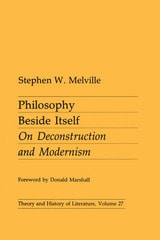
Philosophy Beside Itself
On Deconstruction and ModernismStephen W. MelvilleForeword by Donald Marshall
University of Minnesota Press, 1986
Philosophy Beside Itself was first published in 1986. Minnesota Archive Editions uses digital technology to make long-unavailable books once again accessible, and are published unaltered from the original University of Minnesota Press editions.
The writings of French philosopher Jacques Derrida have been the single most powerful influence on critical theory and practice in the United States over the past decade. But with few exceptions American philosophers have taken little or no interest in Derrida's work, and the task of reception, translation, and commentary has been left to literary critics. As a result, Derrida has appeared as a figure already defined by essentially literary critical activities and interests.
Stephen Melville's aim in Philosophy Beside Itself is to insist upon and clarify the distinctions between philosophy and criticism. He argues that until we grasp Derrida's philosophical project as such, we remain fundamentally unable to see his significance for criticism. In terms derived from Stanley Cavell's writings on modernism, Melville develops a case for Derrida as a modernist philosopher, working at once within and against that tradition and discipline.
Melville first places Derrida in a Hegelian context, the structure of which he explores by examining the work of Heidegger, Lacan, and Bataille. With this foundation, he is able to reappraise the project of deconstructive criticism as developed in Paul de Man's Blindness and Insight and further articulated by other Yale critics. Central to this critique is the ambivalent relationship between deconstructive criticism and Lacanian psychoanalysis. Criticism—radical self-criticism—is a central means through which the difficult facts of human community come to recognition, and Melville argues for criticism as an activity intimately bound to the ways in which we do and do not belong in time and in community. Derrida's achievement has been to find a new and necessary way to assert that the task of philosophy is criticism; the task of literary criticism is to assume the burden of that achievement.
Stephen Melville is an assistant professor of English at Syracuse University, and Donald Marshall is a professor of English at the University of Iowa.
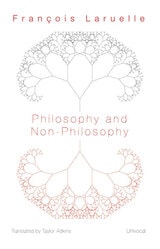
Philosophy and Non-Philosophy
François Laruelle
University of Minnesota Press, 2013
Each generation invents new practices and new writings of philosophy. Ours should have been able to introduce certain mutations that would at least be equivalent with those of cubism, abstract art, and twelve-tone serialism: it has only partially done so. But after all the deconstructions, after Wittgenstein, Heidegger, and Derrida, this demand takes on a different dimension: What do we do with philosophy itself? How do we globally change our relation to this thought, which keeps indicating that it is increasingly conservative and repetitive? These two questions together have prompted what we call “non-philosophy.”
Non-philosophy is not the negation of philosophy. It is the suspension of philosophy’s claim to think the real (Principle of Sufficient Philosophy), and it is the invention of new usages of thought and language that disrupt the rational narrative of the real, which is precisely what every philosophy is. Non-philosophy should rather be understood à la the “non-Euclidean,” namely, as a generalization of the philosophical beyond its traditional limitation by the unitary or “Heraclitean” postulate. From then on, an infinite number of philosophical decisions that are no longer mutually exclusive will correspond with any real phenomenon.
Philosophy and Non-Philosophy is widely considered the first fully explicit elaboration of non-philosophy and one of its most important introductory texts.

Politics of Legitimacy
State-Society Relations and Patterns of Chinese PoliticsDingxin Zhao
University of Chicago Press, 2026
The Chinese communist state has survived massive social changes, including the introduction of capitalist markets, an ongoing explosion of technological innovation, and an unprecedented jump in wealth and education, accompanied by a major cultural transformation. How has China managed to maintain its power even as the ground has so profoundly shifted? In Politics of Legitimacy, Dingxin Zhao argues that state power can be legitimized in three ideal-typical ways: a set of values upheld by the state (ideological legitimacy), recognized political processes such as regular competitive elections (procedural legitimacy), and the state’s capacity to provide public goods (performance legitimacy).
Building on this theoretical framework, Zhao analyzes different aspects of Chinese politics, including the tragic ending of the 1989 pro-democracy movement, the weak development of mass-based nationalism in post-Mao China, the reasons behind China’s economic success, the anti-establishment tendency of the Chinese mass media and social media, and the sources of political tension in China, despite a superb economy. Moreover, Zhao’s innovative framework is widely applicable beyond China, shifting our attention from regime-type categories to the tools and relationships that determine their survival or collapse, and illuminating the current global emergence of conservatism and religious nationalism.

Positions
Jacques Derrida
University of Chicago Press, 1982
The interviews included in this volume offer a multifaceted view of Derrida. "Implications: Interview with Henri Ronse" contains a succinct statement of principles. "Seminology and Grammatology: Interview with Julia Kristeva" provides important clarifications of the role played by linguistics in Derrida's work. "Positions: Interview with Jean-Louis Houdebine and Guy Scarpetta" is a wide-ranging discussion that touches on many of the polemics that Derrida's work has provoked.
Alan Bass, whose translation of Writing and Difference was highly praised for its clarity, accuracy, and readability, has provided extremely useful critical notes, full of vital information, including historical background.

Poststructuralism and Critical Theory's Second Generation
Edited by Alan D. Schrift
University of Chicago Press, 2010
From Kant to Kierkegaard, from Hegel to Heidegger, continental philosophers have indelibly shaped the trajectory of Western thought since the eighteenth century. Although much has been written about these monumental thinkers, students and scholars lack a definitive guide to the entire scope of the continental tradition. The most comprehensive reference work to date, this eight-volume History of Continental Philosophy will both encapsulate the subject and reorient our understanding of it. Beginning with an overview of Kant’s philosophy and its initial reception, the History traces the evolution of continental philosophy through major figures as well as movements such as existentialism, phenomenology, hermeneutics, and poststructuralism. The final volume outlines the current state of the field, bringing the work of both historical and modern thinkers to bear on such contemporary topics as feminism, globalization, and the environment. Throughout, the volumes examine important philosophical figures and developments in their historical, political, and cultural contexts.
The first reference of its kind, A History of Continental Philosophy has been written and edited by internationally recognized experts with a commitment to explaining complex thinkers, texts, and movements in rigorous yet jargon-free essays suitable for both undergraduates and seasoned specialists. These volumes also elucidate ongoing debates about the nature of continental and analytic philosophy, surveying the distinctive, sometimes overlapping characteristics and approaches of each tradition. Featuring helpful overviews of major topics and plotting road maps to their underlying contexts, A History of Continental Philosophy is destined to be the resource of first and last resort for students and scholars alike.