Results by title
75 books match the query 'Derrida, Jacques' and 7 start with p
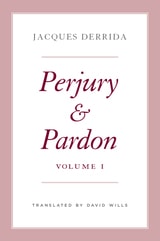
Perjury and Pardon, Volume I
Jacques Derrida
University of Chicago Press, 2022
“One only ever asks forgiveness for what is unforgivable.” From this contradiction begins Perjury and Pardon, a two-year series of seminars given by Jacques Derrida at the École des hautes études en sciences sociales in Paris in the late 1990s. In these sessions, Derrida focuses on the philosophical, ethical, juridical, and political stakes of the concept of responsibility. His primary goal is to develop what he calls a “problematic of lying” by studying diverse forms of betrayal: infidelity, denial, false testimony, perjury, unkept promises, desecration, sacrilege, and blasphemy.
Although forgiveness is a notion inherited from multiple traditions, the process of forgiveness eludes those traditions, disturbing the categories of knowledge, sense, history, and law that attempt to circumscribe it. Derrida insists on the unconditionality of forgiveness and shows how its complex temporality destabilizes all ideas of presence and even of subjecthood. For Derrida, forgiveness cannot be reduced to repentance, punishment, retribution, or salvation, and it is inseparable from, and haunted by, the notion of perjury. Through close readings of Kant, Kierkegaard, Shakespeare, Plato, Jankélévitch, Baudelaire, and Kafka, as well as biblical texts, Derrida explores diverse notions of the “evil” or malignancy of lying while developing a complex account of forgiveness across different traditions.
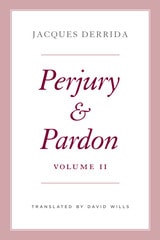
Perjury and Pardon, Volume II
Jacques Derrida
University of Chicago Press, 2023
Perjury and Pardon is a two-year seminar series given by Jacques Derrida at the École des hautes études en sciences sociales in Paris during the late 1990s. In these sessions, Derrida focuses on the philosophical, ethical, juridical, and political stakes of the concept of responsibility. His primary goal is to develop what he calls a “problematic of lying” by studying diverse forms of betrayal: infidelity, denial, false testimony, perjury, unkept promises, desecration, sacrilege, and blasphemy.
This volume covers the seminar’s second year when Derrida explores the political dimensions of forgiveness and repentance. Over eight sessions, he discusses Hegel, Augustine, Levinas, Arendt, and Benjamin as well as Bill Clinton’s impeachment and Nelson Mandela and Desmond Tutu’s testimonies before the Truth and Reconciliation Commission. The seminars conclude with an extended reading of Henri Thomas’s 1964 novel Le Parjure.
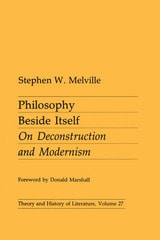
Philosophy Beside Itself
On Deconstruction and ModernismStephen W. MelvilleForeword by Donald Marshall
University of Minnesota Press, 1986
Philosophy Beside Itself was first published in 1986. Minnesota Archive Editions uses digital technology to make long-unavailable books once again accessible, and are published unaltered from the original University of Minnesota Press editions.
The writings of French philosopher Jacques Derrida have been the single most powerful influence on critical theory and practice in the United States over the past decade. But with few exceptions American philosophers have taken little or no interest in Derrida's work, and the task of reception, translation, and commentary has been left to literary critics. As a result, Derrida has appeared as a figure already defined by essentially literary critical activities and interests.
Stephen Melville's aim in Philosophy Beside Itself is to insist upon and clarify the distinctions between philosophy and criticism. He argues that until we grasp Derrida's philosophical project as such, we remain fundamentally unable to see his significance for criticism. In terms derived from Stanley Cavell's writings on modernism, Melville develops a case for Derrida as a modernist philosopher, working at once within and against that tradition and discipline.
Melville first places Derrida in a Hegelian context, the structure of which he explores by examining the work of Heidegger, Lacan, and Bataille. With this foundation, he is able to reappraise the project of deconstructive criticism as developed in Paul de Man's Blindness and Insight and further articulated by other Yale critics. Central to this critique is the ambivalent relationship between deconstructive criticism and Lacanian psychoanalysis. Criticism—radical self-criticism—is a central means through which the difficult facts of human community come to recognition, and Melville argues for criticism as an activity intimately bound to the ways in which we do and do not belong in time and in community. Derrida's achievement has been to find a new and necessary way to assert that the task of philosophy is criticism; the task of literary criticism is to assume the burden of that achievement.
Stephen Melville is an assistant professor of English at Syracuse University, and Donald Marshall is a professor of English at the University of Iowa.
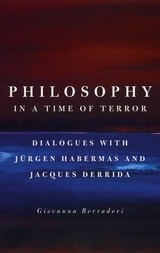
Philosophy in a Time of Terror
Dialogues with Jurgen Habermas and Jacques DerridaGiovanna Borradori
University of Chicago Press, 2003
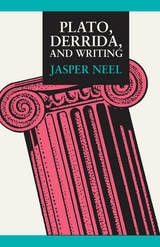
Plato, Derrida, and Writing
Jasper Neel
Southern Illinois University Press, 1988
Winner, Mina P. Shaughnessy Prize
Achieving the remarkable feat of linking composition theory, deconstruction, and classical rhetoric, this book has been admirably summarized by the theorist G. Douglas Atkins, who writes: "This lively and engaging, informed and informative book constitutes an important contribution. Though its ‘field’ is most obviously composition, composition theory, and pedagogy, part of its importance derives from the way it transcends disciplinary boundaries to bear on writing in general. . . I know of no book that so fully and well discusses, and evaluates, the implications of deconstruction for composition and pedagogy. That [it] goes ‘beyond deconstruction,’ rather than merely ‘applying’ it, increases its importance and signals a clear contribution to the understanding of writing."
Jasper Neel analyzes the emerging field of composition studies within the epistemological and ontological debate over writing precipitated by Plato, who would have us abandon writing entirely, and continued by Derrida, who argues that all human beings are written. This book offers a three-part exploration of that debate. In the first part, a deconstructive reading of Plato’s Phaedrus, Neel shows the elaborate sleight-of-hand that Plato must employ as he uses writing to engage in a semblance of spoken dialogue.
The second part describes Derrida’s theory of writing and presents his famous argument that "the history of truth, of the truth of truth, has always been. . .the debasement of writing, and its repression outside full speech." A lexicon of nine Derridean terms, the key to his theory of writing, is also included. At the end of this section, Neel turns deconstruction against itself, demonstrating that Derridean analysis collapses of its own weight.
The concluding section of the book juxtaposes the implications of Platonic and Derridean views of writing, warning that Derrida’s approach may lock writing inside philosophy. The conclusion suggests that writing may be liberated from philosophical judgment by turning to Derrida’s predecessors, the sophists, particularly Protagoras and Gorgias. Drawing on Protagoras’s idea of strong discourse, Neel shows that sophistry is the foundation of democracy: "Strong discourse is public discourse, which, though based on probability and not truth, remains persuasive over a long period of time to a great number of people. This publicly tested discourse exists only among competitors, never alone, but its ability to remain persuasive even when surrounded by other discourses enables the ideas of democracy to emerge and then keeps democracy alive."
Positions
Jacques Derrida
University of Chicago Press, 1982
The interviews included in this volume offer a multifaceted view of Derrida. "Implications: Interview with Henri Ronse" contains a succinct statement of principles. "Seminology and Grammatology: Interview with Julia Kristeva" provides important clarifications of the role played by linguistics in Derrida's work. "Positions: Interview with Jean-Louis Houdebine and Guy Scarpetta" is a wide-ranging discussion that touches on many of the polemics that Derrida's work has provoked.
Alan Bass, whose translation of Writing and Difference was highly praised for its clarity, accuracy, and readability, has provided extremely useful critical notes, full of vital information, including historical background.
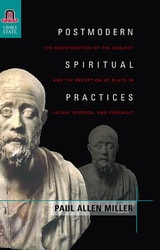
Postmodern Spiritual Practices
The Construction of the Subject and the Reception of Plato in Lacan, Derrida, and FoucaultPaul Allen Miller
The Ohio State University Press, 2007
On the other hand, blindness to the merits of postmodern thought is also due to Anglo-American philology’s own parochial instincts. Ensconced within a nineteenth-century model of Alterumswissenschaft, only a minority of classicists have made forays into philosophical, psychoanalytic, and other speculative modes of inquiry. The result has been that postmodern French thought has largely been the province of scholars of modern languages.
A situation thus emerges in which most classicists do not know theory, and so cannot appreciate the scope of these thinkers’ contribution to our understanding of the genealogy of Western thought, while most theorists do not know the Platonic texts and their contexts that ground them. This book bridges this gap, offering detailed and theoretically informed readings of French postmodernism’s chief thinkers’ debts to Plato and the ancient world.