Results by title
87 books match the query 'Developing & Emerging Countries' and 5 start with p
Partial Stories
Maternal Death from Six AnglesClaire L. Wendland
University of Chicago Press, 2022
By the early twenty-first century, about one woman in twelve could expect to die of a pregnancy or childbirth complication in Malawi. Specific deaths became object lessons. Explanatory stories circulated through hospitals and villages, proliferating among a range of practitioners: nurse-midwives, traditional birth attendants, doctors, epidemiologists, herbalists. Was biology to blame? Economic underdevelopment? Immoral behavior? Tradition? Were the dead themselves at fault?
In Partial Stories, Claire L. Wendland considers these explanations for maternal death, showing how they reflect competing visions of the past and shared concerns about social change. Drawing on extended fieldwork, Wendland reveals how efforts to legitimate a single story as the authoritative version can render care more dangerous than it might otherwise be. Historical, biological, technological, ethical, statistical, and political perspectives on death usually circulate in different expert communities and different bodies of literature. Here, Wendland considers them together, illuminating dilemmas of maternity care in contexts of acute change, chronic scarcity, and endemic inequity within Malawi and beyond.
Planning Families in Nepal
Global and Local Projects of ReproductionBrunson, Jan
Rutgers University Press, 2016
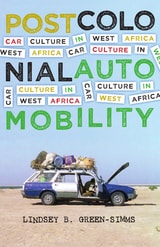
Postcolonial Automobility
Car Culture in West AfricaLindsey B. Green-Simms
University of Minnesota Press, 2015
For more than a century cars have symbolized autonomous, unfettered mobility and an increasingly global experience. And yet, they are often used differently outside the centers of global capitalism. This pioneering book considers how, through the lens of the automobile, we can assess the pleasures, dangers, and limits of global modernity in West Africa. Through new and provocative readings of famous plays, novels, and films, as well as recent popular videos, Postcolonial Automobility reveals the surprising ways in which automobility in the region is, at once, an everyday practice, an ethos, a fantasy of autonomy, and an affective activity intimately tied to modern social life.
Lindsey B. Green-Simms begins with the history of motorization in West Africa from the colonial era to the decolonizing decades after World War II, and addresses the tragedy of car accidents through a close reading of Wole Soyinka’s 1965 postindependence play The Road. Shifting to screen media, she discusses Ousmane Sembene’s Xala and Jean-Pierre Bekolo’s Quartier Mozart and reviews popular, low-budget Nollywood films. Finally, Green-Simms considers how feminist texts rewrite and work in dialogue with the male-centered films and novels where the car stands in for patriarchal power and capitalist achievement.
Providing a unique perspective on technology in Africa—one refusing to be confined to narratives of either underdevelopment or inevitable progress—and covering a broad range of interdisciplinary material, Postcolonial Automobility will appeal not only to scholars and students of African literature and cinema but also to those in postcolonial and globalization studies.
Power in Colonial Africa
Conflict and Discourse in Lesotho, 1870–1960Elizabeth A. Eldredge
University of Wisconsin Press, 2007
In Power in Colonial Africa: Conflict and Discourse in Lesotho, 1870–1960, Elizabeth A. Eldredge analyzes a panoply of archival and oral resources, visual signs and symbols, and public and private actions to show how power may be exercised not only by rulers but also by the ruled. The BaSotho—best known for their consolidation of a kingdom from the 1820s to 1850s through primarily peaceful means, and for bringing colonial forces to a standstill in the Gun War of 1880–1881—struggled to maintain sovereignty over their internal affairs during their years under the colonial rule of the Cape Colony (now part of South Africa) and Britain from 1868 to 1966. Eldredge explores instances of BaSotho resistance, resilience, and resourcefulness in forms of expression both verbal and non-verbal. Skillfully navigating episodes of conflict, the BaSotho matched wits with the British in diplomatic brinksmanship, negotiation, compromise, circumvention, and persuasion, revealing the capacity of a subordinate population to influence the course of events as it selectively absorbs, employs, and subverts elements of the colonial culture.
“A refreshing, readable and lucid account of one in an array of compositions of power during colonialism in southern Africa.”—David Gordon, Journal of African History
“Elegantly written.”—Sean Redding, Sub-Saharan Africa
“Eldredge writes clearly and attractively, and her studies of the war between Lerotholi and Masupha and of the conflicts over the succession to the paramountcy are essential reading for anyone who wants to understand those crises.”—Peter Sanders, Journal of Southern African Studies
Prelude to Protectorate in Morocco
Pre-Colonial Protest and Resistance, 1860-1912Edmund Burke, III
University of Chicago Press, 1977