Results by title
76 books match the query 'Dewey, John' and 2 start with p
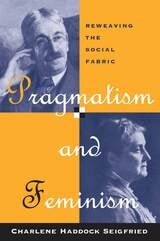
Pragmatism and Feminism
Reweaving the Social FabricCharlene Haddock Seigfried
University of Chicago Press, 1996
Though many pioneering feminists were deeply influenced by American pragmatism, their contemporary followers have generally ignored that tradition because of its marginalization by a philosophical mainstream intent on neutral analyses devoid of subjectivity. In this revealing work, Charlene Haddock Seigfried effectively reunites two major social and philosophical movements, arguing that pragmatism, because of its focus on the emancipatory potential of everyday experiences, offers feminism its most viable and powerful philosophical foundation.
With careful attention to their interwoven histories and contemporary concerns, Pragmatism and Feminism effectively invigorates both traditions, opening them to new interpretations and appropriations and asserting their timely philosophical relevance. This foundational work in feminist theory simultaneously invites and guides future scholarship in an area of rapidly emerging significance.
With careful attention to their interwoven histories and contemporary concerns, Pragmatism and Feminism effectively invigorates both traditions, opening them to new interpretations and appropriations and asserting their timely philosophical relevance. This foundational work in feminist theory simultaneously invites and guides future scholarship in an area of rapidly emerging significance.
[more]
Pragmatism and Political Theory
From Dewey to RortyMatthew Festenstein
University of Chicago Press, 1997
Pragmatism has enjoyed a considerable revival in the latter part of the twentieth century, but what precisely constitutes pragmatism remains a matter of dispute. In reconstructing the pragmatic tradition in political philosophy, Matthew Festenstein rejects the idea that it is a single, cohesive doctrine. His incisive analysis brings out the commonalities and shared concerns among contemporary pragmatists while making clear their differences in how they would resolve those concerns. His study begins with the work of John Dewey and the moral and psychological conceptions that shaped his philosophy. Here Festenstein lays out the major philosophic issues with which first Dewey, and then his heirs, would grapple.
The book's second part traces how Dewey's approach has been differently developed, especially in the work of three contemporary pragmatic thinkers: Richard Rorty, Jurgen Habermas, and Hilary Putnam. This first full-length critical study of the relationship between the pragmatist tradition and political philosophy fills a significant gap in contemporary thought.
The book's second part traces how Dewey's approach has been differently developed, especially in the work of three contemporary pragmatic thinkers: Richard Rorty, Jurgen Habermas, and Hilary Putnam. This first full-length critical study of the relationship between the pragmatist tradition and political philosophy fills a significant gap in contemporary thought.
[more]