Results by title
54 books match the query 'Diaspora' and 3 start with p
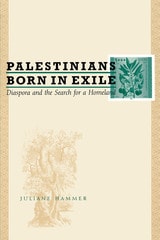
Palestinians Born in Exile
Diaspora and the Search for a HomelandBy Juliane Hammer
University of Texas Press, 2005
In the decade following the 1993 Oslo Peace Accords, some 100,000 diasporic Palestinians returned to the West Bank and Gaza. Among them were children and young adults who were born in exile and whose sense of Palestinian identity was shaped not by lived experience but rather through the transmission and re-creation of memories, images, and history. As a result, "returning" to the homeland that had never actually been their home presented challenges and disappointments for these young Palestinians, who found their lifeways and values sometimes at odds with those of their new neighbors in the West Bank and Gaza.
This original ethnography records the experiences of Palestinians born in exile who have emigrated to the Palestinian homeland. Juliane Hammer interviews young adults between the ages of 16 and 35 to learn how their Palestinian identity has been affected by living in various Arab countries or the United States and then moving to the West Bank and Gaza. Their responses underscore how much the experience of living outside of Palestine has become integral to the Palestinian national character, even as Palestinians maintain an overwhelming sense of belonging to one another as a people.
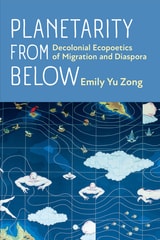
Planetarity from Below
Decolonial Ecopoetics of Migration and DiasporaEmily Yu Zong
University of Michigan Press, 2026
Through short stories, memoirs, speculative fiction, poetry, and documentary films, Zong unpacks a decolonial migrant ecopoetics, revealing a pluralist method of worldmaking—from Australia’s oceanic refugee camps, Indigenous Canadian land, and Chinese migrant worker sweatshops, to climate futures. These migrant ecologies imagine freedom “from below” not simply as individual survival or assimilation but as an unruly and contingent process of shared creativity with animals, waters, minerals, waste, and technology.
Shifting environmental ethics from individual morality to a political ecology of sustaining life in precarity, Zong introduces decolonial knowledges, imaginations, and praxes that help us expand justice and freedom beyond the human, asking how borderland subjectivities can open new possibilities for multispecies flourishing.
Powers Of Diaspora
Two Essays On The Relevance Of Jewish CultureJonathan Boyarin
University of Minnesota Press, 2002
Reasserts the centrality of Jewish culture to contemporary discussions of diaspora
Diaspora: the scattering of a people, often described as a condition of helplessness and a pathology to be overcome. It can also be, as Jonathan Boyarin and Daniel Boyarin assert in this provocative work, a unique source of power and strength. Focusing on Jewish experience, Powers of Diaspora forcefully argues that diasporic communities exercise a distinct form of cultural power in order to maintain themselves.
With reference to rabbinic culture and contemporary Jewish ethnography, the authors evoke the cultural strategies of Jewish diaspora—of regeneration through statelessness—that should prove increasingly relevant to the dilemmas and possibilities of the "new diasporas" born in the midst and in the aftermath of the modern world-system. Their work exposes the various methods by which peoples in diaspora "legislate" distinctive ways of life and establish formal communal structures, thus creating fluid yet effective boundaries between themselves and the others who surround them, and critiques the internal power dynamics that can sometimes result.Powers of Diaspora strongly reasserts the place of Jewish culture in contemporary discussions of diaspora, where the cultural politics of postcolonialism have remarginalized Jewish experience; at the same time, it brings insights from studies of other diasporas to bear on the study of Jews. In challenging the equation of diaspora with powerlessness, the book questions the modern nation-state ideal and suggests that diasporic cultural formations offer important clues toward an alternative means of relating culture to polity.