Results by title
71 books match the query 'Digital' and 4 start with p
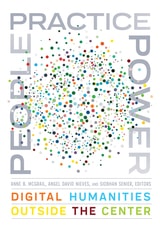
People, Practice, Power
Digital Humanities outside the CenterAnne B. McGrail
University of Minnesota Press, 2021
An illuminating volume of critical essays charting the diverse territory of digital humanities scholarship
The digital humanities have traditionally been considered to be the domain of only a small number of prominent and well-funded institutions. However, through a diverse range of critical essays, this volume serves to challenge and enlarge existing notions of how digital humanities research is being undertaken while also serving as a kind of alternative guide for how it can thrive within a wide variety of institutional spaces.
Focusing on the complex infrastructure that undergirds the field of digital humanities, People, Practice, Power examines the various economic, social, and political factors that shape such academic endeavors. The multitude of perspectives comprising this collection offers both a much-needed critique of the existing structures for digital scholarship and the means to generate broader representation within the field.
This collection provides a vital contribution to the realm of digital scholarly research and pedagogy in acknowledging the role that small liberal arts colleges, community colleges, historically black colleges and universities, and other underresourced institutions play in its advancement. Gathering together a range of voices both established and emergent, People, Practice, Power offers practitioners a self-reflexive examination of the current conditions under which the digital humanities are evolving, while helping to open up new sustainable pathways for its future.
Contributors: Matthew Applegate, Molloy College; Taylor Arnold, U of Richmond; Eduard Arriaga, U of Indianapolis; Lydia Bello, Seattle U; Kathi Inman Berens, Portland State U; Christina Boyles, Michigan State U; Laura R. Braunstein, Dartmouth College; Abby R. Broughton; Maria Sachiko Cecire, Bard College; Brennan Collins, Georgia State U; Kelsey Corlett-Rivera, U of Maryland; Brittany de Gail, U of Maryland; Madelynn Dickerson, UC Irvine Libraries; Nathan H. Dize, Vanderbilt U; Quinn Dombrowski, Stanford U; Ashley Sanders Garcia, UCLA; Laura Gerlitz; Erin Rose Glass; Kaitlyn Grant; Margaret Hogarth, Claremont Colleges; Maryse Ndilu Kiese, U of Alberta; Pamella R. Lach, San Diego State U; James Malazita, Rensselaer Polytechnic Institute; Susan Merriam, Bard College; Chelsea Miya, U of Alberta; Jamila Moore Pewu, California State U, Fullerton; Urszula Pawlicka-Deger, Aalto U, Finland; Jessica Pressman, San Diego State U; Jana Remy, Chapman U; Roopika Risam, Salem State U; Elizabeth Rodrigues, Grinnell College; Dylan Ruediger, American Historical Association; Rachel Schnepper, Wesleyan U; Anelise Hanson Shrout, Bates College; Margaret Simon, North Carolina State U; Mengchi Sun, U of Alberta; Lauren Tilton, U of Richmond; Michelle R. Warren, Dartmouth College.
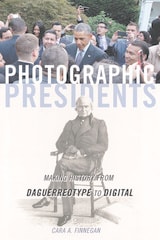
Photographic Presidents
Making History from Daguerreotype to DigitalCara A. Finnegan
University of Illinois Press, 2021
Lincoln’s somber portraits. Lyndon Johnson’s swearing in. George W. Bush’s reaction to learning about the 9/11 attacks. Photography plays an indelible role in how we remember and define American presidents. Throughout history, presidents have actively participated in all aspects of photography, not only by sitting for photos but by taking and consuming them. Cara A. Finnegan ventures from a newly-discovered daguerreotype of John Quincy Adams to Barack Obama’s selfies to tell the stories of how presidents have participated in the medium’s transformative moments. As she shows, technological developments not only changed photography, but introduced new visual values that influence how we judge an image. At the same time, presidential photographs—as representations of leaders who symbolized the nation—sparked public debate on these values and their implications.
An original journey through political history, Photographic Presidents reveals the intertwined evolution of an American institution and a medium that continues to define it.
Poetic Operations
Trans of Color Art in Digital Mediamicha cárdenas
Duke University Press, 2021
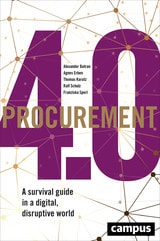
Procurement 4.0
A Survival Guide in a Digital, Disruptive WorldAlexander Batran, Agnes Erben, Ralf Schulz, and Franziska Sperl
Campus Verlag, 2017
As the authors show, dynamic, interconnected value chains are key factors of sustainable business success, with procurement managed and steered by strategic purchasers in their new role as value chain managers. This evolving environment will be influenced by a variety of digitalization forces, including Industry 4.0, the Internet of Things, smart data and clouds, Enterprise 2.0, social media, and mobile computing. Integrating all network levels of procurement—from intra-company and inter-company relationships to global connectivity along value chains—and drawing on interviews with corporate heads of BMW, Lufthansa, Maersk, BP, and Allianz, the authors explore four dimensions of procurement that will address the business needs of the future: competing value chains, co-creation, leadership, and digital transformation.