Results by title
436 books match the query 'Disability' and 9 start with p
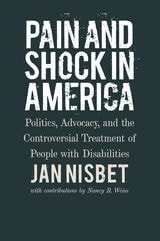
Pain and Shock in America
Politics, Advocacy, and the Controversial Treatment of People with DisabilitiesJan Nisbet
Brandeis University Press, 2021
For more than forty years, professionals in the field of disability studies have engaged in debates over the use of aversive interventions (such as electric shock) like the ones used at the Judge Rotenberg Center. Advocates and lawyers have filed complaints and lawsuits to both use them and ban them, scientists have written hundreds of articles for and against them, and people with disabilities have lost their lives and, some would say, lived their lives because of them. There are families who believe deeply in the need to use aversives to control their children’s behavior. There are others who believe the techniques used are torture. All of these families have children who have been excluded from numerous educational and treatment programs because of their behaviors. For most of the families, placement at the Judge Rotenberg Center is the last resort.
This book is a historical case study of the Judge Rotenberg Center, named after the judge who ruled in favor of keeping its doors open to use aversive interventions. It chronicles and analyzes the events and people involved for over forty years that contributed to the inability of the state of Massachusetts to stop the use of electric shock, and other severe forms of punishment on children and adults with disabilities. It is a long story, sad and tragic, complex, filled with intrigue and questions about society and its ability to protect and support its most vulnerable citizens.
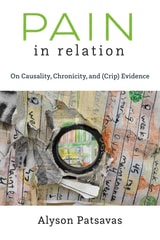
Pain in Relation
On Causality, Chronicity, and (Crip) EvidenceAlyson Patsavas
University of Michigan Press, 2026
Pain in Relation: On Causality, Chronicity, and (Crip) Evidence argues that the dominant stories circulating within contemporary US culture are marked by seemingly contradictory certainties: pain is at once subjective yet universal; that pain makes life unlivable and can be overcome with perseverance. These certainties graft onto pained people as impossible imperatives: the imperatives to live “despite” our pain and to defend the value of lives imagined to be compromised “because of” it. Alyson Patsavas outlines the harm these imperatives cause and draws on feminist, queer, and disability theory to offer alternative frameworks for making sense of and relating to pain.
The study fleshes out “crip autotheory” and experiments with evidencing practices, using anecdotes, journal entries, personal reflections, list-making, and photography to map “cripistemologies of pain,” or critical, disability-informed experiential ways of knowing pain. Equal parts cultural critique, intimate portrait of pained life, and commentary, Pain in Relation invites readers to challenge what they think they know about pain and explore new ways of relating to pain, pained life, and the futures we imagine for pained people.
Parallel Views
Education and Access for Deaf People in France and the United StatesThe French American Foundation
Gallaudet University Press, 1994

Paris in America
A Deaf Nanticoke Shoemaker and His DaughterClara Jean Mosley Hall
Gallaudet University Press, 2018
Hall was abandoned by her Deaf African American mother at a young age and forged a close bond with her father, James Paris Mosley, who communicated with her in American Sign Language. Although his family was Native American, they—like many other Nanticoke Native Americans of that region—had assimilated over time into Dover’s Black community. Hall vividly recounts the social and cultural elements that shaped her, from Jim Crow to the forced integration of public schools, to JFK and Motown. As a Coda (child of deaf adults) in a time when no accessibility or interpreting services were available, she was her father’s sole means of communication with the hearing world, a heavy responsibility for a child. After her turbulent teenage years, and with the encouragement of her future husband, she attended college and discovered that her skills as a fluent ASL user were a valuable asset in the field of education.
Hall went on to become a college professor, mentor, philanthropist, and advocate for Deaf students from diverse backgrounds. Her memoir is a celebration of her family, her faith, her journey, and her heritage.
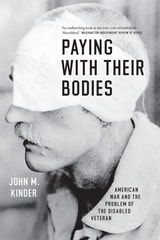
Paying with Their Bodies
American War and the Problem of the Disabled VeteranJohn M. Kinder
University of Chicago Press, 2015
America has grappled with the questions posed by injured veterans since its founding, and with particular force since the early twentieth century: What are the nation’s obligations to those who fight in its name? And when does war’s legacy of disability outweigh the nation’s interests at home and abroad? In Paying with Their Bodies, John M. Kinder traces the complicated, intertwined histories of war and disability in modern America. Focusing in particular on the decades surrounding World War I, he argues that disabled veterans have long been at the center of two competing visions of American war: one that highlights the relative safety of US military intervention overseas; the other indelibly associating American war with injury, mutilation, and suffering. Kinder brings disabled veterans to the center of the American war story and shows that when we do so, the history of American war over the last century begins to look very different. War can no longer be seen as a discrete experience, easily left behind; rather, its human legacies are felt for decades.
The first book to examine the history of American warfare through the lens of its troubled legacy of injury and disability, Paying with Their Bodies will force us to think anew about war and its painful costs.
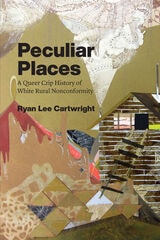
Peculiar Places
A Queer Crip History of White Rural NonconformityRyan Lee Cartwright
University of Chicago Press, 2021
Sensationalized accounts of white rural communities’ aberrant sexualities, racial intermingling, gender transgressions, and anomalous bodies and minds, which proliferated from the turn of the century, created a national view of the perversity of white rural poverty for the American public. Cartwright contends that these accounts, extracted and estranged from their own ambivalent forum of community gossip, must be read in kind: through a racialized, materialist queercrip optic of the deeply familiar and mundane. Taking in popular science, documentary photography, news media, documentaries, and horror films, Peculiar Places orients itself at the intersections of disability studies, queer studies, and gender studies to illuminate a racialized landscape both profoundly ordinary and familiar.
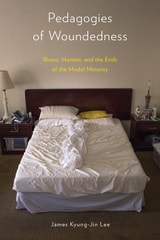
Pedagogies of Woundedness
Illness, Memoir, and the Ends of the Model MinorityJames Kyung-Jin Lee
Temple University Press, 2022
The pressures Asian Americans feel to be socially and economically exceptional include an unspoken mandate to always be healthy. Nowhere is this more evident than in the expectation for Asian Americans to enter the field of medicine, principally as providers of care rather than those who require care. Pedagogies of Woundedness explores what happens when those considered model minorities critically engage with illness and medicine whether as patients or physicians.
James Kyung-Jin Lee considers how popular culture often positions Asian Americans as medical authorities and what that racial characterization means. Addressing the recent trend of writing about sickness, disability, and death, Lee shows how this investment in Asian American health via the model minority is itself a response to older racial forms that characterize Asian American bodies as diseased. Moreover, he pays attention to what happens when academics get sick and how illness becomes both methodology and an archive for scholars.
Pedagogies of Woundedness also explores the limits of biomedical “care,” the rise of physician chaplaincy, and the impact of COVID. Throughout his book and these case studies, Lee shows the social, ethical, and political consequences of these common (mis)conceptions that often define Asian Americans in regard to health and illness.
Points of Contact
Disability, Art, and CultureSusan Crutchfield and Marcy Epstein, Editors
University of Michigan Press, 2000
Promoting Positive Transition Outcomes
Effective Planning for Deaf and Hard of Hearing Young AdultsPamela Luft
Gallaudet University Press, 2016
Promoting Positive Transition Outcomes is the most comprehensive discussion of transition planning and results for DHH students now available. Luft begins with an overview of the historical and current challenges to DHH students and their academic and vocational potential. She explores the importance of forming an identity and building foundational social and problem-solving skills. She then reviews the history of rehabilitation and workforce legislation, which now mandates that every student with an individualized education plan (IEP) have a transition plan in place by the age of 16. Most schools, however, are not equipped to meet the needs of a population as diverse as DHH students. She examines the services that are currently available in high schools and offers recommendations for strengthening transition team planning by reaching out to external experts. The volume concludes with suggestions for creating a framework to address the challenges of transition planning for deaf and hard of hearing students and offers guidance on building effective plans.