Results by title
62 books match the query 'Discrimination' and 4 start with p

Palestinians in Israel
Segregation, Discrimination and DemocracyBen White
Pluto Press, 2012
Palestinians in Israel considers a key issue ignored by the official 'peace process' and most mainstream commentators: that of the growing Palestinian minority within Israel itself.
What the Israeli right-wing calls 'the demographic problem' Ben White identifies as 'the democratic problem' which goes to the heart of the conflict. Israel defines itself not as a state of its citizens, but as a Jewish state, despite the substantial and increasing Palestinian population. White demonstrates how the consistent emphasis on privileging one ethno-religious group over another cannot be seen as compatible with democratic values and that, unless addressed, will undermine any attempts to find a lasting peace.
Individual case studies are used to complement this deeply informed study into the great, unspoken contradiction of Israeli democracy. It is a pioneering contribution which will spark debate amongst all those concerned with a resolution to the Israel/Palestine conflict.
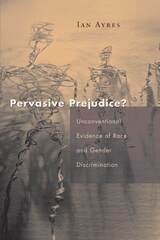
Pervasive Prejudice?
Unconventional Evidence of Race and Gender DiscriminationIan Ayres
University of Chicago Press, 2001
In Pervasive Prejudice? Ian Ayres confronts these questions and more. In a series of important studies he finds overwhelming evidence that in a variety of markets—retail car sales, bail bonding, kidney transplantation, and FCC licensing—blacks and females are consistently at a disadvantage. For example, when Ayres sent out agents of different races and genders posing as potential buyers to more than 200 car dealerships in Chicago, he found that dealers regularly charged blacks and women more than they charged white men. Other tests revealed that it is commonly more difficult for blacks than whites to receive a kidney transplant because of federal regulations. Moreover, Ayres found that minority male defendants are frequently required to post higher bail bonds than their Caucasian counterparts.
Traditional economic theory predicts that free markets should drive out discrimination, but Ayres's startling findings challenge that position. Along with empirical research, Ayres offers game—theoretic and other economic methodologies to show how prejudice can enter the bargaining process even when participants are supposedly acting as rational economic agents. He also responds to critics of his previously published studies included here. These studies suggest that race and gender discrimination is neither a thing of the past nor merely limited to the handful of markets that have been the traditional focus of civil rights laws.
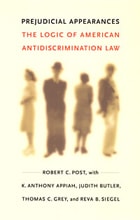
Prejudicial Appearances
The Logic of American Antidiscrimination LawRobert C. Post, with K. Anthony Appiah, Judith Butler, Thomas C. Grey, and Reva B. Siegel
Duke University Press, 2001
Four distinguished commentators respond to Post’s provocative essay. Each adopts a distinctive perspective. K. Anthony Appiah investigates the philosophical logic of stereotyping and of equality. Questioning whether the law ought to endorse any social practices that define persons, Judith Butler explores the tension between sociological and postmodern approaches to antidiscrimination law. Thomas C. Grey examines whether Post’s proposal can be reconciled with the values of the rule of law. And Reva B. Siegel applies critical race theory to query whether antidiscrimination law’s reshaping of race and gender should best be understood in terms of practices of subordination and stratification.
By illuminating the consequential rhetorical maneuvers at the heart of contemporary U.S. antidiscrimination law, Prejudical Appearances forces readers to reappraise the relationship between courts of law and social behavior. As such, it will enrich scholars interested in the relationships between law, rhetoric, postmodernism, race, and gender.
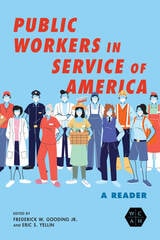
Public Workers in Service of America
A ReaderEdited by Frederick W. Gooding Jr. and Eric S. Yellin
University of Illinois Press, 2023
From white-collar executives to mail carriers, public workers meet the needs of the entire nation. Frederick W. Gooding Jr. and Eric S. Yellin edit a collection of new research on this understudied workforce. Part One begins in the late nineteenth- and early twentieth century to explore how questions of race, class, and gender shaped public workers, their workplaces, and their place in American democracy. In Part Two, essayists examine race and gender discrimination while revealing the subtle contemporary forms of marginalization that keep Black men and Black and white women underpaid and overlooked for promotion. The historic labor actions detailed in Part Three illuminate how city employees organized not only for better pay and working conditions but to seek recognition from city officials, the public, and the national labor movement. Part Four focuses on nurses and teachers to address the thorny question of whether certain groups deserve premium pay for their irreplaceable work and sacrifices or if serving the greater good is a reward unto itself.
Contributors: Eileen Boris, Cathleen D. Cahill, Frederick W. Gooding Jr., William P. Jones, Francis Ryan, Jon Shelton, Joseph E. Slater, Katherine Turk, Eric S. Yellin, and Amy Zanoni