Results by title
230 books match the query 'Doctrines' and 7 start with p
Pilgram Marpeck
His Life and Social TheologyStephen B. Boyd
Duke University Press, 1992
This intellectual and social history is the first comprehensive biography of Pilgram Marpeck (c. 1495–1556), a radical reformer and lay leader of Anabaptist groups in Switzerland, Austria, and South Germany. Marpeck’s influential life and work provide a glimpse of the theologies and practices of the Roman Church and of various reform movements in sixteenth-century Europe.
Drawing on extensive archival data documenting Marpeck’s professional life, as well as on his numerous published and unpublished writings on theology and religious reform, Stephen B. Boyd traces Marpeck’s unconventional transition from mining magistrate to Anabaptist leader, establishes his connections with various radical social and religious groups, and articulates aspects of his social theology. Marpeck’s distinctive and eclectic theology, Boyd demonstrates, focused on the need for personal, uncoerced conversion, rejected state interference in the affairs of the church, denied the need for a monastic withdrawal from the secular world, and called for the Christian’s active pursuit of justice before God and among human beings.
Drawing on extensive archival data documenting Marpeck’s professional life, as well as on his numerous published and unpublished writings on theology and religious reform, Stephen B. Boyd traces Marpeck’s unconventional transition from mining magistrate to Anabaptist leader, establishes his connections with various radical social and religious groups, and articulates aspects of his social theology. Marpeck’s distinctive and eclectic theology, Boyd demonstrates, focused on the need for personal, uncoerced conversion, rejected state interference in the affairs of the church, denied the need for a monastic withdrawal from the secular world, and called for the Christian’s active pursuit of justice before God and among human beings.
[more]
Political Philosophy and Revelation
James V. Schall, SJ
Catholic University of America Press, 2013
A collection of Fr. James Schall's recent essays, Political Philosophy and Revelation offers a learned, erudite, and coherent statement on the relationship between reason and revelation in the modern world. It addresses political philosophy in the context of an awareness of other humane and practical sciences, including history, literature, economics, theology, ethics and metaphysics.
[more]
Politics Reformed
The Anglo-American Legacy of Covenant TheologyGlenn A. Moots
University of Missouri Press, 2022
Many studies have considered the Bible’s relationship to politics, but almost all have ignored the heart of its narrative and theology: the covenant. In this book, Glenn Moots explores the political meaning of covenants past and present by focusing on the theory and application of covenantal politics from the sixteenth through the eighteenth centuries. Moots demands that we revisit political theology because it served as the most important school of politics in early modern Europe and America. He describes the strengths of the covenant tradition while also presenting its limitations and dangers. Contemporary political scientists such as Eric Voegelin, Daniel Elazar, and David Novak are called on to provide insight into both the covenant’s history and its relevance today.
Moots’s work chronicles and critiques the covenant tradition while warning against both political ideology and religious enthusiasm. It provides an inclusive and objective outline of covenantal politics by considering the variations of Reformed theology and their respective consequences for political practice. This includes a careful account of how covenant theology took root on the European continent in the sixteenth century and then inspired ecclesiastical and civil politics in England, Scotland, and America. Moots goes beyond the usual categories of Calvinism or Puritanism to consider the larger movement of which both were a part. By integrating philosophy, theology, and history, Moots also invites investigation of broader political traditions such as natural law and natural right.
Politics Reformed demonstrates how the application of political theology over three centuries has important lessons for our own dilemmas about church and state. It makes a provocative contribution to understanding foundational questions in an era of rising fundamentalism and emboldened secularism, inspiring readers to rethink the importance of religion in political theory and practice, and the role of the covenant tradition in particular.
[more]
Principles of Catholic Theology, Book 1
On the Nature of TheologyThomas Joseph White, OP
Catholic University of America Press, 2023
Catholic theology has to face a certain number of fundamental questions: what is the nature and content of Christian revelation, what are the sources of revelation, how are the mysteries of the faith to be understood in relation of one to another, and how do the truths of the Catholic faith relate to the acquisitions of natural reason. In the contemporary context, Catholic theology is marked by a diversity of approaches, many of which are seemingly incompatible or estranged from one another. How might we think about the unity of Catholic theology over and above the diversity of forms? What role, if any, can Aquinas play as a common doctor in facilitating exchanges between theological traditions in the Church?
Principles of Catholic Theology seeks to address directly the nature of Catholic theology and the challenge of its contemporary articulation with an eye towards its articulation in its Thomistic key. This book is also the first of a series of collections of essays by Thomas Joseph White, OP, extending over a range of fundamental topics in Catholic dogmatic theology.
[more]
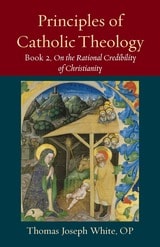
Principles of Catholic Theology, Book 2
On the Rational Credibility of ChristianityThomas Joseph White, OP
Catholic University of America Press, 2023
Can a philosopher defend the rational warrant for belief in Christianity? Is it reasonable to be religious? Is it philosophically responsible to be a Christian who believes in the mystery of the Trinity? Principles of Catholic Theology explores these questions in a systematic way by considering questions of ultimate explanation. Why not hold that modern atheistic naturalism provides the best explanation of reality? Or, if there is a transcendent first principle that explains all of reality, is it impersonal rather than personal? Contrastingly, if monotheism constitutes the best explanation for created being, how can we reasonably believe in any particular revelation concerning God? What are the criteria for rational belief in revelation?
Thomas Joseph White, OP, considers these questions by exploring a series of topics: the transcendentals (existence, oneness, truth, goodness, beauty); rational argument for the existence of God; the immateriality and subsistence after death of the personal soul of the human being; the historical and conceptual coherence of Trinitarian doctrine; and the reasonableness of the natural desire to see God. The aim of Principles of Catholic Theology, Book 2 is to place contemporary natural reason in profound dialogue with the Catholic faith and to think about ways that we can consent to the profound mystery of the Holy Trinity that are in robust concord with the knowledge obtained from philosophical, scientific, and historical sources.
[more]
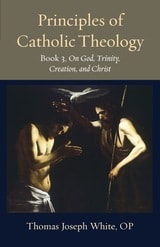
Principles of Catholic Theology, Book 3
On God, Trinity, Creation, and ChristThomas Joseph White
Catholic University of America Press, 2024
What if anything can human beings know about God, either by way of philosophical reasoning or by divine revelation? How does the mystery of the Incarnation illuminate our understanding of the nature and mystery of God and the nature and destiny of the human person? The essays in this book explore topics pertaining to the nature of God, apophatic theology, divine simplicity and the holy Trinity, divine beauty, and the beauty of creation. The book also contains a series of speculative considerations of Christology: Why did God become human? How ought we understand the two natures of Christ and the topic of the communication of idioms (attribution of both divine and human properties to one person)? There is also a sustained treatment of Jesus' human knowledge and voluntary freedom. Did Jesus understand his own lordship and his unity with the Father and the Holy Spirit, and if so, how? Did Christ's human will always accord with the divine will, and what significance does this idea have for our understanding of the redemption affected by Christ for the whole human race? Through these explorations, principles drawn from Thomas Aquinas and from Thomistic tradition are taken into account as key resources for the adjudication of contemporary theological challenges.
Principles of Catholic Theology, Book 3 is a continuation of Fr. Thomas Joseph White's collection of essays, extending over a range of fundamental topics in Catholic dogmatic theology.
[more]
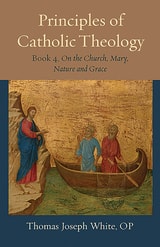
Principles of Catholic Theology, Book 4
On the Church, Mary, Nature and GraceThomas Joseph White
Catholic University of America Press, 2023
In the Nicene Creed Christians profess belief in the Church, "one, holy, catholic, and apostolic." The Church is also called the mystical body of Christ and the bride of Christ. What is the Church and how can we understand her mystery in light of the mystery of Christ? Principles of Catholic Theology, Book 4 explores Catholic ecclesiology and the theology of the Virgin Mary, as an exemplar of the Church's life. It also considers the people of Israel in light of the Church and Christ. The second half of the book considers human nature in light of the grace of Christ, and ecclesial humanity, so as to consider thematic and universal relations of grace to human nature. Major controversies are addressed such as the natural desire to see God and the Thomistic understanding of election and predestination. Effectively this volume seeks to receive and interpret the teaching of the Second Vatican Council Constitution on the Church, Lumen Gentium, within the Thomistic theological tradition and in light of that tradition.
Principles of Catholic Theology, Book 4 is a continuation of Fr. Thomas Joseph White's collection of essays, extending over a range of fundamental topics in Catholic dogmatic theology.
[more]