Results by title
53 books match the query 'Dwellings' and 3 start with p
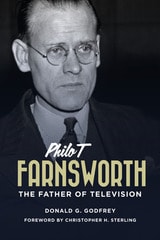
Philo T Farnsworth
Donald Godfrey
University of Utah Press, 2001
Philo T. Farnsworth (1906–1971) has been called the "forgotten father of television." He grew up in Utah and southern Idaho, and was described as a genius by those who knew and worked with him. With only a high school education, Farnsworth drew his first television schematic for his high school teacher in Rigby, Idaho. Subsequent claims and litigation notwithstanding, he was the first to transmit a television image.
Farnsworth filed ten patents between 1927 and 1929 for camera tubes (transmitting), circuitry, and the cathode ray tube (viewing). After his early years as an inventor in San Francisco, he worked as an engineer, doing battle with RCA in the 1930s over patent rights, formed the Farnsworth Television Company in the 1940s, and worked for IT&T after their purchase of the Farnsworth enterprises. Every television set sold utilized at least six of his basic patents.
Because of endless legal wrangling with RCA over patent rights, he received very little financial reward for his television patents. Donald Godfrey examines the genius and the failures in the life of Philo Farnsworth as he struggled to be both inventor and entrepreneur.
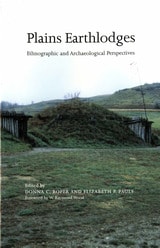
Plains Earthlodges
Ethnographic and Archaeological PerspectivesEdited by Donna C. Roper and Elizabeth P. Pauls
University of Alabama Press, 2005
A survey of Native American earthlodge research from across the Great Plains.
Early explorers initially believed the earthlodge homes of Plains village peoples were made entirely of earth. Actually, however, earthlodges are timber-frame structures, with the frame covered by successive layers of willows, grass, and earth, and with a tunnel-like entryway and a smoke hole in the center of the roof. The products of nearly a millennium of engineering development, historic period lodges were massively built. With diameters up to 60 feet across, they comprise the largest and most complex artifacts built on the Plains until the 20th century. Sheltering nuclear or extended families and their possessions—beds, stored food and clothing, weapons, sweatlodges, and even livestock—they shaped Plains villagers' lives both physically and symbolically.
This collection of papers explores current research in the ethnography and archaeology of Plains earthlodges, considering a variety of Plains tribes, including the Mandan, Hidatsa, Cheyenne, and their late prehistoric period predecessors. Acknowledged experts in the field discuss topics including lodge construction, architecture, maintenance, deterioration, and lifespan; the ritual practices performed in them; their associations with craft traditions, medicine lodges, and the Sun Dance; their gender symbolism; and their geophysical signatures.
With technological advances allowing an ever greater recognition of archaeological evidence in situ, future earthlodge research will yield even more information on their owners and residents. This volume provides a much-needed baseline for such research as well as comparative data for the occurrence of earthlodges in other sections of North America.
Contributors:
Jennifer R. Bales, Donald J. Blakeslee, Kenneth L. Kvamme, Stephen C. Lensink, Margot P. Liberty, Elizabeth P. Pauls, Donna C. Roper, Michael Scullin, W. Raymond Wood
Pox, Empire, Shackles, and Hides
The Townsend Site, 1670-1715Jon Bernard Marcoux
University of Alabama Press, 2010
Marcoux studies the material remains of daily life in order to identify the strategies that households enacted while adapting to the social, political, and economic disruptions associated with European contact. The author focuses on households as the basic units of analysis because these represent the most fundamental and pervasive unit of economic and social production in the archaeological record. His investigations show how the daily lives of Cherokee households changed dramatically as they coped with the shifting social, political, and economic currents of the times. He demonstrates that the community excavated at the Townsend site was formed by immigrant households who came together from geographically disparate and ethnically distinct Cherokee settlements as a way to ameliorate population losses. He also explores changes in community and household patterning, showing how the spatial organization of the Townsend community became less formal and how households became more transient compared to communities predating contact with Europeans. From this evidence, Marcoux concludes that these changes reflect a broader strategic shift to a more flexible lifestyle that would have aided Cherokee households in negotiating the social, political, and economic uncertainty of the period.