Results by title
53 books match the query 'Dynamics' and 2 start with p

Passing and Pedagogy
THE DYNAMICS OF RESPONSIBILITYPamela L. Caughie
University of Illinois Press, 1999
Caughie's discussion of passing illuminates a recent phenomenon in academic writing and popular culture that revolves around identities and the ways in which they are deployed, both in the arts and in lived experience. Through a wide variety of texts—novels, memoirs, film, drama, theory, museum exhibits, legal cases—she demonstrates the dynamics of passing, presenting it not as the assumption of a fraudulent identity but as the recognition that the assumption of any identity, including for the purposes of teaching, is a form of passing.
Astutely addressing the relevance of passing for pedagogy, Caughie presents the possibility of a dynamic ethics responsive to the often polarizing difficulties inherent in today's culture. Challenging and thought-provoking, Passing and Pedagogy offers insight and inspiration for teachers and scholars as they seek to be responsible and effective in a complex, rapidly changing intellectual and cultural environment.
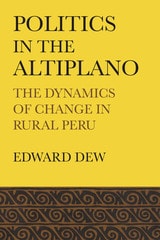
Politics in the Altiplano
The Dynamics of Change in Rural PeruBy Edward Dew
University of Texas Press, 1969
The department of Puno in southern Peru is an area oriented to livestock and agricultural production, peopled by an Indian peasant mass and a dominant minority of culturally Westernized mestizos. A small but growing hybrid group, the cholos, bridged the cultural gap and collaborated with dissident merchant elements within the mestizo group to challenge the economic, social, and political order of the altiplano (high plateau) system. Politics in the Altiplano analyzes the sources of conflict and political change in the plural society as it underwent socioeconomic development through a period of recurring natural disasters.
In the period under study (1956–1966), a prolonged drought precipitated a series of crises. The mismanagement of American aid, sent to the suffering peasants, became a national cause célèbre. As migration to Peru’s coastal cities reached large-scale proportions, several peasant movements were launched in the department. To rechannel local discontent, an autonomous development corporation was created for Puno by the Peruvian Congress. This, plus the institution of local elections in 1963, provided ample opportunity for the coalition of dissident mestizos, cholos, and peasants to pursue their “revolutionary” goals.
A rivalry between two major towns, Puno (the department’s capital) and Juliaca (the commercial center), furthered the conflict between conservative mestizos and the peasant-cholo movement. Juliaca’s attempt to secede from the department in November 1965 set off a series of violent strikes and counterstrikes in both cities. Intervention from the national level by government troops put an end to the crisis for the time being. But the continued need for land reform in the department, combined with institutionalized means for political participation, kept the peasants mobilized and the atmosphere of conflict alive.