Results by title
110 books match the query 'Education (Higher)' and 4 start with p
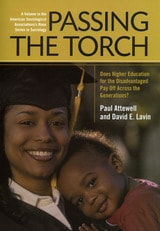
Passing the Torch
Does Higher Education for the Disadvantaged Pay Off Across the Generations?Paul Attewell
Russell Sage Foundation, 2007
The steady expansion of college enrollment rates over the last generation has been heralded as a major step toward reducing chronic economic disparities. But many of the policies that broadened access to higher education—including affirmative action, open admissions, and need-based financial aid—have come under attack in recent years by critics alleging that schools are admitting unqualified students who are unlikely to benefit from a college education. In Passing the Torch, Paul Attewell, David Lavin, Thurston Domina, and Tania Levey follow students admitted under the City University of New York’s “open admissions” policy, tracking its effects on them and their children, to find out whether widening college access can accelerate social mobility across generations.
Unlike previous research into the benefits of higher education, Passing the Torch follows the educational achievements of three generations over thirty years. The book focuses on a cohort of women who entered CUNY between 1970 and 1972, when the university began accepting all graduates of New York City high schools and increasing its representation of poor and minority students. The authors survey these women in order to identify how the opportunity to pursue higher education affected not only their long-term educational attainments and family well-being, but also how it affected their children’s educational achievements. Comparing the record of the CUNY alumnae to peers nationwide, the authors find that when women from underprivileged backgrounds go to college, their children are more likely to succeed in school and earn college degrees themselves. Mothers with a college degree are more likely to expect their children to go to college, to have extensive discussions with their children, and to be involved in their children’s schools. All of these parenting behaviors appear to foster higher test scores and college enrollment rates among their children. In addition, college-educated women are more likely to raise their children in stable two-parent households and to earn higher incomes; both factors have been demonstrated to increase children’s educational success.
The evidence marshaled in this important book reaffirms the American ideal of upward mobility through education. As the first study to indicate that increasing access to college among today’s disadvantaged students can reduce educational gaps in the next generation, Passing the Torch makes a powerful argument in favor of college for all.
Potential on the Periphery
College Access from the Ground UpOmari Scott Simmons
Rutgers University Press, 2019
Public Feminisms
From Academy to CommunityEdited by Carrie N. Baker and Aviva Dove-Viebahn
Lever Press, 2023
The field of feminist studies grew from the U.S. women’s movements of the 1960s and 1970s and has continued to be deeply connected to ongoing movements for social justice. As educational institutions are increasingly seeing public scholarship and community engagement as relevant and fruitful complements to traditional academic work, feminist scholars have much to offer in demonstrating different ways to inform and interact with various communities. In Public Feminisms: From Academy to Community edited by Carrie N. Baker and Aviva Dove-Viebahn, a diverse range of feminist scholar-activists write about the dynamic and varied methods they use to reach beyond the traditional academic classroom and scholarly journals to share their work with the public.
Part one explores how feminist scholars engage broader audiences through art, media, and public programming, including essays on a public discussion series teaching intersectional feminist analysis of popular films, and a podcast from Latina scholars discussing issues of reproductive justice, social justice, motherhood, sexuality, race, and gender. Part two focuses on activism and public education, including essays on “Take Back the Night,” and archiving the women’s march protests. Part three turns to public writing and scholarship, including an essay on elevating the perspectives and voices of underrepresented creatives in the film and television industry. Part four explores feminist pedagogies for community engagement and for teaching public feminisms.
Accessible and engaging to a broad range of readers, the essays in this volume are a rich resource for scholars and students interested in infusing their academic knowledge into the public sphere. With this timely book, the editors offer an opportunity to reflect on the meaning and importance of community engagement and highlight some of the important public-facing work feminist scholars are doing today. Faculty, graduate, and undergraduate students, as well as administrators hoping to increase their schools’ connections to the community, will find this volume indispensable.
Putting Poor People to Work
How the Work-First Idea Eroded College Access for the PoorKathleen M. Shaw
Russell Sage Foundation, 2006