81 books match the query 'Educational equalization' and 4 start with p
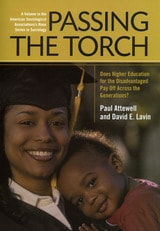
cover of Passing the Torch: Does Higher Education for the Disadvantaged Pay Off Across the Generations?

Passing the Torch

Does Higher Education for the Disadvantaged Pay Off Across the Generations?

Paul Attewell

Russell Sage Foundation, 2007

The steady expansion of college enrollment rates over the last generation has been heralded as a major step toward reducing chronic economic disparities. But many of the policies that broadened access to higher education—including affirmative action, open admissions, and need-based financial aid—have come under attack in recent years by critics alleging that schools are admitting unqualified students who are unlikely to benefit from a college education. In Passing the Torch, Paul Attewell, David Lavin, Thurston Domina, and Tania Levey follow students admitted under the City University of New York’s “open admissions” policy, tracking its effects on them and their children, to find out whether widening college access can accelerate social mobility across generations.

Unlike previous research into the benefits of higher education, Passing the Torch follows the educational achievements of three generations over thirty years. The book focuses on a cohort of women who entered CUNY between 1970 and 1972, when the university began accepting all graduates of New York City high schools and increasing its representation of poor and minority students. The authors survey these women in order to identify how the opportunity to pursue higher education affected not only their long-term educational attainments and family well-being, but also how it affected their children’s educational achievements. Comparing the record of the CUNY alumnae to peers nationwide, the authors find that when women from underprivileged backgrounds go to college, their children are more likely to succeed in school and earn college degrees themselves. Mothers with a college degree are more likely to expect their children to go to college, to have extensive discussions with their children, and to be involved in their children’s schools. All of these parenting behaviors appear to foster higher test scores and college enrollment rates among their children. In addition, college-educated women are more likely to raise their children in stable two-parent households and to earn higher incomes; both factors have been demonstrated to increase children’s educational success.

The evidence marshaled in this important book reaffirms the American ideal of upward mobility through education. As the first study to indicate that increasing access to college among today’s disadvantaged students can reduce educational gaps in the next generation, Passing the Torch makes a powerful argument in favor of college for all.
[more]
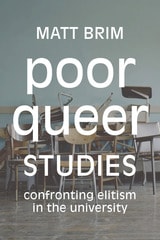
cover of Poor Queer Studies: Confronting Elitism in the University

Poor Queer Studies

Confronting Elitism in the University

Matt Brim

Duke University Press, 2020

In Poor Queer Studies Matt Brim shifts queer studies away from its familiar sites of elite education toward poor and working-class people, places, and pedagogies. Brim shows how queer studies also takes place beyond the halls of flagship institutions: in night school; after a three-hour commute; in overflowing classrooms at no-name colleges; with no research budget; without access to decent food; with kids in tow; in a state of homelessness. Drawing on the everyday experiences of teaching and learning queer studies at the College of Staten Island, Brim outlines the ways the field has been driven by the material and intellectual resources of those institutions that neglect and rarely serve poor and minority students. By exploring poor and working-class queer ideas and laying bare the structural and disciplinary mechanisms of inequality that suppress them, Brim jumpstarts a queer-class knowledge project committed to anti-elitist and anti-racist education. Poor Queer Studies is essential for all of those who care about the state of higher education and building a more equitable academy.
[more]
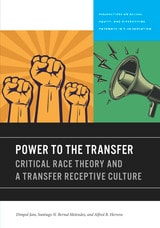
cover of Power to the Transfer: Critical Race Theory and a Transfer Receptive Culture

Power to the Transfer

Critical Race Theory and a Transfer Receptive Culture

Dimpal Jain

Michigan State University Press, 2020
Currently, U.S. community colleges serve nearly half of all students of color in higher education who, for a multitude of reasons, do not continue their education by transferring to a university. For those students who do transfer, often the responsibility for the application process, retention, graduation, and overall success is placed on them rather than their respective institutions. This book aims to provide direction toward the development and maintenance of a transfer receptive culture, which is defined as an institutional commitment by a university to support transfer students of color. A transfer receptive culture explicitly acknowledges the roles of race and racism in the vertical transfer process from a community college to a university and unapologetically centers transfer as a form of equity in the higher education pipeline. The framework is guided by critical race theory in education, which acknowledges the role of white supremacy and its contemporary and historical role in shaping institutions of higher learning.
[more]
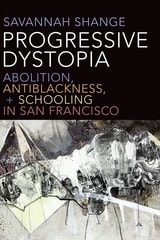
cover of Progressive Dystopia: Abolition, Antiblackness, and Schooling in San Francisco

Progressive Dystopia

Abolition, Antiblackness, and Schooling in San Francisco

Savannah Shange

Duke University Press, 2019

San Francisco is the endgame of gentrification, where racialized displacement means that the Black population of the city hovers at just over 3 percent. The Robeson Justice Academy opened to serve the few remaining low-income neighborhoods of the city, with the mission of offering liberatory, social justice--themed education to youth of color. While it features a progressive curriculum including Frantz Fanon and Audre Lorde, the majority Latinx school also has the district's highest suspension rates for Black students. In Progressive Dystopia Savannah Shange explores the potential for reconciling the school's marginalization of Black students with its sincere pursuit of multiracial uplift and solidarity. Drawing on ethnographic fieldwork and six years of experience teaching at the school, Shange outlines how the school fails its students and the community because it operates within a space predicated on antiblackness. Seeing San Francisco as a social laboratory for how Black communities survive the end of their worlds, Shange argues for abolition over revolution or progressive reform as the needed path toward Black freedom.
[more]