Results by title
153 books match the query 'Egypt' and 11 start with p
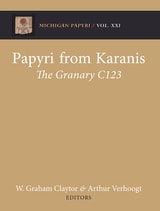
Papyri from Karanis
The Granary C123W. Graham Claytor and Arthur Verhoogt, editors
University of Michigan Press, 2018
The documents are presented with an introduction, transcription of the original Greek or Latin, translation, commentary, and images. A unique community prayer to the emperor and gods (827) is the volume’s most notable contribution. The other papyri are a mix of private and public documents (petitions, declarations, letters, lists, etc.) that date from between the first century BCE and the fourth century CE. The typological and chronological mix of texts shows that they do not form an undisturbed archive but were rather a dump of wastepaper and other household objects.
Michigan’s excavated papyri are here presented for the first time on the basis of their archaeological find spot rather than being organized according to content. The volume’s introduction provides a possible model for analyzing legacy data from the Karanis excavations stored at the University of Michigan. The book will be of interest to papyrologists, ancient historians, and archaeologists of Greco- Roman Egypt.
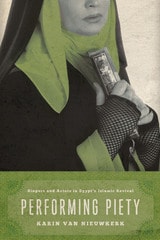
Performing Piety
Singers and Actors in Egypt's Islamic RevivalBy Karin van Nieuwkerk
University of Texas Press, 2013
In the 1980s, Egypt witnessed a growing revival of religiosity among large sectors of the population, including artists. Many pious stars retired from art, “repented” from “sinful” activities, and dedicated themselves to worship, preaching, and charity. Their public conversions were influential in spreading piety to the Egyptian upper class during the 1990s, which in turn enabled the development of pious markets for leisure and art, thus facilitating the return of artists as veiled actresses or religiously committed performers.
Revisiting the story she began in “A Trade like Any Other”: Female Singers and Dancers in Egypt, Karin van Nieuwkerk draws on extensive fieldwork among performers to offer a unique history of the religious revival in Egypt through the lens of the performing arts. She highlights the narratives of celebrities who retired in the 1980s and early 1990s, including their spiritual journeys and their influence on the “pietization” of their fans, among whom are the wealthy, relatively secular, strata of Egyptian society. Van Nieuwkerk then turns to the emergence of a polemic public sphere in which secularists and Islamists debated Islam, art, and gender in the 1990s. Finally, she analyzes the Islamist project of “art with a mission” and the development of Islamic aesthetics, questioning whether the outcome has been to Islamize popular art or rather to popularize Islam. The result is an intimate thirty-year history of two spheres that have tremendous importance for Egypt—art production and piety.
Phoenician Inscriptions
Robert D. Holmstedt
SBL Press, 2026
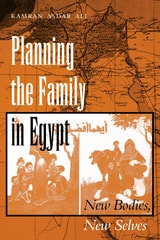
Planning the Family in Egypt
New Bodies, New SelvesBy Kamran Asdar Ali
University of Texas Press, 2002
In this ethnographic study, the author examines the policies and practices of family planning programs in Egypt to see how an elitist, Western-informed state attempts to create obliging citizens. The state sees voluntary compliance with the law for the common good as the cornerstone of modernity. Family planning programs are a training ground for the construction of self-disciplined individuals, and thus a rewarding area of study for the fate of social programs in developing countries.
Through a careful examination of state-endorsed family planning practices in urban and rural contexts, the author shows us the pervasive, high-pressure persuasion of women, who are encouraged to think as individual decision makers of their immediate families and their national interests. But what of the other forces at work in these women’s lives, binding them to their extended families and to their religious identities? And what of the laws that allow for polygamy and discriminate against women in marriage, inheritance, and as part of the workforce?
These forces operate against the received wisdom of the state. Is the Muslim community thought to end at the borders of Egypt? What about local constructions of masculinity when the state appeals to wives to decide for themselves? How does widespread labor migration to foreign countries affect attitudes toward family planning? How is female contraception viewed by the Islamic Brotherhood and other modern Muslim groups?
This book questions much that we have taken for granted and gives us grounds for reexamining our assumptions about family planning and the individual and state in developing countries such as Egypt.
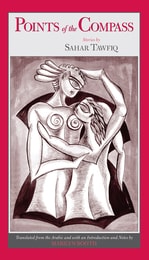
Points of the Compass
StoriesSahar Tawfiq
University of Arkansas Press, 1995
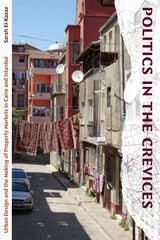
Politics in the Crevices
Urban Design and the Making of Property Markets in Cairo and IstanbulSarah El-Kazaz
Duke University Press, 2023
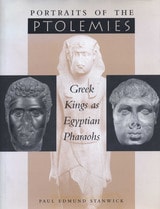
Portraits of the Ptolemies
Greek Kings as Egyptian PharaohsBy Paul Edmund Stanwick
University of Texas Press, 2003
As archaeologists recover the lost treasures of Alexandria, the modern world is marveling at the latter-day glory of ancient Egypt and the Greeks who ruled it from the ascension of Ptolemy I in 306 B.C. to the death of Cleopatra the Great in 30 B.C. The abundance and magnificence of royal sculptures from this period testify to the power of the Ptolemaic dynasty and its influence on Egyptian artistic traditions that even then were more than two thousand years old.
In this book, Paul Edmund Stanwick undertakes the first complete study of Egyptian-style portraits of the Ptolemies. Examining one hundred and fifty sculptures from the vantage points of literary evidence, archaeology, history, religion, and stylistic development, he fully explores how they meld Egyptian and Greek cultural traditions and evoke surrounding social developments and political events. To do this, he develops a "visual vocabulary" for reading royal portraiture and discusses how the portraits helped legitimate the Ptolemies and advance their ideology. Stanwick also sheds new light on the chronology of the sculptures, giving dates to many previously undated ones and showing that others belong outside the Ptolemaic period.
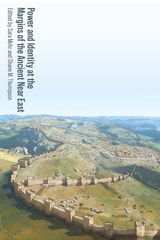
Power and Identity at the Margins of the Ancient Near East
Sara Mohr
University Press of Colorado, 2022
The borderlands of hegemonic entities within the Near East and Egypt pressed against each other, creating cities and societies with influence from several competing polities. The peoples, cities, and cultures that resulted present a unique lens by which to examine how states controlled and influenced the lives, political systems, and social hierarchies of these subjects (and vice versa). This volume addresses the distinct traditions and experiences of areas beyond the core; terminology used when discussing empire, core, periphery, borderlands, and frontiers; conceptualization of space; practices and consequences of warfare, captive-taking, and slavery; identity- and secondary state–formation; economy and society; ritual; diplomacy; and the negotiation of claims to power.
It is imperative that historians and social scientists understand the ways in which these cultures developed, spread, and interacted with others along frontier edges. Using an intersectional approach across disciplines, Power and Identity at the Margins of the Ancient Near East brings together professionals from archaeology, religious studies, history, sociology, and anthropology to make new contributions to the study of the frontier.
Contributors: Alexander Ahrens, Peter Dubovský, Avraham Faust, Daniel E. Fleming, Mahri Leonard-Fleckman, Alvise Matessi, Ellen Morris, Valeria Turriziani, Eric M. Trinka
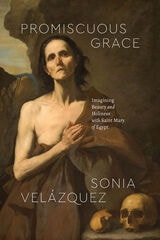
Promiscuous Grace
Imagining Beauty and Holiness with Saint Mary of EgyptSonia Velázquez
University of Chicago Press, 2023
Saint Mary of Egypt has fascinated theologians, poets, and artists since the seventh century. Her story is richly evocative, encompassing sin and sanctity, concupiscence and asceticism, youth and old age. In Promiscuous Grace, Sonia Velázquez thinks with Saint Mary of Egypt about the relationship between beauty and holiness. Drawing on an archive spanning Spanish medieval poetry, Baroque paintings, seventeenth-century hagiography, and Balzac’s Le chef-d’œuvre inconnu, Velázquez argues for the importance of the senses on the surface of religious texts on her way to revealing why the legend of Saint Mary of Egypt still matters today.
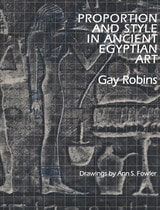
Proportion and Style in Ancient Egyptian Art
By Gay Robins
University of Texas Press, 1993
The painted and relief-cut walls of ancient Egyptian tombs and temples record an amazing continuity of customs and beliefs over nearly 3,000 years. Even the artistic style of the scenes seems unchanging, but this appearance is deceptive. In this work, Gay Robins offers convincing evidence, based on a study of Egyptian usage of grid systems and proportions, that innovation and stylistic variation played a significant role in ancient Egyptian art.
Robins thoroughly explores the squared grid systems used by the ancient artists to proportion standing, sitting, and kneeling human figures. This investigation yields the first chronological account of proportional variations in male and female figures from the Early Dynastic to the Ptolemaic periods. Robins discusses in detail the proportional changes underlying the revolutionary style instituted during the Amarna Period. She also considers how the grid system influenced the composition of scenes as a whole. Numerous line drawings with superimposed grids illustrate the text.
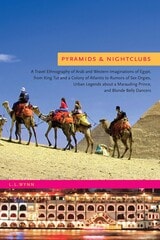
Pyramids and Nightclubs
A Travel Ethnography of Arab and Western Imaginations of Egypt, from King Tut and a Colony of Atlantis to Rumors of Sex Orgies, Urban Legends about a Marauding Prince, and Blonde Belly DancersBy L. L. Wynn
University of Texas Press, 2007
2008 — Leeds Honor Book in Urban Anthropology – Society for Urban, National, and Transnational/Global Anthropology
Living in Egypt at the turn of the millennium, cultural anthropologist L. L. Wynn was struck by the juxtapositions of Western, Gulf Arab, and Egyptian viewpoints she encountered. For some, Egypt is the land of mummies and pharaohs. For others, it is a vortex of decadence, where nightlife promises a chance to salivate over belly dancers and maybe even glimpse a movie star. Offering a new approach to ethnography, Pyramids and Nightclubs examines cross-cultural encounters to bring to light the counterintuitive ways in which Egypt is defined.
Guiding readers on an armchair journey that introduces us to Russian and Australian belly dancers on Nile cruise ships, Egyptian rumors about an Arab prince and his royal entourage, Saudi girls looking for a less restrictive dating scene, and other visitors to this "antique" land, Wynn uses the lens of travel and tourism to depict a fascinating and often surprising version of Egypt, while exploring the concept of stereotype itself. Tracing the history of Western and Arab fascination with Egypt through spurious hunts for lost civilizations and the new economic disparities brought about by the oil industry, Pyramids and Nightclubs ultimately describes the ways in which moments of cultural contact, driven by tourism and labor migration, become eye-opening opportunities for defining self and other.