Results by title
104 books match the query 'Employees' and 3 start with p

Patterns of Time in Hospital Life
A Sociological PerspectiveEviatar Zerubavel
University of Chicago Press, 1979
Patterns of Time will be valued for its several distinctive achievements. Foremost among these is a demonstration of the importance of "temporality" as a topic in its own right. Because measurements of time are a commonplace of social life, sociologists have tended to ignore the significance of temporality as a feature of social organizations. Zerubavel's work is a corrective to this neglect. In addition, the author's imaginative integration of ethnographic description and theoretical analysis bridges the gap between contrasting methods that has characterized much recent sociological and anthropological work. Finally, because of the author's selection of the hospital setting, sociologists of medicine and the professions will find his study useful for its rich and well-observed ethnography, as well as its novel analytical approach.

Play to Submission
Gaming Capitalism in a Tech FirmTongyu Wu
Temple University Press, 2024
Play to Submission shows how Behemoth’s games undermined and manipulated workers. They lost their work-life balance and the constant competition made labor organizing difficult. Nonetheless, many workers embraced management’s games as a chance to show off their “gamer” identities and create a workplace culture with privileged insiders and exiled outsiders, with female and migrant workers usually in the latter group. Moreover, Wu indicates this may be the future of work for high- and low-skilled and, creative workers in an environment where capitalists have heightened demands for technology and creativity.
Drawing from 13 months of ethnographic work, Wu presents a persistent reality in which the company reaps the reward of surplus productivity, leaving employees themselves in a highly competitive and sometimes precarious work position.
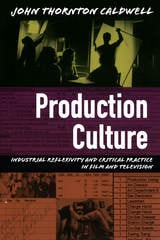
Production Culture
Industrial Reflexivity and Critical Practice in Film and TelevisionJohn Thornton Caldwell
Duke University Press, 2008
Drawing on interviews, observations of sets and workplaces, and analyses of TV shows, industry documents, economic data, and promotional materials, Caldwell shows how film and video workers function in a transformed, post-network industry. He chronicles how workers have responded to changes including media convergence, labor outsourcing, increasingly unstable labor and business relations, new production technologies, corporate conglomeration, and the proliferation of user-generated content. He explores new struggles over “authorship” within collective creative endeavors, the way that branding and syndication have become central business strategies for networks, and the “viral” use of industrial self-reflexivity to motivate consumers through DVD bonus tracks, behind-the-scenes documentaries, and “making-ofs.” A significant, on-the-ground analysis of an industry in flux, Production Culture offers new ways of thinking about media production as a cultural activity.