Results by title
98 books match the query 'Existentialism' and 3 start with p

Phenomenology
Responses and DevelopmentsEdited by Leonard Lawlor
University of Chicago Press, 2010
From Kant to Kierkegaard, from Hegel to Heidegger, continental philosophers have indelibly shaped the trajectory of Western thought since the eighteenth century. Although much has been written about these monumental thinkers, students and scholars lack a definitive guide to the entire scope of the continental tradition. The most comprehensive reference work to date, this eight-volume History of Continental Philosophy will both encapsulate the subject and reorient our understanding of it. Beginning with an overview of Kant’s philosophy and its initial reception, the History traces the evolution of continental philosophy through major figures as well as movements such as existentialism, phenomenology, hermeneutics, and poststructuralism. The final volume outlines the current state of the field, bringing the work of both historical and modern thinkers to bear on such contemporary topics as feminism, globalization, and the environment. Throughout, the volumes examine important philosophical figures and developments in their historical, political, and cultural contexts.
The first reference of its kind, A History of Continental Philosophy has been written and edited by internationally recognized experts with a commitment to explaining complex thinkers, texts, and movements in rigorous yet jargon-free essays suitable for both undergraduates and seasoned specialists. These volumes also elucidate ongoing debates about the nature of continental and analytic philosophy, surveying the distinctive, sometimes overlapping characteristics and approaches of each tradition. Featuring helpful overviews of major topics and plotting road maps to their underlying contexts, A History of Continental Philosophy is destined to be the resource of first and last resort for students and scholars alike.
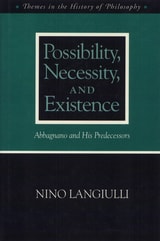
Possibility Necessity and Existence
Abbagnano and His PredecessorsNino Langiulli
Temple University Press, 1992
In this systematic historical analysis, Nino Langiulli focuses on a key philosophical issue, possibility, as it is refracted through the thought of the Italian philosopher Nicola Abbagnano. Langiulli examines Abbagnano's attempt to raise possibility to a level of prime importance and investigates his understanding of existence. In so doing, the author offers a sustained exposition of and argument with the account of possibility in the major thinkers of the Western tradition—Plato, Aristotle, Kant, and Kierkegaard. He also makes pertinent comments on such philosophers as Diodorus Cronus, William of Ockham, Spinoza, Hobbes, and Hegel, as well as such logicians as DeMorgan and Boole.
Nicola Abbagnano, who died in 1990, recently came to the attention of the general public as an influential teacher of author Umberto Eco. Creator of a dictionary of philosophy and author of a multiple-volume history of Western philosophy, Abbagnano was the only philosopher, according to Langiulli, to argue that "to be is to be possible."
Even though the concept of probability and the discipline of statistics are grounded in the concept of possibility, philosophers throughout history have grappled with the problem of defining it. Possibility has been viewed by some as an empty concept, devoid of reality, and by others as reducible to actuality or necessity—concepts which are opposite to it. Langiulli analyzes and debates Abbagnano's treatment of necessity as secondary to possibility, and he addresses the philosopher's conversation with his predecessors as well as his European and American contemporaries.
In the series Themes in the History of Philosophy, edited by Edith Wyschogrod.

Practice, Power, and Forms of Life
Sartre’s Appropriation of Hegel and MarxTerry Pinkard
University of Chicago Press, 2022
Jean-Paul Sartre’s Critique of Dialectical Reason, released to great fanfare in 1960, has since then receded in philosophical visibility. As Sartre’s reputation is now making a comeback, it is time for a reappraisal of his later work. In Practice, Power, and Forms of Life, philosopher Terry Pinkard interprets Sartre’s late work as a fundamental reworking of his earlier ideas, especially in terms of his understanding of the possibility of communal action as genuinely free, which the French philosopher had previously argued was impossible.
Pinkard reveals how Sartre was drawn back to Hegel, a move that was itself incited by Sartre’s newfound interest in Marxism. Pinkard argues that Sartre constructed a novel position on freedom that has yet to be adequately taken up and analyzed within philosophy and political theory. Through Sartre, Pinkard advances an argument that contributes to the history of philosophy as well as key debates on action and freedom.