234 books match the query 'Families' and 6 start with p
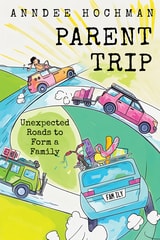
cover of Parent Trip: Unexpected Roads to Form a Family

Parent Trip

Unexpected Roads to Form a Family

Anndee Hochman

Temple University Press, 2026

Families are created through conception, adoption, fostering and family-blending. As a Philadelphia Inquirer columnist for nearly a decade, Anndee Hochman interviewed hundreds of parents—older and younger, single and coupled, straight and queer—about the paths they forged and the obstacles they faced on the road to form a family. Parent Trip is Hochman’s collection of these poignant, wry, and complicated stories.

Hochman recounts the fraught emotions of couples struggling with infertility, the joy of a single gay man becoming a father in his forties, and the anxiety of people waiting for the adoption worker to call with good news. Parent Trip tells of sperm donors and gestational surrogates, midwives and miscarriages; it chronicles how children prompt parents to recalibrate their lives.

In personal essays that weave throughout the profiles, Hochman connects her interviewees’ lives to the love, heartbreak, and uncertainty in her own path to parenthood. Through myriad mundane and extraordinary moments, Parent Trip not only chronicles the magic and labor of childrearing, it also celebrates the infinite ways real families come to be.
[more]
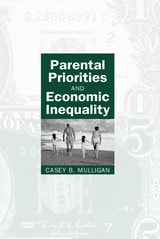
cover of Parental Priorities and Economic Inequality

Parental Priorities and Economic Inequality

Casey B. Mulligan

University of Chicago Press, 1997

What determines whether children grow up to be rich or poor? Arguing that parental actions are some of the most important sources of wealth inequality, Casey B. Mulligan investigates the transmission of economic status from one generation to the next by constructing an economic model of parental preferences.

In Mulligan's model, parents determine the degree of their altruistic concern for their children and spend time with and resources on them accordingly—just as they might make choices about how they spend money. Mulligan tests his model against both old and new evidence on the intergenerational transmission of consumption, earnings, and wealth, including models that emphasize "financial constraints." One major prediction of Mulligan's model confirmed by the evidence is that children of wealthy parents typically spend more than they earn.

Mulligan's innovative approach can also help explain other important behavior, such as charitable giving and "corporate loyalty," and will appeal to a wide range of quantitatively oriented social scientists and sociobiologists.
[more]
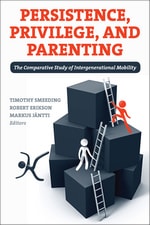
cover of Persistence, Privilege, and Parenting: The Comparative Study of Intergenerational Mobility

Persistence, Privilege, and Parenting

The Comparative Study of Intergenerational Mobility

Timothy Smeeding

Russell Sage Foundation, 2012
Americans like to believe that theirs is the land of opportunity, but the hard facts are that children born into poor families in the United States tend to stay poor and children born into wealthy families generally stay rich. Other countries have shown more success at lessening the effects of inequality on mobility—possibly by making public investments in education, health, and family well-being that offset the private advantages of the wealthy. What can the United States learn from these other countries about how to provide children from disadvantaged backgrounds an equal chance in life? Making comparisons across ten countries, Persistence, Privilege, and Parenting brings together a team of eminent international scholars to examine why advantage and disadvantage persist across generations. The book sheds light on how the social and economic mobility of children differs within and across countries and the impact private family resources, public policies, and social institutions may have on mobility. In what ways do parents pass advantage or disadvantage on to their children? Persistence, Privilege, and Parenting is an expansive exploration of the relationship between parental socioeconomic status and background and the outcomes of their grown children. The authors also address the impact of education and parental financial assistance on mobility. Contributors Miles Corak, Lori Curtis, and Shelley Phipps look at how family economic background influences the outcomes of adult children in the United States and Canada. They find that, despite many cultural similarities between the two countries, Canada has three times the rate of intergenerational mobility as the United States—possibly because Canada makes more public investments in its labor market, health care, and family programs. Jo Blanden and her colleagues explore a number of factors affecting how advantage is transmitted between parents and children in the United States and the United Kingdom, including education, occupation, marriage, and health. They find that despite the two nations having similar rates of intergenerational mobility and social inequality, lack of educational opportunity plays a greater role in limiting U.S. mobility, while the United Kingdom’s deeply rooted social class structure makes it difficult for the disadvantaged to transcend their circumstances. Jane Waldfogel and Elizabeth Washbrook examine cognitive and behavioral school readiness across income groups and find that pre-school age children in both the United States and Britain show substantial income-related gaps in school readiness—driven in part by poorly developed parenting skills among overburdened, low-income families. The authors suggest that the most encouraging policies focus on both school and home interventions, including such measures as increases in federal funding for Head Start programs in the United States, raising pre-school staff qualifications in Britain, and parenting programs in both countries. A significant step forward in the study of intergenerational mobility, Persistence, Privilege, and Parenting demonstrates that the transmission of advantage or disadvantage from one generation to the next varies widely from country to country. This striking finding is a particular cause for concern in the United States, where the persistence of disadvantage remains stubbornly high. But, it provides a reason to hope that by better understanding mobility across the generations abroad, we can find ways to do better at home.
[more]
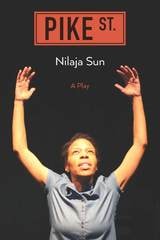
cover of Pike St.: A Play

Pike St.

A Play

Nilaja Sun

Northwestern University Press, 2017
Pike St., Nilaja Sun's highly praised sixth play, vividly brings to life a family on New York's Lower East Side. As a storm approaches, Evelyn is trying to assure the safety of her teenage daughter, Candi, whose unidentified illness has immobilized her. Caring for Candi has forced Evelyn to quit her job as a subway conductor; still, she helps support both her philandering father and her brother, who has returned to New York from Afghanistan and suffers from PTSD. Just behind the grace and humor with which Evelyn manages to hold together her own life and those of the people who depend on her is the constant threat of both natural and man-made disasters.
[more]
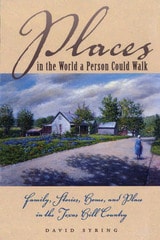
cover of Places in the World a Person Could Walk: Family, Stories, Home, and Place in the Texas Hill Country

Places in the World a Person Could Walk

Family, Stories, Home, and Place in the Texas Hill Country

By David Syring

University of Texas Press, 2000

Spring-fed creeks. Old stone houses. Cedar brakes and bleached limestone. The Hill Country holds powerful sway over the imagination of Texans. So many of us dream of having our own little place in the limestone hills. The Hill Country feels just like home, even if you've never lived there.

This beautifully written book explores what the Hill Country has meant as a homeplace to the author, his family, and longtime residents of the area, as well as to newcomers. David Syring listens to the stories that his aunts, uncles, and cousins tell about life in the Hill Country and grapples with their meaning for his own search for a place to belong. He also collects short stories focused around Honey Creek Church to consider how places become containers for memory. And he draws upon several years of living in Fredericksburg to talk about the problems and opportunities created by heritage tourism and the development of the town as a "home" for German Americans. These interconnected stories illuminate what it means to belong to a place and why the Texas Hill Country has become the spiritual, if not actual, home of many people.
[more]
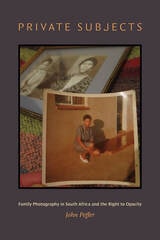
cover of Private Subjects: Family Photography in South Africa and the Right to Opacity

Private Subjects

Family Photography in South Africa and the Right to Opacity

John Peffer

Duke University Press, 2026

In Private Subjects, John Peffer presents perspectives about everyday uses of photography in predominantly Black South African communities during apartheid to give insight into how these images are seen through the eyes of those who own them today. In South Africa, portrait photography was used to create positive self-images during times of hardship and subjection. Peffer shows how owners limited the distribution of their photographs to close networks of family and friends as a means of establishing control over their own image. He develops an intersubjective method for writing about vernacular photographic experience that keeps the people that appear in those photographs at the center of the story, creating a space to converse about race and history in their own ways rather than be explained from outside the frame. He then considers cultural and legal histories of the ownership of the self-image, theorizes an ethics for looking at others’ private family photographs, and argues for a model of writing and scholarship that protects people’s desires for opacity.
[more]