Results by title
81 books match the query 'Farm life' and 3 start with p
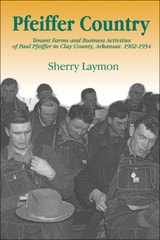
Pfeiffer Country
The Tenant Farms and Business Activities of Paul Pfeiffer in Clay County, Arkansas, 1902-1954Sherry Laymon
Butler Center for Arkansas Studies, 2009
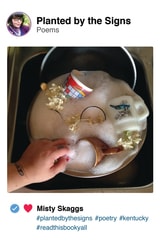
Planted by the Signs
PoemsMisty Skaggs
Ohio University Press, 2019
Planted by the Signs brings us the contemporary Appalachian poetry—cultivated in the dirt of Elliott County, Kentucky—of Misty Skaggs. With an eye for details that exquisitely balance personal and social observation to communicate volumes, she tells the stories of generations of women who have learned to navigate a harsh world with a little help from the Farmers’ Almanac and the stars. The collection is separated into three sections that reference the best times to grow and harvest. Knowing and following these guidelines—planting by the signs—could mean the difference between prosperity and tragedy in the lives of Appalachian families.
Personal, political, and passionate, Planted by the Signs also explores what it means for Skaggs to care for her great-grandmother at the end of her life. Color photos by the poet further showcase her sidelong and fierce outlook. The images and poems together deliver an intimate look into the day-to-day reality of a backwoods woman embracing barefooted radicalism in the only place she could call home.
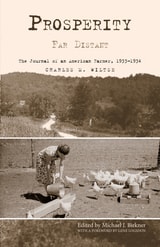
Prosperity Far Distant
The Journal of an American Farmer, 1933–1934Charles M. Wiltse
Ohio University Press, 2012
Fresh from receiving a doctorate from Cornell University in 1933, but unable to find work, Charles M. Wiltse joined his parents on the small farm they had recently purchased in southern Ohio. There, the Wiltses scratched out a living selling eggs, corn, and other farm goods at prices that were barely enough to keep the farm intact.
In wry and often affecting prose, Wiltse recorded a year in the life of this quintessentially American place during the Great Depression. He describes the family’s daily routine, occasional light moments, and their ongoing frustrations, small and large—from a neighbor’s hog that continually broke into the cornfields to the ongoing struggle with their finances. Franklin Roosevelt’s New Deal had little to offer small farmers, and despite repeated requests, the family could not secure loans from local banks to help them through the hard economic times. Wiltse spoke the bitter truth when he told his diary, “We are not a lucky family.” In this he represented millions of others caught in the maw of a national disaster.
The diary is introduced and edited by Michael J. Birkner, Wiltse’s former colleague at the Papers of Daniel Webster Project at Dartmouth College, and coeditor, with Wiltse, of the final volume of Webster’s correspondence.