279 books match the query 'Film & Video' and 7 start with p

cover of Passion of the Reel: Cinematic versus Modernist Political Fictions in Cameroon

Passion of the Reel

Cinematic versus Modernist Political Fictions in Cameroon

Jean-Olivier Tchouaffe

Intellect Books, 2015

Highlighting the challenges faced by a nascent national cinema with limited resources, Passion of the Reel provides an in-depth analysis of the output of the Cameroonian film industry. Jean-Olivier Tchouaffe shows that, far from an empty receptacle for colonial legacies, Cameroon—and Africa—must move beyond their colonial legacies to focus on indigenous productions of meaning informed by traditional wisdom and ordinary Cameroonian life experience. Tchouaffe’s analysis sets the stage for a film-driven exploration of postcolonialism, social construction, and modernization.
[more]
cover of Peter Weir: A Creative Journey from Australia to Hollywood

Peter Weir

A Creative Journey from Australia to Hollywood

Serena Formica

Intellect Books, 2012

Peter Weir has been directing Hollywood films since his successful US debut, Witness, in 1985. But does this make him a Hollywood director? Or should he still be considered an Australian filmmaker as many scholars argue?  
 
For the first time, Weir’s entire three-decade creative journey from Australia to Hollywood is considered in light of the recent theories on transnational cinema and through a close examination of four key films: Picnic at Hanging Rock, The Year of Living Dangerously, Witness, and The Truman Show The films’ analyses integrate original interviews with Weir and his closest collaborators, including Russell Boyd. The book concludes that Weir is both an Australian and a Hollywood filmmaker—and would be better seen as a transnational filmmaker whose success in the United States reflects the fact that he was already a “Hollywood” director by the time he relocated.
[more]
cover of Photocinema: The Creative Edges of Photography and Film

Photocinema

The Creative Edges of Photography and Film

Edited by Neil Campbell and Alfredo Cramerotti

Intellect Books, 2013

Taking as its starting point the notion of photocinema—or the interplay of the still and moving image—the photographs, interviews, and critical essays in this volume explore the ways in which the two media converge and diverge, expanding the boundaries of each in interesting and unexpected ways. The book’s innovative approach to film and photography produces what might be termed a hybrid “third space,” where the whole becomes much more than the sum of its individual parts, encouraging viewers to expand their perceptions to begin to understand the bigger picture.
 
The latest edition in Intellect’s Critical Photography series, Photocinema represents a nuanced theoretical and practical exploration of the experimental cinematic techniques exemplified by artists like Wim Wenders and Hollis Frampton. In addition to new critical essays by Victor Burgin and David Campany, the book includes interviews with Martin Parr, Hannah Starkey, and Aaron Schumann, and a portfolio of photographs from various new and established artists.
[more]
cover of Polanski and Perception: The Psychology of Seeing and the Cinema of Roman Polanski

Polanski and Perception

The Psychology of Seeing and the Cinema of Roman Polanski

Davide Caputo

Intellect Books, 2012

A new approach to a director whose contribution to cinema is often overshadowed his personal life, Polanski and Perception focuses on Roman Polanski’s interest in the nature of perception and how this is manifested in his films. The incorporation of cognitive research into film theory is becoming increasingly widespread, with novel cinematic technologies and recent developments in digital projection making a strong grasp of perceptual psychology critical to fostering cognitive engagement.
Informed by the work of neuropsychologist R. L. Gregory, this volume focuses primarily on two sets of films: the Apartment trilogyof Repulsion, Rosemary’s Baby, and The Tenant; and the Investigation trilogy of Chinatown, Frantic, and The Ninth Gate. Also included are case studies of Knife in the Water, Death and the Maiden, and The Ghost.Polanski and Perception presents a highly original and engaging new look at the work of this influential filmmaker.
[more]
cover of Preston Sturges: The Last Years of Hollywood's First Writer-Director

Preston Sturges

The Last Years of Hollywood's First Writer-Director

Nick Smedley and Tom Sturges

Intellect Books, 2019
Few directors of the 1930s and ‘40s were as distinctive and popular as Preston Sturges, whose whipsmart comedies have entertained audiences for decades. Beginning with a foreword by Peter Bogdanovich, this book offers a new critical appreciation of Sturges’ whole oeuvre, incorporating a detailed study of the last ten years of his life from new primary sources. Preston Sturges details the many unfinished projects of Sturges’ last decade, including films, plays, TV series and his autobiography. Drawing on diaries, sketchbooks, correspondence, unpublished screenplays and more, Nick Smedley and Tom Sturges present the writer-director’s final years in more detail than we’ve ever seen, showing a master still at work—even if very little of that work ultimately made it to the screen or stage.
 
 
[more]
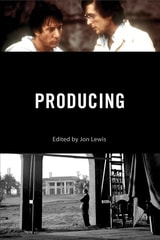
cover of Producing

Producing

Lewis, Jon

Rutgers University Press, 2015

Of all the job titles listed in the opening and closing screen credits, producer is certainly the most amorphous. There are businessmen (and women)-producers, writer-director- and movie-star-producers; producers who work for the studio; executive producers whose reputation and industry clout alone gets a project financed (though their day-to-day participation in the project may be negligible). The job title, regardless of the actual work involved, warrants a great deal of prestige in the film business; it is the credited producers, after all, who collect the Oscar for Best Picture. But what producers do and what they don’t or won’t do varies from project to project.
 
Producing is the first book to provide a comprehensive overview of the roles that producers have played in Hollywood, from the dawn of the twentieth century to the present day. It introduces readers to the colorful figures who helped to define and reimagine the producer’s role, including inventors like Thomas Edison, moguls like Darryl F. Zanuck, entrepreneurs like Walt Disney, and mavericks like Roger Corman. Readers also get an inside look at the less glamorous jobs producers have often performed: shepherding projects through many years of development, securing financial backers, and supervising movie shoots.  
 
The latest book in the acclaimed Behind the Silver Screen series, Producing includes essays written by seven film scholars, each an expert in a different period of cinema history. Together, they give readers a full picture of how the art and business of producing films has changed over time—and how the producer’s myriad job duties continue to evolve in the digital era. 
 
[more]
cover of Producing Children’s Television in the On-demand Age

Producing Children’s Television in the On-demand Age

Anna Potter

Intellect Books, 2020

Much like the rest of the traditional television industry, children’s programming is undergoing a revolution. In this book, Anna Potter provides a detailed insider account of the creative circumstances that are transforming contemporary children’s screen content and reshaping the surrounding digital media landscape. Drawing on extended interviews with leading screen industry figures, Potter explores television’s distribution revolution and reveals how creative practices, funding models, and production norms in children’s TV have adapted to fit the changing times. 

Combining comprehensive case studies, scholarly research, and industry perspectives, Potter presents a rigorous study of success stories in the children’s screen production sector. The book explores effects on the industry from disruptions by streaming giants like Netflix, Amazon, and YouTube, and describes the challenges faced by public service broadcasters like the BBC in their efforts to stay relevant to adolescent culture in the UK. Interdisciplinary and informative, this volume is compulsory reading for anyone struggling to make sense of television’s distribution revolution and what it means for children and young people.

[more]