Results by title
53 books match the query 'Film adaptations' and 3 start with p

Panthers, Hulks and Ironhearts
Marvel, Diversity and the 21st Century SuperheroJeffrey A. Brown
Rutgers University Press, 2021
Panthers, Hulks, and Ironhearts offers the first comprehensive study of how Marvel has reimagined what a superhero might look like in the twenty-first century. It examines how they have revitalized older characters like Black Panther and Luke Cage, while creating new ones like Latina superhero Miss America. Furthermore, it considers the mixed fan responses to Marvel’s recasting of certain “legacy heroes,” including a Pakistani-American Ms. Marvel, a Korean-American Hulk, and a whole rainbow of multiverse Spidermen.
If the superhero comic is a quintessentially American creation, then how might the increasing diversification of Marvel’s superhero lineup reveal a fundamental shift in our understanding of American identity? This timely study answers those questions and considers what Marvel’s comics, TV series, and films might teach us about stereotyping, Orientalism, repatriation, whitewashing, and identification.
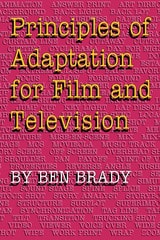
Principles of Adaptation for Film and Television
By Ben Brady
University of Texas Press, 1994
From All Quiet on the Western Front, the Academy Award-winning "Best Picture" of 1929-1930, to Dances with Wolves, the 1991 winner, many of Hollywood's most popular and enduring movies have been screen adaptations of written work, including novels, stories, and plays. In this practical, hands-on guide, veteran TV and screenwriter Ben Brady unlocks the secrets of the adaptation process, showing aspiring writers and writing teachers how to turn any kind of narrative material into workable, salable screenplays for film and television.
Step by step, Brady guides novice screenwriters to the completion of a professional screenplay. He begins with an incisive discussion of how to evaluate a written work's potential as a screenplay. Then he discusses each step of the writing process, showing how to identify the plot and premise of the play, develop character, treatment, and dialogue, and handle camera language and format. Brady illustrates each of these points by developing and writing a complete screenplay of the novel Claire Serrat within the text.
With these tools, beginning screenwriters can draw on the rich resources of words in print to create exciting screenplays for film and television. Written in vivid, entertaining prose, the book will be equally useful in the classroom or at the kitchen table, wherever enterprising writers ply their craft.
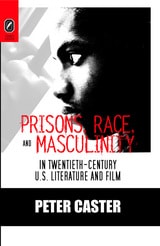
Prisons, Race, and Masculinity in Twentieth-Century U.S. Literature and Film
Peter Caster
The Ohio State University Press, 2008
In Prisons, Race, and Masculinity, Peter Caster demonstrates the centrality of imprisonment in American culture, illustrating how incarceration, an institution inseparable from race, has shaped and continues to shape U.S. history and literature in the starkest expression of what W. E. B. DuBois famously termed “the problem of the color line.”
A prison official in 1888 declared that it was the freeing of slaves that actually created prisons: “we had to establish means for their control. Hence came the penitentiary.” Such rampant racism co ntributed to the criminalization of black masculinity in the cultural imagination, shaping not only the identity of prisoners (collectively and individually) but also America’s national character. Caster analyzes the representations of imprisonment in books, films, and performances, alternating between history and fiction to describe how racism influenced imprisonment during the decline of lynching in the 1930s, the political radicalism in the late 1960s, and the unprecedented prison expansion through the 1980s and 1990s. Offering new interpretations of familiar works by William Faulkner, Eldridge Cleaver, and Norman Mailer, Caster also engages recent films such as American History X, The Hurricane, and The Farm: Life Inside Angola Prison alongside prison history chronicled in the transcripts of the American Correctional Association. This book offers a compelling account of how imprisonment has functioned as racial containment, a matter critical to U.S. history and literary study.