Results by title
208 books match the query 'Finance' and 11 start with p
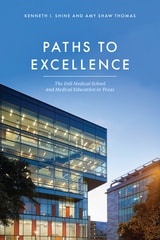
Paths to Excellence
The Dell Medical School and Medical Education in TexasKenneth I. Shine and Amy Shaw Thomas
University of Texas Press, 2021
This book tells in detail and for the first time the story of how this change came about: how dedicated administrators, alumni, business leaders, community organizers, doctors, legislators, professors, and researchers joined forces, overcame considerable resistance, and raised the funds to build a new medical school without any direct state monies. Funding was secured in large part by the unique willingness of the local community to tax itself to pay for the financial operations of the school. Kenneth I. Shine and Amy Shaw Thomas, who witnessed this process from their unique vantages as past and present vice chancellors for health affairs in the University of Texas System, offer a working model that will enable other leaders to more effectively seek solutions, avoid pitfalls, and build for the future.
Paying the Piper
Productivity, Incentives, and Financing in U.S. Higher EducationMichael S. McPherson, Morton Owen Schapiro, and Gordon C. Winston, Editors
University of Michigan Press, 1994
Paying the Price
College Costs, Financial Aid, and the Betrayal of the American DreamSara Goldrick-Rab
University of Chicago Press, 2016
Not necessarily, says Sara Goldrick-Rab, and with Paying the Price, she shows in damning detail exactly why. Quite simply, college is far too expensive for many people today, and the confusing mix of federal, state, institutional, and private financial aid leaves countless students without the resources they need to pay for it.
Drawing on an unprecedented study of 3,000 young adults who entered public colleges and universities in Wisconsin in 2008 with the support of federal aid and Pell Grants, Goldrick-Rab reveals the devastating effect of these shortfalls. Half the students in the study left college without a degree, while less than 20 percent finished within five years. The cause of their problems, time and again, was lack of money. Unable to afford tuition, books, and living expenses, they worked too many hours at outside jobs, dropped classes, took time off to save money, and even went without adequate food or housing. In many heartbreaking cases, they simply left school—not with a degree, but with crippling debt. Goldrick-Rab combines that shocking data with devastating stories of six individual students, whose struggles make clear the horrifying human and financial costs of our convoluted financial aid policies.
America can fix this problem. In the final section of the book, Goldrick-Rab offers a range of possible solutions, from technical improvements to the financial aid application process, to a bold, public sector–focused “first degree free” program. What’s not an option, this powerful book shows, is doing nothing, and continuing to crush the college dreams of a generation of young people.

Pennies for Heaven
The History of American Synagogues and MoneyDaniel Judson
Brandeis University Press, 2018
Pension Puzzles
Social Security and the Great DebateMelissa Hardy
Russell Sage Foundation, 2007
Political Standards
Corporate Interest, Ideology, and Leadership in the Shaping of Accounting Rules for the Market EconomyKarthik Ramanna
University of Chicago Press, 2015
With Political Standards, Karthik Ramanna develops the notion of “thin political markets” to describe a key problem facing technical rule-making in corporate accounting and beyond. When standard-setting boards attempt to regulate the accounting practices of corporations, they must draw on a small pool of qualified experts—but those experts almost always have strong commercial interests in the outcome. Meanwhile, standard setting rarely enjoys much attention from the general public. This absence of accountability, Ramanna argues, allows corporate managers to game the system. In the profit-maximization framework of modern capitalism, the only practicable solution is to reframe managerial norms when participating in thin political markets. Political Standards will be an essential resource for understanding how the rules of the game are set, whom they inevitably favor, and how the process can be changed for a better capitalism.
Politicians, Judges, and City Schools
Reforming School Finance in New YorkJoel S. Berke
Russell Sage Foundation, 1984
Priceless Markets
The Political Economy of Credit in Paris, 1660-1870Philip T. Hoffman, Gilles Postel-Vinay, and Jean-Laurent Rosenthal
University of Chicago Press, 2000
The implications for historians and economists are substantial. The role of notaries operating in Paris that Priceless Markets uncovers has never before been recognized. In the wake of this pathbreaking new study, historians will also have to rethink the origins of the French Revolution. As the authors show, the crisis of 1787-88 did not simply ignite revolt; it was intimately bound up in an economic struggle that reached far back into the eighteenth century, and continued well into the 1800s.
Private Equity at Work
When Wall Street Manages Main StreetEileen Appelbaum
Russell Sage Foundation, 2014
Private Metropolis
The Eclipse of Local Democratic GovernanceDennis R. Judd
University of Minnesota Press, 2021
Examines the complex ecology of quasi-public and privatized institutions that mobilize and administer many of the political, administrative, and fiscal resources of today’s metropolitan regions
In recent decades metropolitan regions in the United States have witnessed the rise of multitudes of “shadow governments” that often supersede or replace functions traditionally associated with municipalities and other local governments inherited from the urban past. Shadow governments take many forms, ranging from billion-dollar special authorities that span entire urban regions, to public–private partnerships and special districts created to accomplish particular tasks, to privatized gated communities, to neighborhood organizations empowered to receive private and public funds. They finance and administer public services ranging from the prosaic (garbage collection and water utilities) to the transformative (economic development and infrastructure). Private Metropolis demonstrates that this complex ecosystem of local governance has compromised and even eclipsed democratic processes by moving important policy decisions out of public sight.
The quasi-public institutions of urban governance generally escape the budgetary and statutory restraints imposed on traditional local governments and protect policy decisions from the limitations and vagaries of electoral politics. Moving major policy decisions into a privatized and corporatized realm facilitates efficiency and speed, but at the cost of democratic oversight. Increasingly, the urban electorate is left debating symbolic issues only tangentially connected to the actual distribution of the resources that affect people’s lives.
The essays in Private Metropolis grapple with the difficult and timely questions that arise from this new ecology of governance: What are the consequences of the proliferation of special authorities, privatized governments, and public–private arrangements? Is the trade-off between democratic accountability and efficiency worth it? Has the public sector, with its messiness and inefficiencies—but also its checks and balances—ceded too much power to these new institutions? By examining such questions, this book provokes a long-overdue debate about the future of urban governance.
Contributors: Douglas Cantor, California State U, Long Beach; Ellen Dannin, Pennsylvania State U; Jameson W. Doig, Princeton U; Mary Donoghue; Peter Eisinger, New School; Steven P. Erie, U of California, San Diego; Rebecca Hendrick, U of Illinois at Chicago; Sara Hinkley, U of California, Berkeley; Amanda Kass, U of Illinois at Chicago; Scott A. MacKenzie, U of California, Davis; David C. Perry, U of Illinois at Chicago; James M. Smith, U of Indiana South Bend; Shu Wang, Michigan State U; Rachel Weber, U of Illinois at Chicago.
Public Dollars, Private Stadiums
The Battle over Building Sports StadiumsDelaney, Kevin J.
Rutgers University Press, 2003
The authors provide an eye-opening account of recent battles over publicly financed stadiums in some of America’s largest cities. Their interviews with the key decision makers present a behind-the-scenes look at how and why powerful individuals and organizations foist these sports palaces on increasingly unreceptive communities.
Delaney and Eckstein show that in the face of studies demonstrating that new sports facilities don’t live up to their promise of big money, proponents are using a new tactic to win public subsidies¾intangible “social” rewards, such as prestige and community cohesion. The authors find these to be empty promises as well, demonstrating that new stadiums may exacerbate, rather than erase, social problems in cities.