67 books match the query 'Fish, Stanley' and 4 start with p
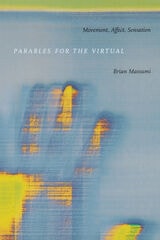
cover of Parables for the Virtual: Movement, Affect, Sensation

Parables for the Virtual

Movement, Affect, Sensation

Brian Massumi

Duke University Press, 2002

Although the body has been the focus of much contemporary cultural theory, the models that are typically applied neglect the most salient characteristics of embodied existence—movement, affect, and sensation—in favor of concepts derived from linguistic theory. In Parables for the Virtual Brian Massumi views the body and media such as television, film, and the Internet, as cultural formations that operate on multiple registers of sensation beyond the reach of the reading techniques founded on the standard rhetorical and semiotic models.

Renewing and assessing William James's radical empiricism and Henri Bergson's philosophy of perception through the filter of the post-war French philosophy of Deleuze, Guattari, and Foucault, Massumi links a cultural logic of variation to questions of movement, affect, and sensation. If such concepts are as fundamental as signs and significations, he argues, then a new set of theoretical issues appear, and with them potential new paths for the wedding of scientific and cultural theory. Replacing the traditional opposition of literal and figural with new distinctions between stasis and motion and between actual and virtual, Parables for the Virtual tackles related theoretical issues by applying them to cultural mediums as diverse as architecture, body art, the digital art of Stelarc, and Ronald Reagan's acting career. The result is an intriguing combination of cultural theory, science, and philosophy that asserts itself in a crystalline and multi-faceted argument.
[more]
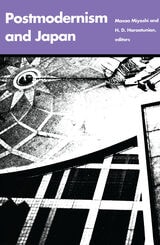
cover of Postmodernism and Japan

Postmodernism and Japan

Masao Miyoshi and H. D. Harootunian, eds.

Duke University Press, 1989
Postmodernism and Japan is a coherent yet diverse study of the dynamics of postmodernism, as described by Lyotard, Baudrillard, Deleuze, and Guatarri, from the often startling perspective of a society bent on transforming itself into the image of Western “enlightenment” wealth and power. This work provides a unique view of a society in transition and confronting, like its models in the West, the problems induced by the introduction of new forms of knowledge, modes of production, and social relationships.
[more]
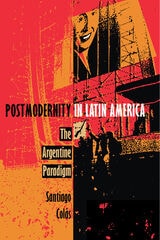
cover of Postmodernity in Latin America: The Argentine Paradigm

Postmodernity in Latin America

The Argentine Paradigm

Santiago Colás

Duke University Press, 1994

Postmodernity in Latin America contests the prevailing understanding of the relationship between postmodernity and Latin America by focusing on recent developments in Latin American, and particularly Argentine, political and literary culture. While European and North American theorists of postmodernity generally view Latin American fiction without regard for its political and cultural context, Latin Americanists often either uncritically apply the concept of postmodernity to Latin American literature and society or reject it in an equally uncritical fashion. The result has been both a limited understanding of the literature and an impoverished notion of postmodernity. Santiago Colás challenges both of these approaches and corrects their consequent distortions by locating Argentine postmodernity in the cultural dynamics of resistance as it operates within and against local expressions of late capitalism.
Focusing on literature, Colás uses Julio Cortázar’s Hopscotch to characterize modernity for Latin America as a whole, Manuel Puig’s Kiss of the Spider Woman to identify the transition to a more localized postmodernity, and Ricardo Piglia’s Artificial Respiration to exemplify the cultural coordinates of postmodernity in Argentina. Informed by the cycle of political transformation beginning with the Cuban Revolution, including its effects on Peronism, to the period of dictatorship, and finally to redemocratization, Colás’s examination of this literary progression leads to the reconstruction of three significant moments in the history of Argentina. His analysis provokes both a revised understanding of that history and the recognition that multiple meanings of postmodernity must be understood in ways that incorporate the complexity of regional differences.
Offering a new voice in the debate over postmodernity, one that challenges that debate’s leading thinkers, Postmodernity in Latin America will be of particular interest to students of Latin American literature and to scholars in all disciplines concerned with theories of the postmodern.
[more]
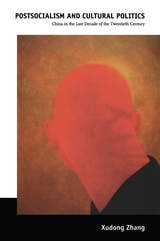
cover of Postsocialism and Cultural Politics: China in the Last Decade of the Twentieth Century

Postsocialism and Cultural Politics

China in the Last Decade of the Twentieth Century

Xudong Zhang

Duke University Press, 2008

In Postsocialism and Cultural Politics, Xudong Zhang offers a critical analysis of China’s “long 1990s,” the tumultuous years between the 1989 Tiananmen Square crackdown and China’s entry into the World Trade Organization in 2001. The 1990s were marked by Deng Xiaoping’s market-oriented reforms, the Taiwan missile crisis, the Asian financial crisis, and the end of British colonial rule of Hong Kong. Considering developments including the state’s cultivation of a market economy, the aggressive neoliberalism that accompanied that effort, the rise of a middle class and a consumer culture, and China’s entry into the world economy, Zhang argues that Chinese socialism is not over. Rather it survives as postsocialism, which is articulated through the discourses of postmodernism and nationalism and through the co-existence of multiple modes of production and socio-cultural norms. Highlighting China’s uniqueness, as well as the implications of its recent experiences for the wider world, Zhang suggests that Chinese postsocialism illuminates previously obscure aspects of the global shift from modernity to postmodernity.

Zhang examines the reactions of intellectuals, authors, and filmmakers to the cultural and political conflicts in China during the 1990s. He offers a nuanced assessment of the changing divisions and allegiances within the intellectual landscape, and he analyzes the postsocialist realism of the era through readings of Mo Yan’s fiction and the films of Zhang Yimou. With Postsocialism and Cultural Politics, Zhang applies the same keen insight to China’s long 1990s that he brought to bear on the 1980s in Chinese Modernism in the Era of Reforms.

[more]