Results by title
70 books match the query 'Folk music' and 6 start with p
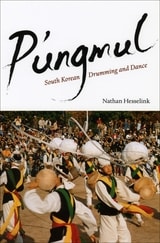
P'ungmul
South Korean Drumming and DanceNathan Hesselink
University of Chicago Press, 2006
The first book to introduce Korean drumming and dance to the English-speaking world, Nathan Hesselink’s P’ungmul offers detailed descriptions of its instrumentation, dance formations, costuming, actors, teaching lineages, and the complexities of training. Hesselink also evaluates how this tradition has taken on new roles and meanings in the twentieth and early-twenty-first centuries, investigating the interrelated yet contested spheres of history, memory, government policy, grassroots politics, opportunities for musical transmission, and performance practices and aesthetics.
P’ungmul offers those interested in ethnomusicology, world music, anthropology, sociology, and Asian studies a special glimpse into the inner workings of a historically rich, artistically complex, and aesthetically and aurally beautiful Korean musical and dance tradition.
Palestinian Arab Music
A Maqam Tradition in PracticeDalia Cohen and Ruth Katz
University of Chicago Press, 2005
Working initially with their own 1957 invention, the Cohen-Katz Melograph, and later with computers, Dalia Cohen and Ruth Katz recorded and digitized several hundred Palestinian music performances. The authors analyzed the musical tradition in light of its main variables. These include musical parameters, modal frameworks, the form and structure of the music, its poetic texts, and aspects of the social functions of the tradition. As a result of their study, the vexed aspect of intonation in practice is revealed to exist in a special relationship with the scale systems or maqamat, which are in turn of great importance to organizing the music and determining its modal systems.
Past Titan Rock
Journeys into an Appalachian ValleyEllesa Clay High
West Virginia University Press, 2021
Past Titan Rock, a winner of the Appalachian Award for Literature, is available in a new edition as part of the series Sounding Appalachia, with an introduction by series editor Travis D. Stimeling.
In 1977 Ellesa Clay High thought she would spend an afternoon interviewing Lily May Ledford, best known as the lead performer of an all-female string band that began playing on the radio in the 1930s. That meeting began an unexpected journey leading into the mountains of eastern Kentucky and a hundred years into the past. Set in Red River Gorge, an area of steep ridges and box canyons, Past Titan Rock is a multigenre, multivocal re-creation of life in that region. With Ledford’s guidance, High traveled and lived in the gorge, visiting with people who could remember life there before the Works Progress Administration built roads across the ridges and into the valleys during the New Deal. What emerges through a unique combination of personal essay, oral history, and short fiction is a portrait of a mountain culture rich in custom, oral tradition, and song. Past Titan Rock demonstrates the depth of community ties in the Red River Gorge and raises important questions about how to resist destructive forces today.

Peggy Seeger
A Life of Music, Love, and PoliticsJean R. Freedman
University of Illinois Press, 2020
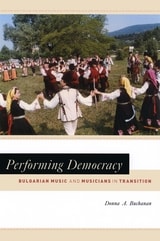
Performing Democracy
Bulgarian Music and Musicians in TransitionDonna A. Buchanan
University of Chicago Press, 2005
Based on fieldwork conducted between 1988 and 1996 with professional Bulgarian folk musicians, Donna A. Buchanan's PerformingDemocracy argues that the performances of traditional music groups may be interpreted not only as harbingers but as agents of Bulgaria's political transition. Many of the musicians in socialist Bulgaria's state folk ensembles served as official cultural emissaries for several decades. Through their reminiscences and repertoires, Buchanan reveals the evolution of Bulgarian musical life as it responded to and informed the political process. By modifying their art to accommodate changing political ideologies, these musicians literally played out regime change on the world's stages, performing their country's democratization musically at home and abroad.
Performing Democracy and its accompanying CD-ROM, featuring traditional Bulgarian music, lyrics, notation, and photos, will fascinate any reader interested in the many ways art echoes and influences politics.
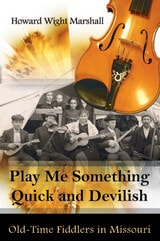
Play Me Something Quick and Devilish
Old-Time Fiddlers in MissouriHoward Wight Marshall
University of Missouri Press, 2012
Beginning with the French villages on the Mississippi River, Marshall leads us chronologically through the settlement of the state and how these communities established our cultural heritage. Other core populations include the “Old Stock Americans” (primarily Scotch-Irish from Kentucky, Tennessee, North Carolina, and Virginia), African Americans, German-speaking immigrants, people with American Indian ancestry (focusing on Cherokee families dating from the Trail of Tears in the 1830s), and Irish railroad workers in the post–Civil War period. These are the primary communities whose fiddle and dance traditions came together on the Missouri frontier to cultivate the bounty of old-time fiddling enjoyed today.
Marshall also examines regional styles in Missouri fiddling and comments on the future of this time-honored, and changing, tradition. Documentary in nature, this social history draws on various academic disciplines and oral histories recorded in Marshall’s forty-some years of research and field experience. Historians, music aficionados, and lay people interested in Missouri folk heritage—as well as fiddlers, of course—will find Play Me Something Quick and Devilish an entertaining and enlightening read.
With 39 tunes, the enclosed Voyager Records companion CD includes a historic sampler of Missouri fiddlers and styles from 1955 to 2012.