Results by title
81 books match the query 'French literature' and 5 start with p
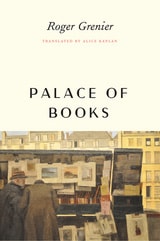
Palace of Books
Roger Grenier
University of Chicago Press, 2014
With Palace of Books, he invites us to explore the domain of literature, its sweeping vistas and hidden recesses. Engaging such fundamental questions as why people feel the need to write, or what is involved in putting one’s self on the page, or how a writer knows she’s written her last sentence, Grenier marshals apposite passages from his favorite writers: Chekhov, Baudelaire, Proust, James, Kafka, Mansfield and many others. Those writers mingle companionably with tales from Grenier’s half-century as an editor and friend to countless legendary figures, including Albert Camus, Romain Gary, Milan Kundera, and Brassai,.
Grenier offers here a series of observations and quotations that feel as spontaneous as good conversation, yet carry the lasting insights of a lifetime of reading and thinking. Palace of Books is rich with pleasures and surprises, the perfect accompaniment to old literary favorites, and the perfect introduction to new ones.
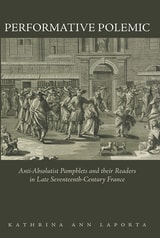
Performative Polemic
Anti-Absolutist Pamphlets and their Readers in Late Seventeenth-Century FranceKathrina Ann LaPorta
University of Delaware Press, 2021

Politics, Writing, Mutilation
The Cases of Bataille, Blanchot, Roussel, Leiris, and PongeAllan Stoekl
University of Minnesota Press, 1985
Politics, Writing, Mutilation was first published in 1985. Minnesota Archive Editions uses digital technology to make long-unavailable books once again accessible, and are published unaltered from the original University of Minnesota Press editions.
Five twentieth-century French writers played, and continue to play, a pivotal role in the development of literary-philosophical thinking that has come to be known in the United States as post-structuralism. The work of Georges Bataille, Maurice Blanchot, Raymond Roussel, Michel Leiris, and Francis Ponge in the 1930s and 1940s amounts to a prehistory of today's theoretical debates; the writings of Foucault and Derrida in particular would have been unthinkable outside the context provided by these writers. In Politics, Writing, Mutilation,Allan Stoekl emphasizes their role as precursors, but he also makes clear that they created a distinctive body of work that must be read and evaluated on its own terms.
Stoekl's critical readings of their work—selected novels, poems, and autobiographical fragments—reveal them to be battlegrounds not only of disruptive language practices, but of conflicting political drives as well. These irreconcilable tendencies can be defined as progressive political revolution, on the one hand with its emphasis on utility, conservation, and labor; and, on the other hand, a notion of dangerous and sinister production that stresses orgiastic sexuality and delirious expenditure. Caught between these forces is the intellectual of Bataille's time (and indeed of ours), locked in impotence, self-betrayal, and automutilation.
Stoekl develops his critique through dual readings of each writer's central work—the first reading deconstructive, the second a search for the political meaning excluded by a deconstructive approach. Repeating this process on a larger scale, he shows how Derrida and Foucault are indebted to their precursors even while they have betrayed them by stripping their work of political conflict and historical specificity. And he acknowledges that one of the most painful questions faced in prewar and Occupied France—that of the unthinkable guilt and duplicity of the intellectual—may not be as remote from contemporary theoretical concerns as some would have us believe.
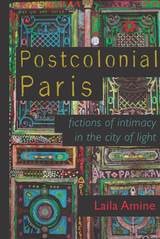
Postcolonial Paris
Fictions of Intimacy in the City of LightLaila Amine
University of Wisconsin Press, 2021
Spanning the decades from the post–World War II era to the present day, Amine demonstrates that the postcolonial other is both peripheral to and intimately entangled with all the ideals so famously evoked by the French capital—romance, modernity, equality, and liberty. In their work, postcolonial writers and artists have juxtaposed these ideals with colonial tropes of intimacy (the interracial couple, the harem, the Arab queer) to expose their hidden violence. Amine highlights the intrusion of race in everyday life in a nation where, officially, it does not exist.
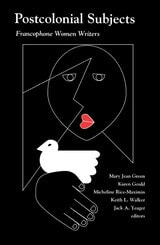
Postcolonial Subjects
Francophone Women WritersMary Green
University of Minnesota Press, 1996
Explores French-language writing by women outside France.
This groundbreaking volume highlights the work of contemporary women writing in French whose cultural links, ethnic identities, and historical roots lie outside France. The writings of these women emanate from the cultures of Africa and the Indian Ocean, the Middle East, the Caribbean, Southeast Asia, and Quebec and other French-speaking regions of Canada.
By writing in French, the writers discussed in Postcolonial Subjects both acknowledge and write against the cultural heritage of France. In doing so, they participate in the subversion of European literary traditions and take part in various forms of cultural and linguistic blending, generating new artistic currents. Each of these essays articulates contemporary debates about the politics and cultural effects of sexism, homophobia, racism, and essentialism, as well as pointing out connections and points of resistance among such diverse strains as feminism, nationalism, and ethnicity. Contributors: Eloise A. Brière, U of Albany; Miriam Cooke, Duke U; Irène Assiba d’Almeida, U of Arizona; Joan Dayan, U of Arizona; John D. Erickson, U of Kentucky; Françoise Lionnet, Northwestern U; Christiane Makward, Pennsylvania State U; Kitzie McKinney, Bentley College; Christopher L. Miller, Yale U; Mary-Kay Miller, Vanderbilt U; Jane Moss, Colby College; Elisabeth Mudimbe-Boyi, Stanford U; Lori Saint-Martin, U du Québec à Montréal; Ronnie Scharfman, Purchase College, SUNY.