Results by title
570 books match the query 'Gay Studies' and 19 start with p
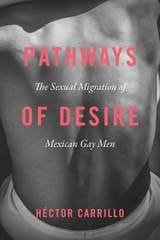
Pathways of Desire
The Sexual Migration of Mexican Gay MenHéctor Carrillo
University of Chicago Press, 2017
Further, Carrillo shows that sexual globalization must be regarded as a bidirectional, albeit uneven, process of exchange between countries in the global north and the global south. With this approach, Carrillo challenges the view that gay men from countries like Mexico would logically want to migrate to a “more sexually enlightened” country like the United States—a partial and limited understanding, given the dynamic character of sexuality in countries such as Mexico, which are becoming more accepting of sexual diversity. Pathways of Desire also provides a helpful analytical framework for the simultaneous consideration of structural and cultural factors in social scientific studies of sexuality. Carrillo explains the patterns of cross-cultural interaction that sexual migration generates and—at the most practical level—shows how the intricacies of cross-cultural sexual and romantic relations may affect the sexual health and HIV risk of transnational immigrant populations.
Patient Zero and the Making of the AIDS Epidemic
Richard A. McKay
University of Chicago Press, 2017
The search for a “patient zero”—popularly understood to be the first person infected in an epidemic—has been key to media coverage of major infectious disease outbreaks for more than three decades. Yet the term itself did not exist before the emergence of the HIV/AIDS epidemic in the 1980s. How did this idea so swiftly come to exert such a strong grip on the scientific, media, and popular consciousness? In Patient Zero, Richard A. McKay interprets a wealth of archival sources and interviews to demonstrate how this seemingly new concept drew upon centuries-old ideas—and fears—about contagion and social disorder.
McKay presents a carefully documented and sensitively written account of the life of Gaétan Dugas, a gay man whose skin cancer diagnosis in 1980 took on very different meanings as the HIV/AIDS epidemic developed—and who received widespread posthumous infamy when he was incorrectly identified as patient zero of the North American outbreak. McKay shows how investigators from the US Centers for Disease Control inadvertently created the term amid their early research into the emerging health crisis; how an ambitious journalist dramatically amplified the idea in his determination to reframe national debates about AIDS; and how many individuals grappled with the notion of patient zero—adopting, challenging and redirecting its powerful meanings—as they tried to make sense of and respond to the first fifteen years of an unfolding epidemic. With important insights for our interconnected age, Patient Zero untangles the complex process by which individuals and groups create meaning and allocate blame when faced with new disease threats. What McKay gives us here is myth-smashing revisionist history at its best.
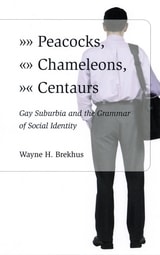
Peacocks, Chameleons, Centaurs
Gay Suburbia and the Grammar of Social IdentityWayne Brekhus
University of Chicago Press, 2003
In this first-ever ethnography of American gay suburbanites, Wayne H. Brekhus demonstrates that who one is depends at least in part on where and when one is. For many urban gay men, being homosexual is key to their identity because they live, work, and socialize in almost exclusively gay circles. Brekhus calls such men "lifestylers" or peacocks. Chameleons or "commuters," on the other hand, live and work in conventional suburban settings, but lead intense gay social and sexual lives outside the suburbs. Centaurs, meanwhile, or "integrators," mix typical suburban jobs and homes with low-key gay social and sexual activities. In other words, lifestylers see homosexuality as something you are, commuters as something you do, and integrators as part of yourself.
Ultimately, Brekhus shows that lifestyling, commuting, and integrating embody competing identity strategies that occur not only among gay men but across a broad range of social categories. What results, then, is an innovative work that will interest sociologists, psychologists, anthropologists, and students of gay culture.

Pedagogies of Crossing
Meditations on Feminism, Sexual Politics, Memory, and the SacredM. Jacqui Alexander
Duke University Press, 2005
In these meditations, Alexander deftly unites large, often contradictory, historical processes across time and space. She focuses on the criminalization of queer communities in both the United States and the Caribbean in ways that prompt us to rethink how modernity invents its own traditions; she juxtaposes the political organizing and consciousness of women workers in global factories in Mexico, the Caribbean, and Canada with the pressing need for those in the academic factory to teach for social justice; she reflects on the limits and failures of liberal pluralism; and she presents original and compelling arguments that show how and why transgenerational memory is an indispensable spiritual practice within differently constituted women-of-color communities as it operates as a powerful antidote to oppression. In this multifaceted, visionary book, Alexander maps the terrain of alternative histories and offers new forms of knowledge with which to mold alternative futures.
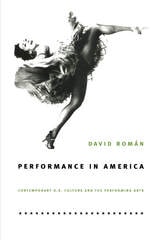
Performance in America
Contemporary U.S. Culture and the Performing ArtsDavid Román
Duke University Press, 2005
The performances that Román analyzes range from localized community-based arts events to full-scale Broadway productions and from the controversial works of established artists such as Tony Kushner to those of emerging artists. Román considers dances produced by the choreographers Bill T. Jones and Neil Greenberg in the mid-1990s as new aids treatments became available and the aids crisis was reconfigured; a production of the Asian American playwright Chay Yew’s A Beautiful Country in a high-school auditorium in Los Angeles’s Chinatown; and Latino performer John Leguizamo’s one-man Broadway show Freak. He examines the revival of theatrical legacies by female impersonators and the resurgence of cabaret in New York City. Román also looks at how the performing arts have responded to 9/11, the U.S. invasion of Afghanistan, and the second war in Iraq. Including more than eighty illustrations, Performance in America highlights the dynamic relationships among performance, history, and contemporary culture through which the past is revisited and the future reimagined.

Performing Mexicanidad
Vendidas y Cabareteras on the Transnational StageBy Laura G. Gutiérrez
University of Texas Press, 2010
Using interdisciplinary performance studies and cultural studies frameworks, Laura G. Gutiérrez examines the cultural representation of queer sexuality in the contemporary cultural production of Mexican female and Chicana performance and visual artists. In particular, she locates the analytical lenses of feminist theory and queer theory in a central position to interrogate Mexican female dissident sexualities in transnational public culture.
This is the first book-length study to wed performance studies and queer theory in examining the performative/performance work of important contemporary Mexicana and Chicana cultural workers. It proposes that the creations of several important artists—Chicana visual artist Alma López; the Mexican political cabareteras Astrid Hadad, Jesusa Rodríguez, Liliana Felipe, and Regina Orozco; the Chicana performance artist Nao Bustamante; and the Mexican video artist Ximena Cuevas—unsettle heterosexual national culture. In doing so, they are not only challenging heterosexist and nationalist discourses head-on, but are also participating in the construction of a queer world-making project. Treating the notion of dis-comfort as a productive category in these projects advances feminist and queer theories by offering an insightful critical movement suggesting that queer worlds are simultaneously spaces of desire, fear, and hope.
Gutiérrez demonstrates how arenas formerly closed to female performers are now providing both an artistic outlet and a powerful political tool that crosses not only geographic borders but social, sexual, political, and class boundaries as well, and deconstructs the relationships among media, hierarchies of power, and the cultures of privilege.
Performing Queer Latinidad
Dance, Sexuality, PoliticsRamón H. Rivera-Servera
University of Michigan Press, 2012
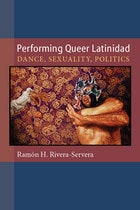
Performing Queer Latinidad highlights the critical role that performance played in the development of Latina/o queer public culture in the United States during the 1990s and early 2000s, a period when the size and influence of the Latina/o population was increasing alongside a growing scrutiny of the public spaces where latinidad could circulate. Performances---from concert dance and street protest to the choreographic strategies deployed by dancers at nightclubs---served as critical meeting points and practices through which LGBT and other nonnormative sex practitioners of Latin American descent (individuals with greatly differing cultures, histories of migration or annexation to the United States, and contemporary living conditions) encountered each other and forged social, cultural, and political bonds. At a time when latinidad ascended to the national public sphere in mainstream commercial and political venues and Latina/o public space was increasingly threatened by the redevelopment of urban centers and a revived anti-immigrant campaign, queer Latinas/os in places such as the Bronx, San Antonio, Austin, Phoenix, and Rochester, NY, returned to performance to claim spaces and ways of being that allowed their queerness and latinidad to coexist. These social events of performance and their attendant aesthetic communication strategies served as critical sites and tactics for creating and sustaining queer latinidad.

Performing Revolutionary
Art, Action, ActivismNicole Garneau and Anne Cushwa
Intellect Books, 2018

Philip Sparrow Tells All
Lost Essays by Samuel Steward, Writer, Professor, Tattoo ArtistSamuel Steward
University of Chicago Press, 2015
In Philip Sparrow Tells All, Jeremy Mulderig has collected thirty of these engaging but forgotten columns, prefacing them with revealing introductions that relate the essays to people and events in Steward’s life and to the intellectual and cultural contexts in which he wrote during the 1940s. In these essays we encounter such famous friends of Steward as Gertrude Stein, André Gide, and Thornton Wilder. We hear of his stint as a holiday sales clerk at Marshall Field’s (where he met and seduced fellow employee Rock Hudson), of his roles as an opera and ballet extra in hilariously shoddy costumes, of his hoarding tendencies, his disappointment with the drabness of men’s fashions, and his dread of turning forty. We go along with him to a bodybuilding competition and a pet cemetery, and together we wander the boulevards of Paris and the alleys of Algiers. Throughout, Mulderig’s entertaining annotations explain the essays’ wide-ranging allusions and also highlight their gay subtext, which constituted a kind of private game that Steward played with his mostly oblivious audience of Midwestern dentists.
The first collection of any of Samuel Steward’s writings to be republished since his death in 1993, Philip Sparrow Tells All makes these lost essays available to a broad readership that Steward imagined but never actually enjoyed when he wrote them. In doing so, it takes a major step toward documenting his important place in twentieth-century gay literature and history.
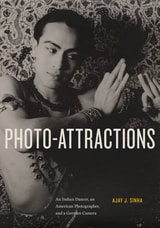
Photo-Attractions
An Indian Dancer, an American Photographer, and a German CameraAjay Sinha
Rutgers University Press, 2022
Art historian Ajay Sinha uses these hitherto unpublished photographs and archival research to raise provocative and important questions about photographic technology, colonial histories, race, sexuality and transcultural desires. Challenging the assumption that Gopal was merely objectified by Van Vechten’s Orientalist gaze, he explores the ways in which the Indian dancer co-authored the photos. In Sinha’s reading, Van Vechten’s New York studio becomes a promiscuous contact zone between world cultures, where a “photo-erotic” triangle is formed between the American photographer, Indian dancer, and German camera.
A groundbreaking study of global modernity, Photo-Attractions brings scholarship on American photography, literature, race and sexual economies into conversation with work on South Asian visual culture, dance, and gender. In these remarkable historical documents, it locates the pleasure taken in cultural difference that still resonates today.
Pink Revolutions
Globalization, Hindutva, and Queer Triangles in Contemporary IndiaNishant Shahani
Northwestern University Press, 2021
Eschewing structures of absolute complicity or abject alterity, Pink Revolutions pays attention to the logics of triangulation in various contexts: gay tourism, university campus politics, diasporic cultural productions, and AIDS activism. The book articulates a framework through which queer politics can challenge rather than participate in neoliberal imperatives, an approach that will interest scholars engaged with queer studies and postcolonial scholarship, as well as activists and academics wrestling with global capitalism and right-wing regimes around the world.

Pivotal Voices, Era of Transition
Toward a 21st Century PoeticsRigoberto González
University of Michigan Press, 2017
This book fills a glaring gap in existing poetry scholarship by focusing exclusively on writers of color, and particularly on Latino poetry. González makes important observations about the relevance, urgency, and exquisite craft of the work coming from writers who represent marginalized communities. His insightful connections between the Latino, African American, Asian American, and Native American literatures persuasively position them as a collective movement critiquing, challenging, and reorienting the direction of American poetry with their nuanced and politicized verse. González’s inclusive vision covers a wide landscape of writers, opening literary doors for sexual and ethnic minorities.
Pleasure Consuming Medicine
The Queer Politics of DrugsKane Race
Duke University Press, 2009
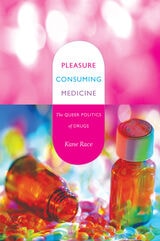
Race does not suggest that drug use is risk-free, good, or bad, but rather that the regulation of drugs has become a site where ideological lessons about the propriety of consumption are propounded. He argues that official discourses about drug use conjure a space where the neoliberal state can be seen to be policing the “excesses” of the amoral market. He explores this normative investment in drug regimes and some “counterpublic health” measures that have emerged in response. These measures, which Race finds in certain pragmatic gay men’s health and HIV prevention practices, are not cloaked in moralistic language, and they do not cast health as antithetical to pleasure.
Pop Out
Queer WarholJennifer Doyle, Jonathan Flatley, and Jose Esteban Muñoz, eds.
Duke University Press, 1996
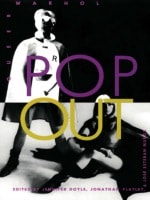
Written from the perspectives of art history, critical race theory, psychoanalysis, feminist theory, cinema studies, and social and literary theory, these essays consider Warhol in various contexts and within the history of the communities in which he figured. The homoerotic subjects, gay audiences, and queer contexts that fuel a certain fascination with Warhol are discussed, as well as Batman, Basquiat, and Valerie Solanas. Taken together, the essays in this collection depict Warhol’s career as a practical social reflection on a wide range of institutions and discourses, including those, from the art world to mass culture, that have almost succeeded in sanitizing his work and his image.
Contributors. Jennifer Doyle, Jonathan Flatley, Marcie Frank, David E. James, Mandy Merck, Michael Moon, José Esteban Muñoz, Eve Kosofsky Sedgwick, Brian Selsky, Sasha Torres, Simon Watney, Thomas Waugh

Porn Archives
Tim Dean, Steven Ruszczycky and David Squires, eds.
Duke University Press, 2014
The essays in this collection address the historically and culturally varied interactions between porn and the archive. Topics range from library policies governing access to sexually explicit material to the growing digital archive of "war porn," or eroticized combat imagery; and from same-sex amputee porn to gay black comic book superhero porn. Together the pieces trace pornography as it crosses borders, transforms technologies, consolidates sexual identities, and challenges notions of what counts as legitimate forms of knowledge. The collection concludes with a valuable resource for scholars: a list of pornography archives held by institutions around the world.
Contributors. Jennifer Burns Bright, Eugenie Brinkema, Joseph Bristow, Robert Caserio, Ronan Crowley, Tim Dean, Robert Dewhurst, Lisa Downing, Frances Ferguson, Loren Glass, Harri Kahla, Marcia Klotz, Prabha Manuratne, Mireille Miller-Young, Nguyen Tan Hoang, John Paul Ricco, Steven Ruszczycky, Melissa Schindler, Darieck Scott, Caitlin Shanley, Ramon Soto-Crespo, David Squires, Linda Williams
Pre-Gay L.A.
A Social History of the Movement for Homosexual RightsC. Todd White
University of Illinois Press, 2008

Private Practices
Harry Stack Sullivan, the Science of Homosexuality, and American LiberalismWake, Naoko
Rutgers University Press, 2011
Private Practices examines the relationship between science, sexuality, gender, race, and culture in the making of modern America between 1920 and 1950, when contradictions among liberal intellectuals affected the rise of U.S. conservatism. Naoko Wake focuses on neo-Freudian, gay psychiatrist Harry Stack Sullivan, founder of the interpersonal theory of mental illness. She explores medical and social scientists' conflicted approach to homosexuality, particularly the views of scientists who themselves lived closeted lives.
Wake discovers that there was a gap--often dramatic, frequently subtle--between these scientists' "public" understanding of homosexuality (as a "disease") and their personal, private perception (which questioned such a stigmatizing view). This breach revealed a modern culture in which self-awareness and open-mindedness became traits of "mature" gender and sexual identities. Scientists considered individuals of society lacking these traits to be "immature," creating an unequal relationship between practitioners and their subjects. In assessing how these dynamics--the disparity between public and private views of homosexuality and the uneven relationship between scientists and their subjects--worked to shape each other, Private Practices highlights the limits of the scientific approach to subjectivity and illuminates its strange career--sexual subjectivity in particular--in modern U.S. culture.
Professing Selves
Transsexuality and Same-Sex Desire in Contemporary IranAfsaneh Najmabadi
Duke University Press, 2013
Public City/Public Sex
Homosexuality, Prostitution, and Urban Culture in Nineteenth-Century ParisAndrew Israel Ross
Temple University Press, 2019
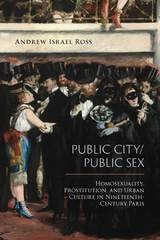
In the 1800s, urban development efforts modernized Paris and encouraged the creation of brothels, boulevards, cafés, dancehalls, and even public urinals. However, complaints also arose regarding an apparent increase in public sexual activity, and the appearance of “individuals of both sexes with depraved morals” in these spaces. Andrew Israel Ross’s illuminating study, Public City/Public Sex, chronicles the tension between the embourgeoisement and democratization of urban culture in nineteenth-century Paris and the commercialization and commodification of a public sexual culture, the emergence of new sex districts, as well as the development of gay and lesbian subcultures.
Public City/Public Sex examines how the notion that male sexual desire required suitable outlets shaped urban policing and development. Ross traces the struggle to control sex in public and argues that it was the very effort to police the city that created new opportunities for women who sold sex and men who sought sex with other men. Placing public sex at the center of urban history, Ross shows how those who used public spaces played a central role in defining the way the city was understood.