Results by title
52 books match the query 'Gender identity in literature' and 7 start with p
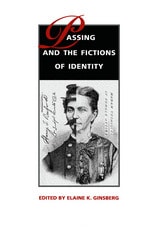
Passing and the Fictions of Identity
Elaine K. Ginsberg
Duke University Press, 1996
These essays consider a wide range of texts and moments from colonial times to the present that raise significant questions about the political motivations inherent in the origins and maintenance of identity categories and boundaries. Through discussions of such literary works as Running a Thousand Miles for Freedom, The Autobiography of an Ex–Coloured Man, Uncle Tom’s Cabin, The Hidden Hand, Black Like Me, and Giovanni’s Room, the authors examine issues of power and privilege and ways in which passing might challenge the often rigid structures of identity politics. Their interrogation of the semiotics of behavior, dress, language, and the body itself contributes significantly to an understanding of national, racial, gender, and sexual identity in American literature and culture.
Contextualizing and building on the theoretical work of such scholars as Judith Butler, Diana Fuss, Marjorie Garber, and Henry Louis Gates Jr., Passing and the Fictions of Identity will be of value to students and scholars working in the areas of race, gender, and identity theory, as well as U.S. history and literature.
Contributors. Martha Cutter, Katharine Nicholson Ings, Samira Kawash, Adrian Piper, Valerie Rohy, Marion Rust, Julia Stern, Gayle Wald, Ellen M. Weinauer, Elizabeth Young
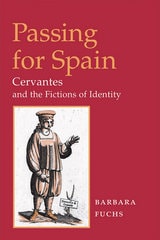
Passing for Spain
CERVANTES AND THE FICTIONS OF IDENTITYBarbara Fuchs
University of Illinois Press, 2003
In five lucid and engaging chapters, Fuchs examines what passes in Cervantes’s fiction: gender and race in Don Quijote and “Las dos doncellas”; religion in “El amante liberal” and La gran sultana; national identity in the Persiles and “La española inglesa.” She argues that Cervantes represents cross-cultural impersonation -- or characters who pass for another gender, nationality, or religion -- as challenges to the state’s attempts to assign identities and categories to proper Spanish subjects.
Fuchs demonstrates the larger implications of this challenge by bringing a wide range of literary and political texts to bear on Cervantes’s representations. Impeccably researched, Passing for Spain examines how the fluidity of individual identity in early modern Spain undermined a national identity based on exclusion and difference.

Philosophy for Spiders
On the Low Theory of Kathy AckerMcKenzie Wark
Duke University Press, 2021
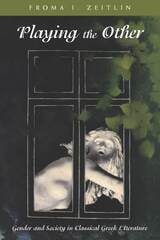
Playing the Other
Gender and Society in Classical Greek LiteratureFroma I. Zeitlin
University of Chicago Press, 1995
Zeitlin demonstrates the indispensable workings of gender as a major factor in Greek social, religious, and cultural practices and in more abstract ideas about nature and culture, public and private, citizen and outsider, self and other, and mortal and immortal. Focusing on the prominence of female figures in these male authored texts, she enlarges our perspective on critical components of political order and civic identity by including issues of sexuality, the body, modes of male and female maturation, and speculations about parentage, kinship, and reproductive strategies. Along with considerations of genre, poetics, and theatrical mimesis, she points to the powerful mythmaking capacities of Greek culture for creating memorable paradigms and dramatic scenarios that far exceed simple notions of male and female opposition and predictable enforcement of social norms. Consisting of both new and revised essays, Playing the Other is a wide-ranging account of a central category of Greek literature by a scholar who pioneered an approach to classics through the perspective of gender.
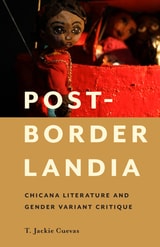
Post-Borderlandia
Chicana Literature and Gender Variant CritiqueCuevas, T. Jackie
Rutgers University Press, 2018
2019 Lambda Literary Awards Finalist
Bringing Chicana/o studies into conversation with queer theory and transgender studies, Post-Borderlandia examines why gender variance is such a core theme in contemporary Chicana and Chicanx narratives. It considers how Chicana butch lesbians and Chicanx trans people are not only challenging heteropatriarchal norms, but also departing from mainstream conceptions of queerness and gender identification.
Expanding on Gloria Anzaldúa’s classic formulation of the Chicana as transformer of the “borderlands,” Jackie Cuevas explores how a new generation of Chicanx writers, performers, and filmmakers are imagining a “post-borderlands” subjectivity, where shifting national, racial, class, sexual, and gender identifications produce complex power dynamics. In addition, Cuevas offers fresh archival analysis of the Chicana feminist canon to reveal how queer gender variance has always been crucial to this literary tradition.

Postnationalism in Chicana/o Literature and Culture
By Ellie D. Hernández
University of Texas Press, 2009
In recent decades, Chicana/o literary and cultural productions have dramatically shifted from a nationalist movement that emphasized unity to one that openly celebrates diverse experiences. Charting this transformation, Postnationalism in Chicana/o Literature and Culture looks to the late 1970s, during a resurgence of global culture, as a crucial turning point whose reverberations in twenty-first-century late capitalism have been profound.
Arguing for a postnationalism that documents the radical politics and aesthetic processes of the past while embracing contemporary cultural and sociopolitical expressions among Chicana/o peoples, Hernández links the multiple forces at play in these interactions. Reconfiguring text-based analysis, she looks at the comparative development of movements within women's rights and LGBTQI activist circles. Incorporating economic influences, this unique trajectory leads to a new conception of border studies as well, rethinking the effects of a restructured masculinity as a symbol of national cultural transformation. Ultimately positing that globalization has enhanced the emergence of new Chicana/o identities, Hernández cultivates important new understandings of borderlands identities and postnationalism itself.
Purple Passages
Pound, Eliot, Zukofsky, Olson, Creeley, and the Ends of Patriarchal PoetryRachel Blau DuPlessis
University of Iowa Press, 2012