Results by title
153 books match the query 'Genres' and 7 start with p
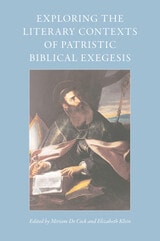
Patristic Exegesis in Context
Exploring the Genres of Early Christian Biblical InterpretationMiriam De Cock
Catholic University of America Press, 2023
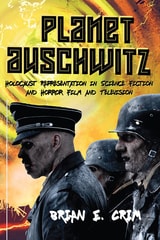
Planet Auschwitz
Holocaust Representation in Science Fiction and Horror Film and TelevisionBrian E. Crim
Rutgers University Press, 2020
Planet Auschwitz website (https://planetauschwitz.com)
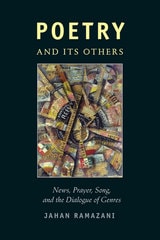
Poetry and Its Others
News, Prayer, Song, and the Dialogue of GenresJahan Ramazani
University of Chicago Press, 2013
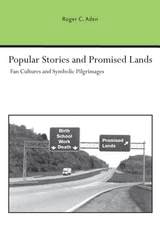
Popular Stories and Promised Lands
Fan Cultures and Symbolic PilgrimagesRoger C. Aden
University of Alabama Press, 2007
A conversation about who we are, where we’ve been, and where we might be going.
Popular Stories and Promised Lands enters a conversation about who we are, where we’ve been, and where we might be going by suggesting that possible answers to those questions can be found in the popular stories we encounter at the movies, on television, in popular magazines, and even on the funny pages.
As countless scholars and popular writers have noted, those of us living in the United States find ourselves at a cultural crossroads. We are increasingly aware that the stories that once permeated life in these United States, stories that tell us that social and economic progress comes from working hard, that everyone has an equal opportunity to experience such progress, do not resonate to the degree they once did. Because many Americans have traditionally defined themselves, others, and their unique sense of place through these stories, we find ourselves displaced socially, economically, politically, and/or culturally.
So, Roger Aden says, we go to places of our own making. Fans of the television series The X-Files return to the Funhouse each week for a dose of frightening fun. Fans of the weekly magazine Sports Illustrated play in the American Elysian Fields where democratic efforts at balancing work and play are valued. Fans of the movie Field of Dreams work as altruistic producers in an alternative garden spot.
Grounded in the author’s own experiences and reinforced by the voices of approximately two hundred additional fans of the four popular stories, this book offers a compelling case for understanding the alleged wasteland of popular culture as a fertile site of individually and communally created sacred places.
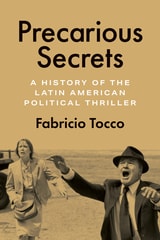
Precarious Secrets
A History of the Latin American Political ThrillerFabricio Tocco
University of Texas Press, 2025
An exploration of the political thriller genre and its context in Latin American politics and entertainment.
For the past five decades, a distinctive type of political thriller has been steadily developing in Latin America. Precarious Secrets is a panoramic overview of the genre in the hands of renowned writers and filmmakers from Argentina, Mexico, Chile, and Brazil, as well as lesser-known Peruvian, Uruguayan and Paraguayan artists for whom the style has been a vehicle for pungent narratives shot through with menace and conspiracy.
Fabricio Tocco explores the genre’s unique role in Latin American entertainment and activism. Precarious Secrets traces the evolutions of the Latin American political thriller from its emergence in the 1970s, through the silence imposed by dictatorships and the genre’s resurgence after the Cold War. The political thriller has dramatized the region’s turbulent past, through assassinations, coups, mass killings, revolutions and the search of desaparecidos by human rights organizations. In the process, Tocco isolates the Latin American political thriller’s particular grammar of secrecy. In the Hollywood thriller, revealing secrets involves high stakes and transformative consequences. In Latin American political thrillers, by contrast, secrets produce only more precarity—moral ambiguity as unsettling as it is unshakeable.
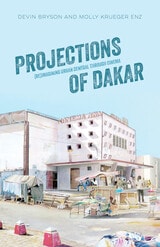
Projections of Dakar
(Re)Imagining Urban Senegal through CinemaDevin Bryson and Molly Krueger Enz
Ohio University Press, 2024
Like contemporary Senegalese cinema, African urban centers are often perceived as sites of despair and social decay. In each chapter of this book, Devin Bryson and Molly Krueger Enz focus on a particular urban issue and analyze how Senegalese filmmakers document and reimagine it from diverse perspectives and contexts. The authors draw from interviews and ethnographic observations to center filmmakers’ practices and conceptualizations of contemporary cinema in Dakar. Bryson and Enz trace developments in production, distribution, viewership, and audience response since 2012 to study how these films and their production both reveal and contribute to how people live in the city, relate to one another, build their lives, advocate for change, find joy and meaning, and build community. They also document and articulate more equitable and inclusive forms of these activities. Ultimately, the book illustrates how Senegalese filmmakers reimagine Africa as a place that will lead to a better future for its inhabitants.
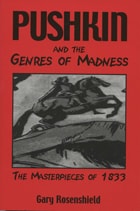
Pushkin and the Genres of Madness
The Masterpieces of 1833Gary Rosenshield
University of Wisconsin Press, 2003
In 1833 Alexander Pushkin began to explore the topic of madness, a subject little explored in Russian literature before his time. The works he produced on the theme are three of his greatest masterpieces: the prose novella The Queen of Spades, the narrative poem The Bronze Horseman, and the lyric "God Grant That I Not Lose My Mind." Gary Rosenshield presents a new interpretation of Pushkin’s genius through an examination of his various representations of madness.
Pushkin brilliantly explored both the destructive and creative sides of madness, a strange fusion of violence and insight. In this study, Rosenshield illustrates the surprising valorization of madness in The Queen of Spades and "God Grant That I Not Lose My Mind" and analyzes The Bronze Horseman’s confrontation with the legacy of Peter the Great, a cornerstone figure of Russian history. Drawing on themes of madness in western literature, Rosenshield situates Pushkin in a greater framework with such luminaries as Shakespeare, Sophocles, Cervantes, and Dostoevsky providing an insightful and absorbing study of Russia’s greatest writer.