Results by title
341 books match the query 'Geography' and 18 start with p

PRESIDENTIAL MUSINGS FROM THE MERIDIAN
REFLECTIONS ON THE NATURE OF GEOGRAPHYM. DUANE NELLIS
West Virginia University Press, 2005
For decades, presidents of the Association of American Geographers have written insightful columns in the AAG Newsletter. One of the most popular sections of the newsletter, these columns illustrate the changes and consistencies of geography over the past thirty-four years. They offer an insight into the past of the geography discipline and a broader perspective on the future. Previously inaccessible even to most professional geographers, the Presidential Columns will now be available in Presidential Musings from the Meridian: Reflections of the Nature of Geography.
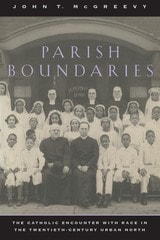
Parish Boundaries
The Catholic Encounter with Race in the Twentieth-Century Urban NorthJohn T. McGreevy
University of Chicago Press, 1996
"Parish Boundaries can take its place in the front ranks of the literature of urban race relations."—Jonathan Dorfman, Washington Post Book Review
"A prodigiously researched, gracefully written book distinguished especially by its seamless treatment of social and intellectual history."—Robert Orsi, American Historical Review
"Parish Boundaries will fascinate historians and anyone interested in the historic connection between parish and race."—Ed Marciniak, Chicago Tribune
"The history that remains to be written will rest on the firm foundation of Mr. McGreevy's remarkable book."—Richard Wightman Fox, New York Times Book Review
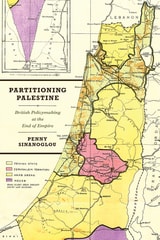
Partitioning Palestine
British Policymaking at the End of EmpirePenny Sinanoglou
University of Chicago Press, 2019

Picturing Empire
Photography and the Visualization of the British EmpireJames R. Ryan
University of Chicago Press, 1997
But as James R. Ryan argues in Picturing Empire, Victorian photographs reveal as much about the imaginative landscapes of imperial culture as they do about the "real" subjects captured within their frames. Ryan considers the role of photography in the exploration and domestication of foreign landscapes, in imperial warfare, in the survey and classification of "racial types," in "hunting with the camera," and in teaching imperial geography to British schoolchildren.
Ryan's careful exposure of the reciprocal relation between photographic image and imperial imagination will interest all those concerned with the cultural history of the British Empire.
Place Names of Illinois
Edward Callary
University of Illinois Press, 2007
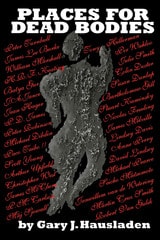
Places for Dead Bodies
By Gary J. Hausladen
University of Texas Press, 2000
From Tony Hillerman's Navajo Southwest to Martin Cruz Smith's Moscow, an exotic, vividly described locale is one of the great pleasures of many murder mysteries. Indeed, the sense of place, no less than the compelling character of the detective, is often what keeps authors writing and readers reading a particular series of mystery novels.
This book investigates how "police procedural" murder mysteries have been used to convey a sense of place. Gary Hausladen delves into the work of more than thirty authors, including Tony Hillerman, Martin Cruz Smith, James Lee Burke, David Lindsey, P. D. James, and many others. Arranging the authors by their region of choice, he discusses police procedurals set in America, the United Kingdom and Ireland, Europe, Moscow, Asia, and selected locales in other parts of the world, as well as in historical places ranging from the Roman Empire to turn-of-the-century Cairo.
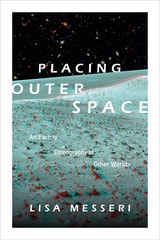
Placing Outer Space
An Earthly Ethnography of Other WorldsLisa Messeri
Duke University Press, 2016
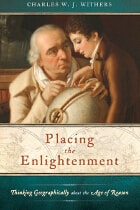
Placing the Enlightenment
Thinking Geographically about the Age of ReasonCharles W. J. Withers
University of Chicago Press, 2007
The Enlightenment was the age in which the world became modern, challenging tradition in favor of reason, freedom, and critical inquiry. While many aspects of the Enlightenment have been rigorously scrutinized—its origins and motivations, its principal characters and defining features, its legacy and modern relevance—the geographical dimensions of the era have until now largely been ignored. Placing the Enlightenment contends that the Age of Reason was not only a period of pioneering geographical investigation but also an age with spatial dimensions to its content and concerns.
Investigating the role space and location played in the creation and reception of Enlightenment ideas, Charles W. J. Withers draws from the fields of art, science, history, geography, politics, and religion to explore the legacies of Enlightenment national identity, navigation, discovery, and knowledge. Ultimately, geography is revealed to be the source of much of the raw material from which philosophers fashioned theories of the human condition.
Lavishly illustrated and engagingly written, Placing the Enlightenment will interest Enlightenment specialists from across the disciplines as well as any scholar curious about the role geography has played in the making of the modern world.
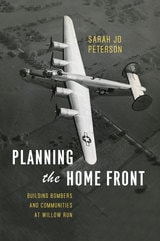
Planning the Home Front
Building Bombers and Communities at Willow RunSarah Jo Peterson
University of Chicago Press, 2013
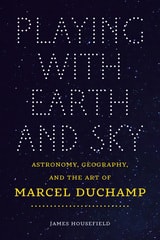
Playing with Earth and Sky
Astronomy, Geography, and the Art of Marcel DuchampJames Housefield
Dartmouth College Press, 2016
Political Essay on the Island of Cuba
A Critical EditionAlexander von Humboldt
University of Chicago Press, 2011
The research Alexander von Humboldt amassed during his five-year trek through the Americas in the early nineteenth-century proved foundational to the fields of botany, geography, and geology. But his visit to Cuba during this time yielded observations that extended far beyond the natural world. Political Essay on the Island of Cuba is a physical and cultural study of the island nation. In it, Humboldt denounces colonial slavery on both moral and economic grounds and stresses the vital importance of improving intercultural relations throughout the Americas.
Humboldt’s most controversial book, Political Essay on the Island of Cuba was banned, censored, and willfully mistranslated to suppress Humboldt’s strong antislavery sentiments. It reemerges here, newly translated from the original two volume French edition, to introduce a new generation of readers to Humboldt’s astonishing multiplicity of scientific and philosophical perspectives. In their critical introduction, Vera Kutzinski and Ottmar Ette emphasize Humboldt’s rare ability to combine scientific rigor with a cosmopolitan consciousness and a deeply felt philosophical humanism. The result is a work on Cuba of historical import that will attract historians of science as well as cultural historians, political scientists, and literary scholars.
Political Essay on the Kingdom of New Spain, Volume 1
A Critical EditionAlexander von Humboldt
University of Chicago Press, 2019
Alexander von Humboldt was the most celebrated modern chronicler of North and South America and the Caribbean, and this translation of his essay on New Spain—the first modern regional economic and political geography—covers his travels across today’s Mexico in 1803–1804. The work canvases natural-scientific and cultural-scientific objects alike, combining the results of fieldwork with archival research and expert testimony.
To show how people, plants, animals, goods, and ideas moved across the globe, Humboldt wrote in a variety of styles, bending and reshaping familiar writerly conventions to keep readers attentive to new inputs. Above all, he wanted his readers to be open-minded when confronted with cultural and other differences in the Americas. Fueled by his comparative global perspective on politics, economics, and science, he used his writing to support Latin American independence and condemn slavery and other forms of colonial exploitation. It is these voluminous and innovative writings on the New World that made Humboldt the undisputed father of modern geography, early American studies, transatlantic cultural history, and environmental studies.
This two-volume critical edition—the third installment in the Alexander von Humboldt in English series—is based on the full text, including all footnotes, tables, and maps, of the second, revised French edition of Essai politique sur le royaume de de Nouvelle Espagne from 1825 to 1827, which has never been translated into English before. Extensive annotations and full-color atlases are available on the series website.
Political Essay on the Kingdom of New Spain, Volume 2
A Critical EditionAlexander von Humboldt
University of Chicago Press, 2019
Alexander von Humboldt was the most celebrated modern chronicler of North and South America and the Caribbean, and this translation of his essay on New Spain—the first modern regional economic and political geography—covers his travels across today’s Mexico in 1803–1804. The work canvases natural-scientific and cultural-scientific objects alike, combining the results of fieldwork with archival research and expert testimony.
To show how people, plants, animals, goods, and ideas moved across the globe, Humboldt wrote in a variety of styles, bending and reshaping familiar writerly conventions to keep readers attentive to new inputs. Above all, he wanted his readers to be open-minded when confronted with cultural and other differences in the Americas. Fueled by his comparative global perspective on politics, economics, and science, he used his writing to support Latin American independence and condemn slavery and other forms of colonial exploitation. It is these voluminous and innovative writings on the New World that made Humboldt the undisputed father of modern geography, early American studies, transatlantic cultural history, and environmental studies.
This two-volume critical edition—the third installment in the Alexander von Humboldt in English series—is based on the full text, including all footnotes, tables, and maps, of the second, revised French edition of Essai politique sur le royaume de de Nouvelle Espagne from 1825 to 1827, which has never been translated into English before. Extensive annotations and full-color atlases are available on the series website.
Political Matter
Technoscience, Democracy, and Public LifeBruce Braun
University of Minnesota Press, 2010
Exploring the frictions that come from linking the work of scholars in science and technology studies and political theory, these essays spark new ways of understanding the matter of politics.
Contributors: Andrew Barry, U of Oxford; Jane Bennett, Johns Hopkins U; Stephen J. Collier, New School; William E. Connolly, Johns Hopkins U; Rosalyn Diprose, U of New South Wales; Lisa Disch, U of Michigan; Gay Hawkins, U of New South Wales; Andrew Lakoff, UC San Diego; Noortje Marres, U of London; Isabelle Stengers, U Libre de Bruxelles; Nigel Thrift, U of Warwick.
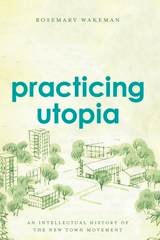
Practicing Utopia
An Intellectual History of the New Town MovementRosemary Wakeman
University of Chicago Press, 2016
In Practicing Utopia, Rosemary Wakeman gives us a sweeping view of the new town movement as a global phenomenon. From Tapiola in Finland to Islamabad in Pakistan, Cergy-Pontoise in France to Irvine in California, Wakeman unspools a masterly account of the golden age of new towns, exploring their utopian qualities and investigating what these towns can tell us about contemporary modernization and urban planning. She presents the new town movement as something truly global, defying a Cold War East-West dichotomy or the north-south polarization of rich and poor countries. Wherever these new towns were located, whatever their size, whether famous or forgotten, they shared a utopian lineage and conception that, in each case, reveals how residents and planners imagined their ideal urban future.
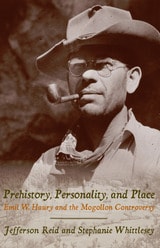
Prehistory, Personality, and Place
Emil W. Haury and the Mogollon ControversyJefferson Reid and Stephanie Whittlesey
University of Arizona Press, 2011
Reid and Whittlesey present the arguments and actions surrounding the Mogollon discovery, definition, and debate. Drawing on extensive interviews conducted with Haury before his death in 1992, they explore facets of the debate that scholars pursued at various times and places and how ultimately the New Archaeology shifted attention from the research questions of cultural affiliation and antiquity that had been at the heart of the controversy. In gathering the facts and anecdotes surrounding the debate, Reid and Whittlesey offer a compelling picture of an academician who was committed to understanding the unwritten past, who believed wholeheartedly in the techniques of scientific archaeology, and who used his influence to assist scholarship rather than to advance his own career.
Prehistory, Personality, and Place depicts a real archaeologist practicing real archaeology, one that fashioned from potsherds and pit houses a true understanding of prehistoric peoples. But more than the chronicle of a controversy, it is a book about places and personalities: the role of place in shaping archaeologists’ intellect and personalities, as well as the unusual intersections of people and places that produced resolutions of some intractable problems in Southwest history.

Provincialising nature
multidisciplinary approaches to the politics of the environment in Latin AmericaEdited by Michela Coletta and Malayna Raftopoulos
University of London Press, 2016
Psychedelic White
Goa Trance and the Viscosity of RaceArun Saldanha
University of Minnesota Press, 2007
A bold new approach to racial difference conceived through rave tourism
The village of Anjuna, located in the coastal Indian state of Goa, has been one of the premier destinations on the global rave scene for nearly two decades. The birthplace of Goa trance, the most psychedelic variety of electronic dance music, Anjuna first attracted adventurous Westerners in the 1970s who were drawn there by its tropical beaches, tolerant locals, and readily available drugs. Today, rave tourists travel to Goa to take part in round-the-clock dance parties and lose themselves in the crowds, the music, and the drugs. But do they really escape where they come from and who they are?
A rich and theoretically sophisticated ethnography, Psychedelic White explains how race plays out in Goa’s white counterculture and grapples with how to make sense of racism when it is not supposed to be there. Goa is a site of particularly revealing forms of interracial collision, and contrary to author Arun Saldanha’s expectations that the nature of rave would create an inclusive atmosphere, he repeatedly witnessed stark segregation between white and Indian tourists. He came to understand race in its creative dimension as a shifting and fuzzy assemblage of practices, environments, sounds, and substances—dance skills, sunlight, conversation, cannabis, and tea. In doing so, his work shows how the rave scene in Goa harbors conflicting tendencies regarding race. The complicated intersection of cultures and phenotypes, Saldanha asserts, helps to consolidate whiteness. Race emerges not through rigid boundaries but rather through what he terms viscosity, the degree to which bodies gather together for pleasure and self-transformation.
Challenging the prevailing conception of racial difference as a purely social construction and offering building on the works of Gilles Deleuze and Félix Guattari, Psychedelic White presents nothing less than a new materialist approach to race.