Results by title
56 books match the query 'Great Basin' and 6 start with p
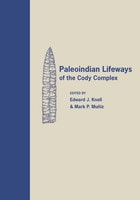
Paleoindian Lifeways of the Cody Complex
Edward J. Knell
University of Utah Press, 2013
Paleoindian Lifeways of the Cody Complex represents the first synthesis in the more than fifty year history of one of the most important Paleoindian cultural traditions in North America. Research on the Cody complex (~10,000–8,000 radiocarbon yrs B.P.) began in the 1940s; however, until now publications have focused almost exclusively on specific sites, issues of projectile point technology and typology, and bison hunting. This volume provides fresh perspectives and cutting-edge research that significantly increases our understanding of the Cody complex by focusing more squarely on the human behaviors that created the archaeological record, rather than on more strictly technical aspects of the artifacts and faunal remains.
Because the Cody complex extends from the central Canadian plains to the Gulf of Mexico and from Nevada to the eastern Great Lakes—making it second only to Clovis in geographical expanse—this volume will appeal to a wide range of North American archaeologists. Across this broad geographic distribution, the contributors address hunter-gatherer adaptive strategies from diverse ecosystems at the onset of the Holocene, which will also make it of interest to human ecologists and paleoenvironmental researchers. Paleoindian Lifeways of the Cody Complex provides an innovative synthesis of a well-known but little-studied cultural tradition that opens the door for a new generation of exciting research.
Paleoindian or Paleoarchaic?
Great Basin Human Ecology at the Pleistocene-Holocene TransitionKelly E Graf
University of Utah Press, 2008
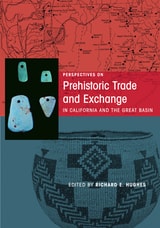
Perspectives on Prehistoric Trade and Exchange in California and the Great Basin
Richard E. Hughes
University of Utah Press, 2011
How does prehistoric material get from its place of origin to its location of archaeological recovery? While this question may seem basic, a moment’s reflection suggests that the answers carry important implications for arc-haeological interpretation about social organization, settlement, and subsistence practices. Archaeologists know much about the temporal and spatial distribution of materials in prehistoric western North America, but comparatively little has emerged regarding the causes of such distributions. Trade and exchange, mobility, and direct access all have been credited with observed distributions, but the reasons for settling on specific behavioral linkages is rarely made clear.
This volume investigates the circumstances and conditions under which trade/exchange, direct access, and/or mobility best account for material conveyance across varying distances at different times in the past. Each chapter contextualizes distributional and chemical data, evaluates competing distribution hypotheses, and addresses the reasoning and inferences employed to arrive at conclusions about the human behaviors responsible for the distributions of materials. Contributors showcase a range of diverse and creative ways of thinking about these issues in the California and Great Basin archaeological record, and why it matters.
Pottery of the Great Basin and Adjacent Areas
UUAP 111Suzanne Griset
University of Utah Press, 1986
Prehistoric Lifeways in the Great Basin Wetlands
Bioarchaelogical Reconstruction and InterpretationBrian Hemphill
University of Utah Press, 1999
Prehistoric Lifeways of the Great Basin Wetlands examines how the earliest inhabitants of the Great basin in Nevada, Utah, and Oregon made use of ancient marshes and lakes.
When the Great Salt Lake receded in the 1980s from its highest historically recorded levels, it exposed a large number of archaeological and burial sites. Other wetland areas in the region experienced similar flooding and site exposure. The resulting archaeological bonanza resolved long-standing controversy over the role of wetlands in prehistoric Great Basin human subsistence. Previously, archaeologists argued two disparate views: either wetlands offered a wealth of resources and served as a magnet for human occupation and rather sedentary lifestyles, or wetlands provided only meager fare that was insufficient to promote increased sedentism. The exposure of human remains coincided with improved analytic techniques, enabling new conclusions about diet, behavior, and genetic affiliation.
This volume presents findings from three Great Basin wetland areas: Great Salt Lake, Stillwater Marsh (Nevada) and Malheur Lake (Oregon). The evidence presented here does not indicate the superiority of one interpretation over another but offers a more complex picture of variable adaptation, high mobility, and generally robust health among peoples living in a harsh setting with heavy physical demands. It is the first volume to draw together new approaches to the study of earlier human societies, including analysis of mtDNA for population reconstruction and cross-sectional geometric assessment of long bones for behavior interpretation.
Purshia
The Wild And Bitter RosesJames A. Young
University of Nevada Press, 2002
A useful and complete summary of all the scientific information available on one of the most significant plant species in the western and intermountain regions. Among the plant species of the great Basin rangeland, the Purshia—ancient members of the rose family evolved to survive the aridity and temperature extremes of this harsh region—are one of the most important. This book-length study of this key plant species provides a comprehensive examination of the biology and ecology of the species and region.