Results by title
149 books match the query 'Group identity' and 11 start with p
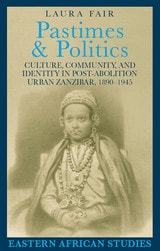
Pastimes and Politics
Culture, Community, and Identity in Post-Abolition Urban Zanzibar, 1890–1945Laura Fair
Ohio University Press, 2001
The first decades of the twentieth century were years of dramatic change in Zanzibar, a time when the social, economic, and political lives of island residents were in incredible flux, framed by the abolition of slavery, the introduction of colonialism, and a tide of urban migration. Pastimes and Politics explores the era from the perspective of the urban poor, highlighting the numerous and varied ways that recently freed slaves and other immigrants to town struggled to improve their individual and collective lives and to create a sense of community within this new environment. In this study Laura Fair explores a range of cultural and social practices that gave expression to slaves’ ideas of emancipation, as well as how such ideas and practices were gendered.
Pastimes and Politics examines the ways in which various cultural practices, including taarab music, dress, football, ethnicity, and sexuality, changed during the early twentieth century in relation to islanders’ changing social and political identities. Professor Fair argues that cultural changes were not merely reflections of social and political transformations. Rather, leisure and popular culture were critical practices through which the colonized and former slaves transformed themselves and the society in which they lived.
Methodologically innovative and clearly written, Pastimes and Politics is accessible to specialists and general readers alike. It is a book that should find wide use in courses on African history, urbanization, popular culture, gender studies, or emancipation.
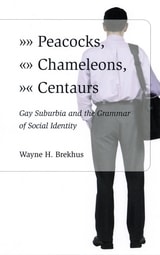
Peacocks, Chameleons, Centaurs
Gay Suburbia and the Grammar of Social IdentityWayne Brekhus
University of Chicago Press, 2003
In this first-ever ethnography of American gay suburbanites, Wayne H. Brekhus demonstrates that who one is depends at least in part on where and when one is. For many urban gay men, being homosexual is key to their identity because they live, work, and socialize in almost exclusively gay circles. Brekhus calls such men "lifestylers" or peacocks. Chameleons or "commuters," on the other hand, live and work in conventional suburban settings, but lead intense gay social and sexual lives outside the suburbs. Centaurs, meanwhile, or "integrators," mix typical suburban jobs and homes with low-key gay social and sexual activities. In other words, lifestylers see homosexuality as something you are, commuters as something you do, and integrators as part of yourself.
Ultimately, Brekhus shows that lifestyling, commuting, and integrating embody competing identity strategies that occur not only among gay men but across a broad range of social categories. What results, then, is an innovative work that will interest sociologists, psychologists, anthropologists, and students of gay culture.
Peruvian Lives across Borders
Power, Exclusion, and HomeM. Cristina Alcalde
University of Illinois Press, 2018
Alcalde draws on interviews, surveys, participant observation, and textual analysis to argue that to belong is to exclude. To that end, transnational Peruvians engage in both subtle and direct policing along the borders of belonging. These acts allow them to claim and maintain the social status they enjoyed in their homeland even as they profess their openness and tolerance. Alcalde details these processes and their origins in Peru's gender, racial, and class hierarchies. As she shows, the idea of return—whether desired or rejected, imagined or physical—spurs constructions of Peruvianness, belonging, and home.
Deeply researched and theoretically daring, Peruvian Lives across Borders answers fascinating questions about an understudied group of migrants.
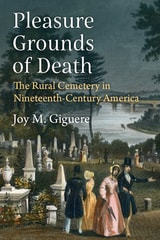
Pleasure Grounds of Death
The Rural Cemetery in Nineteenth-Century AmericaJoy M. Giguere
University of Michigan Press, 2024
Pleasure Grounds of Death considers the history of the rural cemetery in the United States throughout the duration of the nineteenth century as not only a critical cultural institution embedded in the formation of community and national identities, but also as major sites of contest over matters of burial reform, taste and respectability, and public behavior; issues concerning race, class, and gender; conflicts over the burial of the Civil War dead and formation of postwar memory; and what constituted the most appropriate ways to structure the landscape of the dead in a modern and progressive society. As cultural landscapes that served the needs of the living as well as the dead, rural cemeteries offer a mirror for the transformations and conflicts taking place throughout the nineteenth century in American society.
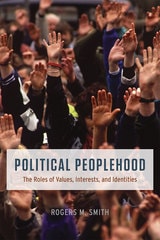
Political Peoplehood
The Roles of Values, Interests, and IdentitiesRogers M. Smith
University of Chicago Press, 2015
This book gathers Smith’s most important writings on peoplehood to build a coherent theoretical and historical account of what peoplehood has meant in American political life, informed by frequent comparisons to other political societies. From the revolutionary-era adoption of individual rights rhetoric to today’s battles over the place of immigrants in a rapidly diversifying American society, Smith shows how modern America’s growing embrace of overlapping identities is in tension with the providentialism and exceptionalism that continue to make up so much of what many believe it means to be an American.
A major work that brings a lifetime of thought to bear on questions that are as urgent now as they have ever been, Political Peoplehood will be essential reading for social scientists, political philosophers, policy analysts, and historians alike.
Postnational Self
Belonging And IdentityUlf Hedetoft
University of Minnesota Press, 2002
A timely look at how our globalized era has reconfigured experiences of belonging.
What happens to a sense of belonging when national and regional governments, religious organizations, community groups, political parties, and corporations become unstable and incoherent, as they have in these nationalist and postnationalist times? From a richly interdisciplinary perspective, the authors examine notions of citizenship and cultural hybridization, migration and other forms of mobility, displacements and ethnic cleansing, and the nature of national belonging in a world turning ever more fluid, aided by transnational flows of capital, information, people, and ideas.
Contributors: Seyla Benhabib, Yale; John A. Hall, McGill U; Ulf Hannerz, Stockholm U; Jeffrey Herf, U of Maryland; Michael Herzfeld, Harvard; Richard Jenkins, U of Sheffield, UK; Mark Juergensmeyer, U of California, Santa Barbara; Riva Kastoryano, Center for International Studies and Research (CERI), Paris; Michèle Lamont, Princeton; Benjamin Lee, Rice U; Orvar Löfgren, U of Lund, Sweden; Philip Schlesinger, U of Stirling, Scotland; Yasemin Nuhõglu Soysal, U of Essex, UK; Ray Taras, Tulane U; James Tully, U of Victoria, British Columbia.
Postnationalism Prefigured
Caribbean BorderlandsCarnegie, Charles V
Rutgers University Press, 2002
Carnegie shows not only that the nation-state is an exhausted form of political organization, but that in the Caribbean the ideological and political reach of the nation-state has always been tenuous at best. Caribbean peoples, he suggests, live continually in breach of the nation-state configuration. Drawing both on his own experiences as a Jamaican-born anthropologist and on the examples provided by those who have always considered national borders as little more than artificial administrative nuisances, Carnegie investigates a fascinating spectrum of individuals, including Marcus Garvey, traders, black albinos, and Caribbean Ba’hais. If these people have not themselves developed a scholarly doctrine of transnationalism, they have, nevertheless, effectively lived its demand and prefigured a postnational life.
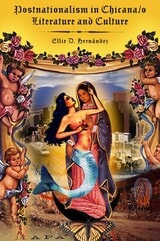
Postnationalism in Chicana/o Literature and Culture
By Ellie D. Hernández
University of Texas Press, 2009
In recent decades, Chicana/o literary and cultural productions have dramatically shifted from a nationalist movement that emphasized unity to one that openly celebrates diverse experiences. Charting this transformation, Postnationalism in Chicana/o Literature and Culture looks to the late 1970s, during a resurgence of global culture, as a crucial turning point whose reverberations in twenty-first-century late capitalism have been profound.
Arguing for a postnationalism that documents the radical politics and aesthetic processes of the past while embracing contemporary cultural and sociopolitical expressions among Chicana/o peoples, Hernández links the multiple forces at play in these interactions. Reconfiguring text-based analysis, she looks at the comparative development of movements within women's rights and LGBTQI activist circles. Incorporating economic influences, this unique trajectory leads to a new conception of border studies as well, rethinking the effects of a restructured masculinity as a symbol of national cultural transformation. Ultimately positing that globalization has enhanced the emergence of new Chicana/o identities, Hernández cultivates important new understandings of borderlands identities and postnationalism itself.
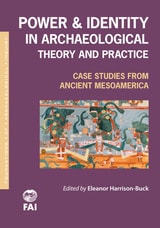
Power and Identity in Archaeological Theory and Practice
Case Studies from Ancient MesoamericaEleanor Harrison-Buck
University of Utah Press, 2012
The contributions to this volume represent a diverse array of Mesoamerican archaeological studies that are all theo-retically rooted to larger, global debates concerning issues of power and identity—two logically paired concepts. While social identity has been the focus of more critical analysis in recent years, the concept of power has received far less attention. Most studies focus on large-scale, institutional forms of power and the ruling body. Here, the focus is on relations of power, addressing broader segments of society outside the dominant group, that often are ignored in traditional reconstructions of past societies.
Harrison-Buck has compiled works that address a common criticism of social theory in the field of anthropological archaeology—the lack of strong case studies and corroborating facts supporting the abstract and often complex social theoretical concepts presented by scholars. Each contributor offers innovative method and theory and provides alternative and varied approaches to understanding power and identity in the archaeological record. They draw from a wide range of related disciplines and theoretical frameworks, including feminism, queer theory, cognitive studies, and postcolonial theory. The provocative case studies and exciting theoretical applications presented here will stimulate lively debate among scholars working both in and outside of Mesoamerica.
Problematic Paradigms and the Contours of US Latinidad
Essays by Silvio Torres-SaillantEdited by Nancy Kang and Michael Nieto Garcia
University of Texas Press, 2026
Silvio Torres-Saillant’s collected writings examine political contradictions within Latinx identity in the United States.
Since the 1990s Silvio Torres-Saillant’s work has questioned the notion of Latinidad, challenging presumptions of panethnic unity within the US Hispanic population and assessing dominant modes of Latinx representation. The essays in Problematic Paradigms and the Contours of US Latinidad examine the dynamics of a diverse collective of over 65 million people whose cultural heritage, ancestral origins, and belief systems arguably differ as much as they resemble one another. The volume dissects prevailing assumptions, namely the essentializing sense of homogeneity in the Latinx “community,” which mask important nuances and fascinating contradictions. Torres-Saillant also targets the role of marketing and mass communications in shaping popular perceptions of ethnic groups, thereby tracing connections between media rhetoric and the language of scholarship.
Newly revised by editors Nancy Kang and Michael Nieto Garcia, this collection curates Torres-Saillant’s core contributions to Latinx studies over the last two decades and underscores the veteran scholar’s evolving thoughts on key conversations in the field. The epilogue narrates his beginnings in Caribbean studies, acknowledges his ongoing analysis of Dominican blackness, and discourages uncritical views of cultural heritage.
Psychology and Constructivism in International Relations
An Ideational AllianceVaughn P. Shannon and Paul A. Kowert, Editors
University of Michigan Press, 2011
"The conversation between political psychology and constructivism is essential and long overdue. By exploring the interaction of individual cognition and social processes, this 'ideational alliance' more fully explains how ideas work all the way down to shape world politics."
---Theo Farrell, King's College London
"This is a worthwhile and engaging volume. Political psychology is gaining ground as an essential perspective to consider when analyzing international relations, and the book's focus on constructivism provides key insights into the relationship between identity, norms, and behavior---bedrock concepts in understanding the social underpinnings of global politics."
---Mira Sucharov, Carleton University
"An indispensable guide to understanding what distinguishes and what unites psychology and constructivism. A wonderful resource for political psychologists, constructivists, and their critics."
---Jonathan Mercer, University of Washington
Constructivist IR scholars study the ways in which international norms, culture, and identities---all intersubjective phenomena---inform foreign policy and affect the reaction to and outcomes of international events. Political psychologists similarly investigate divergent national self-conceptions as well as the individual cognitive and emotional propensities that shape ideology and policy. Given their mutual interest in human subjectivity and identity politics, a dialogue and synthesis between constructivism and political psychology is long overdue.
The contributors to this volume discuss both theoretical and empirical issues of complementarity and critique, with an emphasis on the potential for integrating the viewpoints within a progressive ideational paradigm. Moreover, they make a self-conscious effort to interrogate, rather than gloss over, their differences in the hope that such disagreements will prove particularly rich sources of analytical and empirical insight.
Jacket illustration © Ocean Photography/Veer