Results by title
133 books match the query 'Guatemala' and 5 start with p
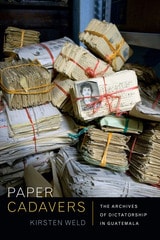
Paper Cadavers
The Archives of Dictatorship in GuatemalaKirsten Weld
Duke University Press, 2014
The unearthing of the archives renewed fierce debates about history, memory, and justice. In Paper Cadavers, Weld explores Guatemala's struggles to manage this avalanche of evidence of past war crimes, providing a firsthand look at how postwar justice activists worked to reconfigure terror archives into implements of social change. Tracing the history of the police files as they were transformed from weapons of counterinsurgency into tools for post-conflict reckoning, Weld sheds light on the country's fraught transition from war to an uneasy peace, reflecting on how societies forget and remember political violence.
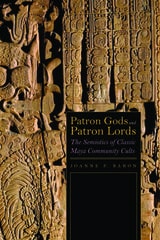
Patron Gods and Patron Lords
The Semiotics of Classic Maya Community CultsJoanne Baron
University Press of Colorado, 2016
Using semiotic theory, Baron draws on three bodies of evidence: ethnographies and manuscripts from Postclassic, Colonial, and modern Maya communities that connect patron saints to pre-Columbian patron gods; hieroglyphic texts from the Classic period that discuss patron deity veneration; and excavations from four patron deity temples at the site of La Corona, Guatemala. She shows how the Classic Maya used patron deity effigies, temples, and acts of devotion to negotiate group membership, social entitlements, and obligations between individuals and communities. She also explores the wider role of these processes in politics, arguing that rituals and discourses related to patron deities ultimately formulated Maya rulership as a locally oriented institution, which limited the ability of powerful kingdoms to create wider religious communities.
Applying a new theoretical approach for the archaeological study of ideology and power dynamics, Patron Gods and Patron Lords reveals an overlooked aspect of the belief system of Maya communities.
Plants of the Petén Itza’ Maya
Plantas de los maya itza’ del PeténScott Atran, Ximena Lois and Edilberto Ucan Ek'
University of Michigan Press, 2004
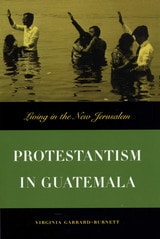
Protestantism in Guatemala
Living in the New JerusalemBy Virginia Garrard-Burnett
University of Texas Press, 1998
Guatemala has undergone an unprecedented conversion to Protestantism since the 1970s, so that thirty percent of its people now belong to Protestant churches, more than in any other Latin American nation. To illuminate some of the causes of this phenomenon, Virginia Garrard-Burnett here offers the first history of Protestantism in a Latin American country, focusing specifically on the rise of Protestantism within the ethnic and political history of Guatemala.
Garrard-Burnett finds that while Protestant missionaries were early valued for their medical clinics, schools, translation projects, and especially for the counterbalance they provided against Roman Catholicism, Protestantism itself attracted few converts in Guatemala until the 1960s. Since then, however, the militarization of the state, increasing public violence, and the "globalization" of Guatemalan national politics have undermined the traditional ties of kinship, custom, and belief that gave Guatemalans a sense of identity, and many are turning to Protestantism to recreate a sense of order, identity, and belonging.

Public Loves, Private Troubles
Migration, Technology, and Intimacy in Rural Indigenous GuatemalaMeghan Farley Webb
University of Alabama Press, 2025
Examines the role of digital technologies in the lives of Kaqchikel Maya women whose husbands work abroad.
Anthropologist Meghan Farley Webb’s ethnography, Public Loves, Private Troubles, uses the lens of cellphones and other digital technologies to unpack marriage, love, sexuality, and family issues of Kaqchikel Maya women who remain in Guatemala while their husbands are part of the transnational migration workforce. Indigenous intimacy has been underexplored in ethnographic literature, and this is among the first books to focus on information technology's impact on intimacy and family in the Maya area. Overall, Webb shows how Maya women are empowered with their more autonomous lives when the husbands are absent but also are constrained by social media monitoring of their activities.
To begin, Webb surveys the Tecpán highland setting and civil war and migration history. She discusses how neoliberal policies are manifested in the financial and emotional stress of having to leave for the United States for economic opportunities. Chapter 1 characterizes the lives of Maya women in Guatemala who “endure” while their husbands are working abroad. Webb describes how marriage, family, and even the Catholic Church shape how the women see themselves and their situations. Chapter 2 delves into the history and use of technologies, such as cellphones and WhatsApp, and how they affect communication in these transnational households. Insight is given to the family and personhood. Chapter 3 focuses on the prominent use of the Facebook platform. Men use the app to conduct extramarital affairs, but the app is also used by couples as a way to express a public performance of devotion and a happy family. Chapter 4 focuses on the surveillance, including malicious gossip, that Kaqchikel women are subjected to especially from their mothers-in-law, who live nearby or in the same household. The narrative culminates in a discussion of how many wives are happier and more empowered without the men at home, yet they still can experience uncertainty, loneliness, and depression.