Results by title
165 books match the query 'Health' and 3 start with p
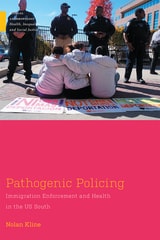
Pathogenic Policing
Immigration Enforcement and Health in the U.S. SouthNolan Kline
Rutgers University Press, 2019
The relationship between undocumented immigrants and law enforcement officials continues to be a politically contentious topic in the United States. Nolan Kline focuses on the hidden, health-related impacts of immigrant policing to examine the role of policy in shaping health inequality in the U.S., and responds to fundamental questions regarding biopolitics, especially how policy can reinforce ‘race’ as a vehicle of social division. He argues that immigration enforcement policy results in a shadow medical system, shapes immigrants’ health and interpersonal relationships, and has health-related impacts that extend beyond immigrants to affect health providers, immigrant rights groups, hospitals, and the overall health system. Pathogenic Policing follows current immigrant policing regimes in Georgia and contextualizes contemporary legislation and law enforcement practices against a backdrop of historical forms of political exclusion from health and social services for all undocumented immigrants in the U.S. For anyone concerned about the health of the most vulnerable among us, and those who interact with the overall health safety net, this will be an eye-opening read.
[more]
Peripheral Nerve
Health and Medicine in Cold War Latin AmericaAnne-Emanuelle Birn and Raúl Necochea López
Duke University Press, 2020
Buenos Aires psychoanalysts resisting imperialism. Brazilian parasitologists embracing communism as an antidote to rural misery. Nicaraguan revolutionaries welcoming Cuban health cooperation. Chilean public health reformers gauging domestic approaches against their Soviet and Western counterparts. As explored in Peripheral Nerve, these and accompanying accounts problematize existing understandings of how the Cold War unfolded in Latin America generally and in the health and medical realms more specifically. Bringing together scholars from across the Americas, this volume chronicles the experiences of Latin American physicians, nurses, medical scientists, and reformers who interacted with dominant U.S. and European players and sought alternative channels of health and medical solidarity with the Soviet Union and via South-South cooperation. Throughout, Peripheral Nerve highlights how Latin American health professionals accepted, rejected, and adapted foreign involvement; manipulated the rivalry between the United States and the USSR; and forged local variants that they projected internationally. In so doing, this collection reveals the multivalent nature of Latin American health politics, offering a significant contribution to Cold War history.
Contributors. Cheasty Anderson, Anne-Emanuelle Birn, Katherine E. Bliss, Gilberto Hochman, Jennifer L. Lambe, Nicole Pacino, Carlos Henrique Assunção Paiva, Jadwiga E. Pieper Mooney, Raúl Necochea López, Marco A. Ramos, Gabriela Soto Laveaga
Contributors. Cheasty Anderson, Anne-Emanuelle Birn, Katherine E. Bliss, Gilberto Hochman, Jennifer L. Lambe, Nicole Pacino, Carlos Henrique Assunção Paiva, Jadwiga E. Pieper Mooney, Raúl Necochea López, Marco A. Ramos, Gabriela Soto Laveaga
[more]
Pink and Blue
Gender, Culture, and the Health of ChildrenElena Conis
Rutgers University Press, 2021
In modern pediatric practice, gender matters. From the pink-and-blue striped receiving blankets used to swaddle newborns, to the development of sex-specific nutrition plans based on societal expectations of the stature of children, a gendered culture permeates pediatrics and children’s health throughout the twentieth and early twenty-first centuries. This book provides a look at how gender has served as one of the frameworks for pediatric care in the U.S. since the specialty’s inception. Pink and Blue deploys gender—often in concert with class and race—as the central critical lens for understanding the function of pediatrics as a cultural and social project in modern U.S. history.
[more]