Results by title
168 books match the query 'Health Policy' and 12 start with p
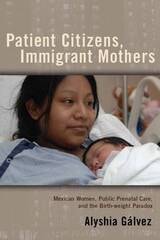
Patient Citizens, Immigrant Mothers
Mexican Women, Public Prenatal Care, and the Birth Weight ParadoxGalvez, Alyshia
Rutgers University Press, 2011
According to the Latina health paradox, Mexican immigrant women have less complicated pregnancies and more favorable birth outcomes than many other groups, in spite of socioeconomic disadvantage. Alyshia Gálvez provides an ethnographic examination of this paradox. What are the ways that Mexican immigrant women care for themselves during their pregnancies? How do they decide to leave behind some of the practices they bring with them on their pathways of migration in favor of biomedical approaches to pregnancy and childbirth?
This book takes us from inside the halls of a busy metropolitan hospital’s public prenatal clinic to the Oaxaca and Puebla states in Mexico to look at the ways Mexican women manage their pregnancies. The mystery of the paradox lies perhaps not in the recipes Mexican-born women have for good perinatal health, but in the prenatal encounter in the United States. Patient Citizens, Immigrant Mothers is a migration story and a look at the ways that immigrants are received by our medical institutions and by our society

Patients as Policy Actors
Hoffman, Beatrix
Rutgers University Press, 2011
Politics Of Women's Health
Susan Sherwin
Temple University Press, 1998
Rather than focusing on types of medical interventions, The Politics of Women's Health asks what feminist health care ethics looks like if we start with women's experiences and concerns. It begins to unravel two key concepts of women's empowerment -- agency and autonomy -- that apply to all areas of concern to women.
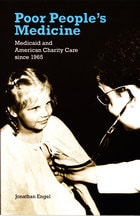
Poor People's Medicine
Medicaid and American Charity Care since 1965Jonathan Engel
Duke University Press, 2006
Starting with a brief overview of the history of charity medical care, Jonathan Engel presents the debates surrounding Medicaid’s creation and the compromises struck to allow federal funding of the nascent programs. He traces the development of Medicaid through the decades, as various states attempted to both enlarge the programs and more finely tailor them to their intended targets. At the same time, he describes how these new programs affected existing institutions and initiatives such as public hospitals, community clinics, and private pro bono clinical efforts. Along the way, Engel recounts the many political battles waged over Medicaid, particularly in relation to larger discussions about comprehensive health care and social welfare reform. Poor People’s Medicine is an invaluable resource for understanding the evolution and present state of programs to deliver health care to America’s poor.
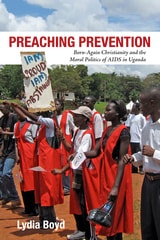
Preaching Prevention
Born-Again Christianity and the Moral Politics of AIDS in UgandaLydia Boyd
Ohio University Press, 2015
Preaching Prevention examines the controversial U.S. President’s Emergency Plan for AIDS Relief (PEPFAR) initiative to “abstain and be faithful” as a primary prevention strategy in Africa. This ethnography of the born-again Christians who led the new anti-AIDS push in Uganda provides insight into both what it means for foreign governments to “export” approaches to care and treatment and the ways communities respond to and repurpose such projects. By examining born-again Christians’ support of Uganda’s controversial 2009 Anti-Homosexuality Bill, the book’s final chapter explores the enduring tensions surrounding the message of personal accountability heralded by U.S. policy makers.
Preaching Prevention is the first to examine the cultural reception of PEPFAR in Africa. Lydia Boyd asks, What are the consequences when individual responsibility and autonomy are valorized in public health initiatives and those values are at odds with the existing cultural context? Her book investigates the cultures of the U.S. and Ugandan evangelical communities and how the flow of U.S.-directed monies influenced Ugandan discourses about sexuality and personal agency. It is a pioneering examination of a global health policy whose legacies are still unfolding.
Principles of Corporate Renewal
Harlan D. Platt
University of Michigan Press, 2023
Now in its third edition, Harlan D. Platt has revised, updated, and expanded the text. As the first edition did, this new Principles of Corporate Renewal cuts to the heart of the patterns, procedures, and pitfalls of bringing a corporation back to life and health.

Principles of Corporate Renewal, Second Edition
Harlan D. Platt
University of Michigan Press, 2004
Now in its second edition, Harlan D. Platt has revised, updated, and expanded the text to include a new chapter on bankruptcy law, a profile of the turnaround manager, and an overview of the typical turnaround engagement. As the first edition did, this new Principles of Corporate Renewal cuts to the heart of the patterns, procedures, and pitfalls of bringing a corporation back to life and health.

Private Bodies, Public Texts
Race, Gender, and a Cultural BioethicsKarla FC Holloway
Duke University Press, 2011
Private Guns, Public Health
David Hemenway
University of Michigan Press, 2004
-Richard F. Corlin, Past President, American Medical Association
"This lucid and penetrating study is essential reading for anyone who wishes to understand the tragedy of gun violence in America and-even more important-what we can do to stop it. David Hemenway cuts through the cant and rhetoric in a way that no fair-minded person can dismiss, and no sane society can afford to ignore."
-Richard North Patterson, novelist
"The rate of gun-related homicide, suicide, and accidental injury has reached epidemic proportions in American society. Diagnosing and treating the gun violence epidemic demands the development of public health solutions in conjunction with legislative and law enforcement strategies."
-Kweisi Mfume, President and CEO of NAACP
"In scholarly, sober analytic assessments, including rigorous critiques of NRA-popularized pseudoscience, David Hemenway constructs a convincing case that firearm availability is a critical and proximal cause of unparalleled carnage. By formulating such violence as a public health issue, he proposes workable policies analogous to ones that reduced injuries from tobacco, alcohol, and automobiles."
-Jerome P. Kassirer, Editor-in-Chief Emeritus, New England Journal of Medicine, and Distinguished Professor, Tufts University School of Medicine
"As a former District Attorney and Attorney General, I know the urgency of providing safe homes, schools and neighborhoods for all. This remarkable tour-de-force is a powerful study of one promising solution: a data-rich, eminently readable demonstration of why we should treat gun violence as an American epidemic."
-Scott Harshbarger, Former Attorney General of Massachusetts, President and CEO of Common Cause
On an average day in the United States, guns are used to kill almost eighty people, and to wound nearly three hundred more. If any other consumer product had this sort of disastrous effect, the public outcry would be deafening; yet when it comes to guns such facts are accepted as a natural consequence of supposedly high American rates of violence.
Private Guns, Public Health explodes that myth and many more, revealing the advantages of treating gun violence as a consumer safety and public health problem. David Hemenway fair-mindedly and authoritatively demonstrates how a public-health approach-which emphasizes prevention over punishment, and which has been so successful in reducing the rates of injury and death from infectious disease, car accidents, and tobacco consumption-can be applied to gun violence.
Hemenway uncovers the complex connections between guns and self-defense, gun violence and schools, gun prevalence and homicide, and more. Finally, he outlines a policy course that would significantly reduce gun-related injury and death.
With its bold new public-health approach to guns, Private Guns, Public Health marks a shift in our understanding of guns that will-finally-point us toward a solution.

Private Guns, Public Health, New Ed.
David Hemenway
University of Michigan Press, 2017
Hemenway fair-mindedly and authoritatively outlines a policy course that would significantly reduce gun-related injury and death, pointing us toward a solution.

Protecting American Health Care Consumers
Eleanor DeArman Kinney
Duke University Press, 2002
To promote and ensure consumer protection in an increasingly adversarial and complicated health-care culture, Kinney first analyzes the procedures by which consumer concerns are presently discerned and resolved and then explains why these systems are unsatisfactory. She also discusses problematic procedures for making coverage policy and quality standards and proposes reforms in a variety of processes that would enable all consumers, including the uninsured, to influence key policies and standards and also to raise concerns and obtain appropriate remedies.
As the first comprehensive treatment of administrative procedures in American health plans and other such institutions, Protecting American Health Care Consumers will be welcomed by state and federal policymakers, managed care executives, and lawyers charged with designing and implementing protections for consumers in public and private health plans.
Purchasing Population Health
Paying for ResultsDavid A. Kindig
University of Michigan Press, 1997