69 books match the query 'Hegel, Georg Wilhelm Friedrich' and 7 start with p
cover of Person, Being, and History

Person, Being, and History

Michael Baur

Catholic University of America Press, 2011
the various essays in this volume by colleagues and former students of Schmitz examine his thought and the subjects of his teaching. In addition to an overall exposition of his own thought, the collection treats themes such as gift, faith and reason, culture and dialogue, modernity and post-modernity
[more]
cover of Philosophical Legacies: Essays on the Thought of Kant, Hegel, and Their Contemporaries (Studies in Philosophy and the History of Philosophy, Volume 50)

Philosophical Legacies

Essays on the Thought of Kant, Hegel, and Their Contemporaries (Studies in Philosophy and the History of Philosophy, Volume 50)

Daniel O. Dahlstrom

Catholic University of America Press, 2008
The essays trace carefully the histories of the influences of earlier thinkers and their legacies upon later thinkers.
[more]
cover of Politics, Religion, and Art: Hegelian Debates

Politics, Religion, and Art

Hegelian Debates

Douglas Moggach

Northwestern University Press, 2011

The period from 1780 to 1850 witnessed an unprecedented explosion of philosophical creativity in the German territories. In the thinking of Kant, Schiller, Fichte, Hegel, and the Hegelian school, new theories of freedom and emancipation, new conceptions of culture, society, and politics, arose in rapid succession. The members of the Hegelian school, forming around Hegel in Berlin and most active in the 1830’s and 1840’s, are often depicted as mere epigones, whose writings are at best of historical interest. In Politics, Religion, and Art: Hegelian Debates, Douglas Moggach moves the discussion past the Cold War–era dogmas that viewed the Hegelians as proto-Marxists and establishes their importance as innovators in the fields of theology, aesthetics, and ethics and as creative contributors to foundational debates about modernity, state, and society.
[more]
cover of Practice, Power, and Forms of Life: Sartre’s Appropriation of Hegel and Marx

Practice, Power, and Forms of Life

Sartre’s Appropriation of Hegel and Marx

Terry Pinkard

University of Chicago Press, 2022

Philosopher Terry Pinkard revisits Sartre’s later work, illuminating a pivotal stance in Sartre’s understanding of freedom and communal action.

Jean-Paul Sartre’s Critique of Dialectical Reason, released to great fanfare in 1960, has since then receded in philosophical visibility. As Sartre’s reputation is now making a comeback, it is time for a reappraisal of his later work. In Practice, Power, and Forms of Life, philosopher Terry Pinkard interprets Sartre’s late work as a fundamental reworking of his earlier ideas, especially in terms of his understanding of the possibility of communal action as genuinely free, which the French philosopher had previously argued was impossible.

Pinkard reveals how Sartre was drawn back to Hegel, a move that was itself incited by Sartre’s newfound interest in Marxism. Pinkard argues that Sartre constructed a novel position on freedom that has yet to be adequately taken up and analyzed within philosophy and political theory. Through Sartre, Pinkard advances an argument that contributes to the history of philosophy as well as key debates on action and freedom.
[more]
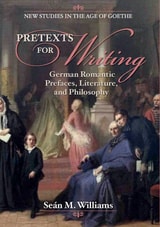
cover of Pretexts for Writing: German Romantic Prefaces, Literature, and Philosophy

Pretexts for Writing

German Romantic Prefaces, Literature, and Philosophy

Williams, Seán M

Bucknell University Press, 2019

Around 1800, print culture became a particularly rich source for metaphors about thinking as well as writing, nowhere more so than in the German tradition of Dichter und Denker. Goethe, Jean Paul, and Hegel (among many others) used the preface in order to reflect on the problems of writing itself, and its interpretation. If Sterne teaches us that a material book enables mind games as much as it gives expression to them, the Germans made these games more theoretical still. Weaving in authors from Antiquity to Agamben, Williams shows how European–and, above all, German–Romanticism was a watershed in the history of the preface. The playful, paradoxical strategies that Romantic writers invented are later played out in continental philosophy, and in post-Structuralist literature. The preface is a prompt for playful thinking with texts, as much as it is conventionally the prosaic product of such an exercise.

Published by Bucknell University Press. Distributed worldwide by Rutgers University Press.
[more]
cover of Prolegomena to Any Future Materialism: A Weak Nature Alone

Prolegomena to Any Future Materialism

A Weak Nature Alone

Adrian Johnston

Northwestern University Press, 2019

Adrian Johnston’s trilogy Prolegomena to Any Future Materialism aims to forge a thoroughly materialist yet antireductive theory of subjectivity. In this second volume, A Weak Nature Alone, Johnston focuses on the philosophy of nature required for such a theory. This volume is guided by a fundamental question: How must nature be rethought so that human minds and freedom do not appear to be either impossible or inexplicable within it? Asked differently: How must the natural world itself be structured such that sapient subjects in all their distinctive peculiarities emerged from and continue to exist within this world?

In A Weak Nature Alone, Johnston develops his transcendental materialist account of nature through engaging with and weaving together five main sources of inspiration: Hegelian philosophy, Marxist materialism, Freudian-Lacanian metapsychology, Anglo-American analytic neo-Hegelianism, and evolutionary theory and neurobiology. Johnston argues that these seemingly (but not really) strange bedfellows should be brought together so as to construct a contemporary ontology of nature. Through this ontology, nonnatural human subjects can be seen to arise in an immanent, bottom-up fashion from nature itself. 
[more]
cover of Prosaic Conditions: Heinrich Heine and the Spaces of Zionist Literature

Prosaic Conditions

Heinrich Heine and the Spaces of Zionist Literature

Na'ama Rokem

Northwestern University Press, 2013

In her penetrating new study, Na’ama Rokem observes that prose writing—more than poetry, drama, or other genres—came to signify a historic rift that resulted in loss and disenchantment. In Prosaic Conditions, Rokem treats prose as a signifying practice—that is, a practice that creates meaning. During the nineteenth and twentieth centuries, prose emerges in competition with other existing practices, specifically, the practice of performance. Using Zionist literature as a test case, Rokem examines the ways in which Zionist authors put prose to use, both as a concept and as a literary mode. Writing prose enables these authors to grapple with historical, political, and spatial transformations and to understand the interrelatedness of all of these changes.
[more]