Results by title
73 books match the query 'Higher Education' and 6 start with p
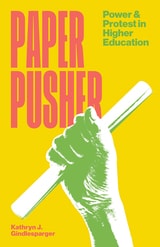
Paper Pusher
Power and Protest in Higher EducationKathryn J. Gindlesparger
University of Minnesota Press, 2027
Paperwork is the new protest: leveraging bureaucracy for progressive action
In contemporary higher education, power increasingly circulates through documents rather than debate, making paperwork one of the most consequential sites of protest. Yet as universities become more corporatized and subject to authoritarian influence, bureaucratic writing is often treated as passive, procedural, or politically neutral. Paper Pusher shows how paperwork is a central mechanism of governance and therefore a formidable, underused medium for democratic action and protest within bureaucracies.
Kathryn J. Gindlesparger reframes the “paper pusher” from a symbol of compliance into an agent of institutional accountability and resistance. She develops four avenues for protesting through bureaucracy—voice, filing, circulation, and stasis-seeking—showing how everyday documents such as meeting minutes, policy drafts, budgets, and accreditation reports can be used to push back against authoritarian and corporate forces that undermine an institution’s mission. Rather than emphasizing visible confrontation, Paper Pusher demonstrates how activism can operate quietly and credibly from within systems where overt protest may carry professional risk.
Grounded in story and lived experience, this book is a love letter to office workers, staff, and middle managers whose labor sustains institutions and whose expertise is often overlooked. It foregrounds feminist, working-class, queer, disabled, Black, and brown voices, highlighting how marginalized workers have long used bureaucratic knowledge to create access, protection, and change. Practical and people-centered, Paper Pusher calls for bureaucratic literacy to be taught wherever writing is taught, insisting that paperwork is not grunt work but power work.
Retail e-book files for this title are screen-reader friendly with images accompanied by short alt text and/or extended descriptions.
Power Despite Precarity
Strategies for the Contingent Faculty Movement in Higher EducationJoe Berry
Pluto Press, 2021
Higher education is the site of an ongoing conflict. At the heart of this struggle are the precariously employed faculty 'contingents' who work without basic job security, living wages or benefits. Yet they have the incentive and, if organized, the power to shape the future of higher education.
Power Despite Precarity is part history, part handbook and a wholly indispensable resource in this fight. Joe Berry and Helena Worthen outline the four historical periods that led to major transitions in the worklives of faculty of this sector. They then take a deep dive into the 30-year-long struggle by California State University lecturers to negotiate what is recognized as the best contract for contingents in the US.
The authors ask: what is the role of universities in society? Whose interests should they serve? What are the necessary conditions for the exercise of academic freedom? Providing strategic insight for activists at every organizing level, they also tackle 'troublesome questions' around legality, union politics, academic freedom and how to recognize friends (and foes) in the struggle.
Power Despite Precarity
Strategies for the Contingent Faculty Movement in Higher EducationJoe Berry
Pluto Press, 2021
Higher education is the site of an ongoing conflict. At the heart of this struggle are the precariously employed faculty 'contingents' who work without basic job security, living wages or benefits. Yet they have the incentive and, if organized, the power to shape the future of higher education.
Power Despite Precarity is part history, part handbook and a wholly indispensable resource in this fight. Joe Berry and Helena Worthen outline the four historical periods that led to major transitions in the worklives of faculty of this sector. They then take a deep dive into the 30-year-long struggle by California State University lecturers to negotiate what is recognized as the best contract for contingents in the US.
The authors ask: what is the role of universities in society? Whose interests should they serve? What are the necessary conditions for the exercise of academic freedom? Providing strategic insight for activists at every organizing level, they also tackle 'troublesome questions' around legality, union politics, academic freedom and how to recognize friends (and foes) in the struggle.

Private Sectors in Higher Education
Structure, Function, and Change in Eight CountriesRoger L. Geiger
University of Michigan Press, 1986

Productivity in Higher Education
Edited by Caroline M. Hoxby and Kevin Stange
University of Chicago Press, 2019

Pursuing Opportunitites Through Partnerships
Higher Education and CommunitiesBRUCE A. BEHRINGER
West Virginia University Press, 2004
In 1998, the W.W. Kellogg Foundation provided funding for four universities to collaborate with surrounding communities on mutually beneficial projects, through the Expanding Community Partnerships Program. In a series of innovative learning collaborations, East Tennessee University, the University of Texas at El Paso, West Virginia University, and Northeastern University established strong, sustainable partnerships with organizations in their local communities. Although each university approached its partnering differently, they all shared the goal of benefiting the underserved communities where they are located and transforming their institutions by enhancing students’ educational experiences and strengthening faculty, student, administration, and staff relationships with local residents. This book shares those relationship-building experiences of the four universities and communities. Highly recommended for all public and higher education administrators; for students and teachers of education, business, and sociology; and for those interested in innovative business and social-service models.