Results by title
72 books match the query 'Hinduism' and 3 start with p
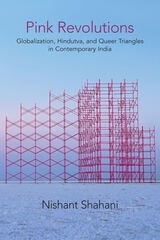
Pink Revolutions
Globalization, Hindutva, and Queer Triangles in Contemporary IndiaNishant Shahani
Northwestern University Press, 2021
Eschewing structures of absolute complicity or abject alterity, Pink Revolutions pays attention to the logics of triangulation in various contexts: gay tourism, university campus politics, diasporic cultural productions, and AIDS activism. The book articulates a framework through which queer politics can challenge rather than participate in neoliberal imperatives, an approach that will interest scholars engaged with queer studies and postcolonial scholarship, as well as activists and academics wrestling with global capitalism and right-wing regimes around the world.
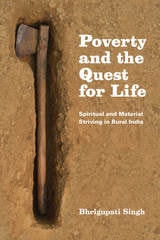
Poverty and the Quest for Life
Spiritual and Material Striving in Rural IndiaBhrigupati Singh
University of Chicago Press, 2015
The Indian subdistrict of Shahabad, located in the dwindling forests of the southeastern tip of Rajasthan, is an area of extreme poverty. Beset by droughts and food shortages in recent years, it is the home of the Sahariyas, former bonded laborers, officially classified as Rajasthan’s only “primitive tribe.” From afar, we might consider this the bleakest of the bleak, but in Poverty and the Quest for Life, Bhrigupati Singh asks us to reconsider just what quality of life means. He shows how the Sahariyas conceive of aspiration, advancement, and vitality in both material and spiritual terms, and how such bridging can engender new possibilities of life.
Singh organizes his study around two themes: power and ethics, through which he explores a complex terrain of material and spiritual forces. Authority remains contested, whether in divine or human forms; the state is both despised and desired; high and low castes negotiate new ways of living together, in conflict but also cooperation; new gods move across rival social groups; animals and plants leave their tracks on human subjectivity and religiosity; and the potential for vitality persists even as natural resources steadily disappear. Studying this milieu, Singh offers new ways of thinking beyond the religion-secularism and nature-culture dichotomies, juxtaposing questions about quality of life with political theologies of sovereignty, neighborliness, and ethics, in the process painting a rich portrait of perseverance and fragility in contemporary rural India.
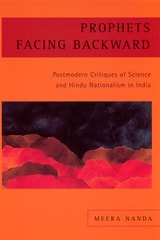
Prophets Facing Backward
Postmodern Critiques of Science and Hindu Nationalism in IndiaNanda, Meera
Rutgers University Press, 2003
The leading voices in science studies have argued that modern science reflects dominant social interests of Western society. Following this logic, postmodern scholars have urged postcolonial societies to develop their own “alternative sciences” as a step towards “mental decolonization”. These ideas have found a warm welcome among Hindu nationalists who came to power in India in the early 1990s. In this passionate and highly original study, Indian-born author Meera Nanda reveals how these well-meaning but ultimately misguided ideas are enabling Hindu ideologues to propagate religious myths in the guise of science and secularism.
At the heart of Hindu supremacist ideology, Nanda argues, lies a postmodernist assumption: that each society has its own norms of reasonableness, logic, rules of evidence, and conception of truth, and that there is no non-arbitrary, culture-independent way to choose among these alternatives. What is being celebrated as “difference” by postmodernists, however, has more often than not been the source of mental bondage and authoritarianism in non-Western cultures. The “Vedic sciences” currently endorsed in Indian schools, colleges, and the mass media promotes the same elements of orthodox Hinduism that have for centuries deprived the vast majority of Indian people of their full humanity.
By denouncing science and secularization, the left was unwittingly contributing to what Nanda calls “reactionary modernism.” In contrast, Nanda points to the Dalit, or untouchable, movement as a true example of an “alternative science” that has embraced reason and modern science to challenge traditional notions of hierarchy.