Results by title
184 books match the query 'Hispanic Americans' and 8 start with p

Playful Protest
The Political Work of Joy in Latinx MediaKristie Soares
University of Illinois Press, 2023
Joy is a politicized form of pleasure that goes beyond gratification to challenge norms of gender, sexuality, race, and class. Kristie Soares focuses on the diasporic media of Puerto Rico and Cuba to examine how music, public activist demonstrations, social media, sitcoms, and other areas of culture resist the dominant stories told about Latinx joy. As she shows, Latinx creators compose versions of joy central to social and political struggle and at odds with colonialist and imperialist narratives that equate joy with political docility and a lack of intelligence. Soares builds her analysis around chapters that delve into gozando in salsa music, precise joy among the New Young Lords Party, choteo in the comedy ¿Qué Pasa U.S.A.?, azúcar in the life and death of Celia Cruz, dale as Pitbull’s signature affect, and Alexandria Ocasio-Cortez’s use of silliness to take seriously political violence.
Daring and original, Playful Protest examines how Latinx creators resist the idea that joy only exists outside politics and activist struggle.

Pleas and Petitions
Hispano Culture and Legislative Conflict in Territorial ColoradoVirginia Sánchez
University Press of Colorado, 2021
Sánchez highlights the struggles experienced by Hispano territorial assemblymen trying to create opportunity and a better life in the face of cultural conflict and the institutional racism used to effectively shut them out of the process of establishing new laws and social order. For example, the federal and Colorado territorial governments did not provide an interpreter for the Hispano assemblymen or translations of the laws passed by the legislature, and they taxed Hispano constituents without representation and denied them due process in court.
The first in-depth history of Hispano sociopolitical life during Colorado’s territorial period, Pleas and Petitions provides fundamental insight into Hispano settlers’ interactions with their Anglo neighbors, acknowledges the struggles and efforts of those Hispano assemblymen who represented southern Colorado during the territorial period, and augments the growing historical record of Hispanos who have influenced the course of Colorado’s history.
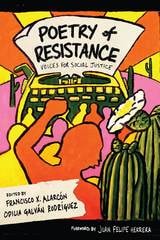
Poetry of Resistance
Voices for Social JusticeEdited by Francisco X. Alarcón and Odilia Galván Rodríguez
University of Arizona Press, 2016
Since then, more than three thousand original contributions by poets and artists from around the globe have been posted to the page. Poetry of Resistance offers a selection of these works, addressing a wide variety of themes, including racial profiling, xenophobia, cultural misunderstanding, violence against refugees, shared identity, and much more. Contributors include distinguished poets such as Francisco Aragón, Devreaux Baker, Sarah Browning, Lorna Dee Cervantes, Susan Deer Cloud, Sharon Dubiago, Martín Espada, Genny Lim, Pam Uschuk, and Alma Luz Villanueva.
Bringing together more than eighty writers, the anthology powerfully articulates the need for change and the primacy of basic human rights. Each poem shows the heartfelt dedication these writers and artists have to justice in a world that has become larger than borders. Poetry of Resistance is a poetic call for tolerance, reflection, reconciliation, and healing.

Precarious Privilege
Race and the Middle-Class Immigrant ExperienceIrene Browne
Russell Sage Foundation, 2024
Browne finds that when asked to identify themselves by race, these immigrants either reject racial identities entirely or draw on belief systems from Mexico and the Dominican Republic that emphasize European-indigenous mixed race identities. When branded as typical Latines in the U.S., Mexican middle-class immigrants emphasize their social class or explain that a typical Latine can be middle-class, while Dominicans simply indicate that they are not Mexican. Rather than blame systemic racism, both Mexican and Dominican middle-class immigrants often attribute misperceptions of their identity to non-Latines’ ignorance or to individual Latines’ lack of effort in trying to assimilate.
But these middle-class Latine immigrants do not simply seek to position themselves on par with the U.S.-born white middle class. Instead, they leverage their cosmopolitanism—for example, their multilingualism or their children’s experiences traveling abroad—to engage in what Browne calls “one-up assimilation,” a strategy that aims to position them above the white middle class, who are often monolingual and unaware of the world outside the United States. Middle-class Latines’ cosmopolitanism and valuing of diversity also lead them to have cordial relations with African Americans, but these immigrants do not see themselves as sharing African Americans’ status as oppressed minorities.
Although the stereotype of the typical Latine has made middle-class Latine immigrants susceptible to stigma, they insist that this stigma does not play a significant role in their lives. In many cases, they view the stereotype as a minor issue, feel that opportunities for upward mobility outweigh any negative experiences, or downplay racism by emphasizing their class privilege. Browne observes that while downplaying racism may help middle-class Latine immigrants maintain their dignity, it also perpetuates inequality by reinforcing the lower status of working-class undocumented immigrants. It is thus imperative, Browne argues, to repeal harsh anti-immigration policies, a move that will not only ease the lives of the undocumented but also send a message about who belongs in the country.
Offering a nuanced exploration of how race, social class, and immigration status intersect, Precarious Privilege provides a complex portrait of middle-class Latine immigrants in the United States today.
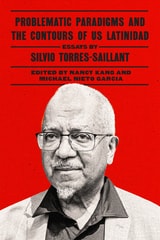
Problematic Paradigms and the Contours of US Latinidad
Essays by Silvio Torres-SaillantEdited by Nancy Kang and Michael Nieto Garcia
University of Texas Press, 2026
Silvio Torres-Saillant’s collected writings examine political contradictions within Latinx identity in the United States.
Since the 1990s Silvio Torres-Saillant’s work has questioned the notion of Latinidad, challenging presumptions of panethnic unity within the US Hispanic population and assessing dominant modes of Latinx representation. The essays in Problematic Paradigms and the Contours of US Latinidad examine the dynamics of a diverse collective of over 65 million people whose cultural heritage, ancestral origins, and belief systems arguably differ as much as they resemble one another. The volume dissects prevailing assumptions, namely the essentializing sense of homogeneity in the Latinx “community,” which mask important nuances and fascinating contradictions. Torres-Saillant also targets the role of marketing and mass communications in shaping popular perceptions of ethnic groups, thereby tracing connections between media rhetoric and the language of scholarship.
Newly revised by editors Nancy Kang and Michael Nieto Garcia, this collection curates Torres-Saillant’s core contributions to Latinx studies over the last two decades and underscores the veteran scholar’s evolving thoughts on key conversations in the field. The epilogue narrates his beginnings in Caribbean studies, acknowledges his ongoing analysis of Dominican blackness, and discourages uncritical views of cultural heritage.
Public Negotiations
Gender and Journalism in Contemporary US Latina/o LiteratureAriana E. Vigil
The Ohio State University Press, 2019
Vigil also reveals how these conversations inevitably engage with gender concerns, showing how the role of gender in this relationship is neither static nor consistent over time. Examining how these works represent such things as gendered Latina/o counter publics, how Central American–American communities are gendered in relation to other US Latina/o communities, how and why gendered expressions of Latinidad are produced and marketed, and how print media provides an important space for dissemination of diverse ideas, Public Negotiations considers the way in which gender functions in terms of both the construction and reception of a Latina/o public in a transnational space. Through thorough examination and with deep insight, Vigil shows how literature can invaluably reflect current and historical issues surrounding media and the public sphere and help us imagine new, hopefully better, possibilities.
Publishing Latinidad
Latinx Literary and Intellectual Production, 1880–1960Jose O. Fernandez
University of Arizona Press, 2025
Publishing Latinidad brings to light the overlooked contributions of early Latinx writers and intellectuals, offering a fresh perspective on their roles in shaping American literary and cultural landscapes.
Jose O. Fernandez meticulously examines the works of notable figures like José Martí, Arturo Schomburg, Jesús Colón, José de la Luz Sáenz, Adela Sloss-Vento, and Américo Paredes, illuminating their innovative approaches to circumventing exclusionary practices in the publishing world. He demonstrates how these writers and intellectuals entered literary, cultural, and intellectual discourses through alternative modes of literary production: crónicas, translations, paratexts, bibliographies, archival practices, sketches, diaries, biographies, unpublished fiction, and scholarly monographs. Through these examples, Fernandez situates Latinx literary production in this time period within the broader context of racial and ethnic solidarity movements in the United States.
Publishing Latinidad is essential reading for anyone interested in the social and cultural underpinnings of Latinx literature and intellectual thought. It challenges traditional narratives and enriches our appreciation of the diverse voices that have long been instrumental in the fight for justice.
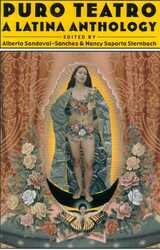
Puro Teatro, A Latina Anthology
Edited by Alberto Sandoval-Sánchez and Nancy Sandoval Sternbach
University of Arizona Press, 2000
Puro Teatro, A Latina Anthology includes a variety of theatrical genres: plays, performance pieces, puppet shows, innovative collaborations, and testimonials. It features previously unpublished plays from a broad range of experiences within the Latino/a community, including families and home, friends and community building, coming of age and empowerment, and sexual and ethnic identities. The editors' introduction provides a comprehensive survey of contemporary Latina theater, placing it in its theatrical context and examining its divergent roots. Puro Teatro, A Latina Anthology is the first book of its kind to reflect in print a diversified body of writing that turns the spotlight on some of America's most talented and prolific artists. A subsequent volume will complement this anthology with a theoretical, critical reading of Latina theater and performance.
CONTENTS
Botánica by Dolores Prida
Heart of the Earth: A Popul Vuh Story by Cherríe Moraga
The Fat-Free Chicana and the Snow Cap Queen by Elaine Romero
One-act Plays
Las nuevas tamaleras by Alicia Mena
And Where Was Pancho Villa When You Really Needed Him? by Silviana Wood
Fuschia by Janis Astor del Valle
Performance Pieces
Nostalgia Maldita: 1-900-MEXICO : A StairMaster Piece by Yareli Arizmendi
Good Grief, Lolita by Wilma Bonet
A Roomful of Men by Amparo García Crow
Describe Your Work by Monica Palacios
Testimonials
"Battle Worn," by Laura Esparza
"Dancing with the Voice of Truth," by María Mar
"Searching for Sanctuaries: Cruising through Town in a Red Convertible," by Diane Rodríguez
"Home, Desire, Memory: There Are No Borders Here," by Caridad Svich
"Tales of a South-of-the-Border/North-of-the-Stereotype Theatre Director, by Susana Tubert
"Catching the Next Play: The Joys and Perils of Playwriting," by Edit Villarreal
Full-Length Plays, Collaborative Works
Frida: The Story of Frida Kahlo by Migdalia Cruz and Hilary Blecher
Memorias de la revolución by Carmelita Tropicana and Uzi Parnes