Results by title
883 books match the query 'Historical' and 20 start with p
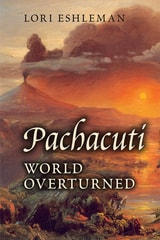
Pachacuti
World OverturnedLori Eshleman
Arizona Center for Medieval and Renaissance Studies, 2015
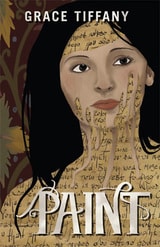
Paint
Grace Tiffany
Arizona Center for Medieval and Renaissance Studies, 2013
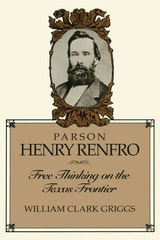
Parson Henry Renfro
Free Thinking on the Texas FrontierBy William C. Griggs
University of Texas Press, 1994
The years following the Texas Revolution held even more turbulent events as diverse droves of pioneers crossed the Sabine and Red Rivers to start new lives in Texas. Early Texas society contended with religious issues, family life in a rugged environment, and the Civil War. This cultural history was clearly reflected in the life of frontier preacher Henry C. Renfro.
Migrating to Texas in 1851, Renfro enrolled in the fledgling Baylor University and became a Baptist preacher. Eventually disillusioned with Baptist orthodoxy, Renfro was disenfranchised on charges of infidelity as he embraced the ideals of the Free Thought Movement, inspired by the writings of men such as Thomas Paine, Spinoza, and Robert Ingersoll.
Renfro's Civil War experience was no less unusual. Serving as both soldier and chaplain, Renfro left a valuable legacy of insight into the conflict, captured in a wealth of correspondence that is in itself significant.
Drawing on a vast body of letters, speeches, sermons, and oral histories that had never before been available, this chronological narrative of "The Parson's" life describes significant changes in Texas from 1850 to 1900, especially the volatile formation and growth of Baptist churches in North Central Texas. William Griggs' study yields numerous new details about the Free Thought Movement and depicts public reaction to sectarian leaders in nineteenth-century Texas.
The author also describes the developing Central Texas region known as the Cross Timbers, including the personal dynamics between a frontier family and its patriarch and encompassing such issues as property conflicts, divorce, and family reconciliation. This work unlocks an enlightening, engaging scene from Texas history.
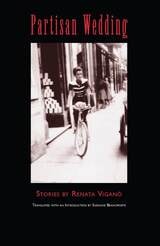
Partisan Wedding
StoriesStories by Renata Vigano & Translated by Suzanne Branciforte
University of Missouri Press, 1999
A generation of Italian authors dedicated their lives, their works, and their voices to the primary driving force behind twentieth-century narratives of World War II. Renata Viganò was an active member of the Italian Resistance during World War II, and, like many of her male counterparts, she depicted the actions of the brave people who contributed to and participated in the partisan movement. Unlike her counterparts, however, Viganò vividly portrayed the experiences of women, notably women on the front line, in her posthumously published Matrimonio in brigata, here translated for the first time in English as Partisan Wedding.
"If it had not been for them, the women . . . who got used to `men's business,' . . . the partisan army would have lost a vital, necessary force." The women in Partisan Wedding joined the struggle for many reasons; some for their husbands, others for their fathers, brothers, or sons; some for a sense of justice and the desire to do what was right. Whatever the cause, Viganò demonstrates that women maintained the ability to nurture and to care, to preserve their female qualities in the face of war.
Because of her own role as a partisan, the stories in Partisan Wedding are based on Viganò's personal experiences. Two stories in the collection are specifically autobiographical: "Acquitted" and "My Resistance." Relating her own plight to find her husband, a partisan commander, after his sudden arrest, "Acquitted" aptly conveys Viganò's struggle to maintain her strength in the face of complete helplessness. "My Resistance" is a personal account of her own experiences during the war and the women she met along the way.
Partisan Wedding is an invaluable contribution to the literature of the Second World War, completing the picture of those involved in the struggle for freedom. Viganò's remarkable prose, equally beautiful and terrible in its description of the minute details of human suffering and sacrifice, opens a window to a world that has rarely been seen, and a world not easily forgotten.
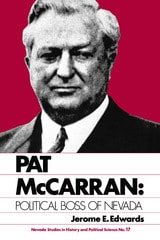
Pat McCarran
Political Boss Of NevadaJerome E. Edwards
University of Nevada Press, 1982
Within his native state of Nevada, McCarran constructed a machine designed to dominate the state’s political and economic life. This domination, which extended to both political parties, was built on personal favors for constituents, shrewd use of patronage, rewards for friends, and inevitable punishment for those suspected of being enemies. Ironically, the Senator employed the same tactics that others had once used against him to stymie his own early political efforts.
This work discusses the Senator’s background, his rise to power, and his methods of establishing political domination. Personal correspondence, excerpts from speeches, newspaper editorials, and interviews all help bring to life a colorful account of a controversial, driven man who held the levers of political control in Nevada during the early twentieth century.
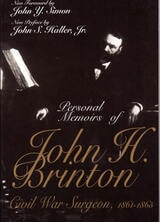
Personal Memoirs of John H. Brinton
Civil War Surgeon, 1861-1865John H. Brinton. Preface by John S. Haller, Jr. Foreword by John Y. Simon
Southern Illinois University Press, 1996
John Hill Brinton (1832–1907) met, observed, and commented on practically the entire hierarchy of the Union army; serving as medical director for Ulysses S. Grant, he came into contact with Philip H. Sheridan, John C. Frémont, Henry W. Halleck, William A. Hammond, D. C. Buell, John A. Rawlins, James Birdseye McPherson, C. F. Smith, John A. McClernand, William S. Rosecrans, and his first cousin George Brinton McClellan. John Y. Simon points out in his foreword that Brinton was one of the first to write about a relatively obscure Grant early in the war:
"Brinton found a quiet and unassuming man smoking a pipe—he could not yet afford cigars— and soon recognized a commander with mysterious strength of intellect and character."
Positioned perfectly to observe the luminaries of the military, Brinton also occupied a unique perspective from which to comment on the wretched state of health and medicine in the Union army and on the questionable quality of medical training he found among surgeons. With both A.B. and A.M. degrees from the University of Pennsylvania and postgraduate training in Paris and Vienna at a time when most medical schools required only a grammar school education, Brinton was exceptional among Civil War doctors. He found, as John S. Haller, Jr., notes in his preface, "the quality of candidates for surgeon’s appointments was meager at best." As president of the Medical Examining Board, Brinton had to lower his standards at the insistence of Secretary of War Edwin Stanton. Haller points out that one "self-educated candidate for an appointment as brigade surgeon explained to the board that he could do ‘almost anything, from scalping an Indian, up and down.’" Brinton assigned this singular candidate to duty in Kansas "where Brinton hoped he would do the least amount of damage." Throughout the war, the dearth of qualified surgeons created problems.
Brinton’s memoirs reveal a remarkable Civil War surgeon, a witness to conditions in Cairo, the Battle of Belmont, and the Siege of Fort Donelson who encountered almost every Union military leader of note.
Brinton wrote his memoirs for the edification of his family, not for public consumption. Yet he was, as Haller notes, a "keen observer of character." And with the exception of Brinton’s acceptance of late nineteenth-century gossip favorable to his cousin General McClellan, Simon finds the memoirs "remarkable for accuracy and frankness." His portrait of Grant is vivid, and his comments on the state of medicine during the war help explain, in Haller’s terms, why the "Civil War was such a medical and human tragedy."
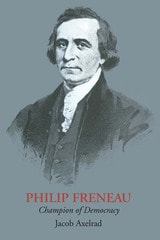
Philip Freneau
Champion of DemocracyBy Jacob Axelrad
University of Texas Press, 1967
Philip Freneau was a poet, editor, and mariner. A graduate of Princeton, he was the roommate of James Madison and a classmate of Hugh Henry Brackenridge and Aaron Burr. When the colonies rebelled against England, he supported his newly born nation as a privateer, spending some time in a British prison as a result. He also served, more effectively, as “the poet of the Revolution.” Later he became the journalistic voice of the democrats.
Ardently devoted to liberty, he believed himself to be a defender of the common man, for whom he fought selflessly and often vitriolicly throughout his life. In newspapers such as The Freeman’s Journal, The New York Daily Advertiser, The National Gazette, The Jersey Chronicle, and The Time-Piece, he published articles, letters, and poems, instructing the citizens of the new Republic about their rights, and attacking those who, he believed, were infringing on those rights. In the midst of the controversy in which he was so often involved, he also found time to write a small body of poetry whose sensitivity and beauty mark him as the poetic equal of his European contemporaries, and, in fact, as a precursor of the new Romantic movement
In Philip Freneau: Champion of Democracy Jacob Axelrad provides a detailed biography of this pensman of the Revolution and early Republic. He gives a sympathetic, imaginative, perceptive, yet objective interpretation of Freneau and his place in history, and at the same time he presents a delightfully readable and clear picture of the period during which the poet lived.
These pages not only re-create the battles between Whig and Tory, federalist and democrat, but they also are alive with the activities and philosophies of the men who made American history. James Madison, Thomas Jefferson, Alexander Hamilton, George Washington, John Adams, James Monroe go about the business of creating and shaping a new country, and as they do, they move into and out of the life of the poet of Monmouth, influencing him in a variety of ways.
Above all, Axelrad brings to life for the reader the man Freneau: simple, direct, often uncritical in his devotion to the cause he believed in; courageous in sustaining his stand against strong opposition; disillusioned and pessimistic about human nature, yet boldly optimistic about the future of humanity and of his country. And always behind the furor the reader is aware of the man struggling to provide a living for himself and his family, and never quite succeeding.
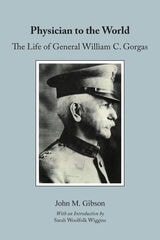
Physician to the World
The Life of General William C. GorgasJohn M. Gibson
University of Alabama Press, 1989
The remarkable story of the physician whose public health victories changed the world.
Physician to the World by John M. Gibson is a study of the career of William Crawford Gorgas, focusing primarily on the 22 years from the Spanish-American War until his death at the age of 65. The book details the medical community’s gradual acceptance of the mosquito theory as the cause for yellow fever epidemics and follows Gorgas as his initial skepticism gave way to belief while he participated in Walter Reed’s massive cleanup of Havana. From this success Gorgas moved to the Panama Canal Zone and a bureaucratic quagmire as he attempted to apply sanitary principles there to control yellow fever and malaria. As canal construction proceeded, assorted red-tape and critics repeatedly thwarted Gorgas’s efforts. His particular nemesis was the imperious engineer George Goethals, who ruled the construction project with an iron hand. Gorgas’s dogged persistence to make Panama healthy for both Americans and natives eventually succeeded, enabling the project to be completed with minimum loss of life. During World War I Gorgas became U.S. Surgeon General, and finally his reputation equaled his accomplishments. He traveled widely in Europe, South Africa, and South America on behalf of public health improvements and was about to begin another such journey when he died of complications from a stroke in London in 1920.
Picturing Texas Politics
A Photographic History from Sam Houston to Rick PerryBy Chuck Bailey; with historical text by Patrick Cox; introduction by John Anderson
University of Texas Press, 2015
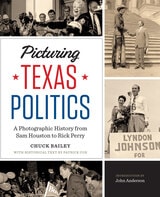
With rare, previously unpublished photographs and iconic images of politicians from the state’s founders to Ann Richards, George W. Bush, and Rick Perry, here is the first-ever photographic album of Texas politicians and political campaigns.
The Republic of Texas was founded in 1839, around the time that photography was being invented. So while there were no photographers at the Alamo or San Jacinto, they arrived soon after to immortalize, on film, Sam Houston, David Burnett, Mirabeau Lamar, and many other founding fathers of the Lone Star State. Over the following nearly two centuries, Texas politics and politicians have provided reliable, often dramatic, and sometimes larger-than-life subjects for photographers to capture in the moment and add to the historical record.
Picturing Texas Politics presents the first photographic album of Texas politicians and political campaigns ever assembled. Chuck Bailey has searched archives, museums, libraries, and private collections to find photographs that have never been published, as well as iconic images, such as Russell Lee’s pictures of one of Ralph Yarborough’s campaigns. These photographs are arranged into four chronological sections, each one introduced by historian Patrick Cox, who also provides informative photo captions. The photographs display power and political savvy from the early Republic to Lyndon Johnson and Bob Bullock; unmatched dedication to Texas in the Hobby and Bush families; and the growing influence of women in politics, from Miriam “Ma” Ferguson to Barbara Jordan, Ann Richards, and Kay Bailey Hutchison. With Sam Houston’s jaguar vest, W. Lee “Pappy” O’Daniel’s hillbilly band, a famous governor with an ostrich, and prominent Texans eating watermelons, shooting guns, and riding horses, this is Texas politics at its liveliest and best.
Pinnick Kinnick Hill
An American StoryBy G. W. González, Edited by Mark Brazaitis, with a Preface by Suronda González, with a Spanish translation Las colinas sueñan en español by Daniel Ferreras
West Virginia University Press, 2006
Nearly a century ago, hundreds of families journeyed from Spain to the United States, to search for a better life in the growing zinc-industry towns of Harrison County, West Virginia. As they created a new culture and a new home in this strange land, they added another thread to the rich fabric of our nation. Writing from his perspective as a first-generation son of this immigrant community, González recounts his childhood memories of his neighborhood, where these immigrants raised their families, worked in the often insufferable conditions of the zinc factories, and celebrated "romerias" and feast days with their neighbors.
Playing from Memory
David Milofsky
University Press of Colorado, 1999
Ben Seidler, an intense, passionately committed violist, is at the height of his career as a member of the Casa Bella Quartet, one of the foremost string quartets in the nation. His gifts as a concert artist had always been intuitive, but love did not come so easily. It took determination to win the hand of his wife, Dory, who was reluctant to set aside her ambitions of becoming an artist.
Their marriage is at once complex and ordinary, balancing the rigors of long rehearsal sessions against the daily round of family life with their two sons. Then suddenly the rhythm of their lives is shattered when Ben falls victim to multiple sclerosis. Stubbornly independent, Ben refuses to rely on others until necessity forces him to see that there are things beyond his control. Through a new closeness with his aging father, his older son, and, most importantly, Dory, he learns to accept help and to appreciate human frailty and affection.
As Ben's health declines, Dory is forced to resume her career and compete in a world dominated by men, and to re-examine her feelings and commitment to her husband. As their lives change, so does their marriage, and Ben and Dory forge a new kind of love, a fierce love that sustains them through everything.
Plotting History
The Russian Historical Novel in the Imperial AgeDan Ungurianu
University of Wisconsin Press, 2007
Balanced precariously between fact and fiction, the historical novel is often viewed with suspicion. Some have attacked it as a mongrel form, a “bastard son” born of “history’s flagrant adultery with imagination.” Yet it includes some of the most celebrated achievements of Russian literature, with Alexander Pushkin, Nikolai Gogol, Leo Tolstoy, and scores of other writers contributing to this tradition.
Dan Ungurianu’s Plotting History traces the development of the Russian historical novel from its inception in the romantic era to the emergence of Modernism on the eve of the Revolution. Organized historically and thematically, the study is focused on the cultural paradigms that shaped the evolution of the genre and are reflected in masterpieces such as The Captain’s Daughter and War and Peace. Ungurianu examines the variety of approaches by which Russian writers combined fact with fiction and explores the range of subjects that inspired the Russian historical imagination.
Outstanding Academic Title, Choice Magazine
“Ungurianu has produced a most valuable work for literary scholars.”—Andrew M. Drozd, Slavic and East European Journal
“[Ungurianu’s] overwhelming knowledge, impeccable documentation, erudite notes, and valuable addenda make for a treasure house of information and keen analysis. . . . Essential.”—Choice
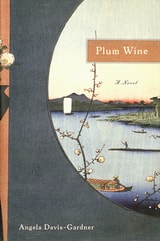
Plum Wine
A NovelAngela Davis-Gardner
University of Wisconsin Press, 2006
Barbara Jefferson, a young American teaching in Tokyo in the 1960s, is set on a life-changing quest when her Japanese surrogate mother, Michi, dies, leaving her a tansu of homemade plum wines wrapped in rice paper. Within the papers Barbara discovers writings in Japanese calligraphy that comprise a startling personal narrative. With the help of her translator, Seiji Okada, Barbara begins to unravel the mysteries of Michi's life, a story that begins in the early twentieth century and continues through World War II and its aftermath.
As Barbara and Seiji translate the plum wine papers they form an intimate bond, with Michi a ghostly third in what becomes an increasingly uneasy triangle. Barbara is deeply affected by the revelation that Michi and Seiji are hibakusha, survivors of the atomic bombing in Hiroshima, and even harder for her to understand are the devastating psychological effects wrought by war. Plum Wine examines human relationships, cultural differences, and the irreparable consequences of war in a story that is both original and timeless.
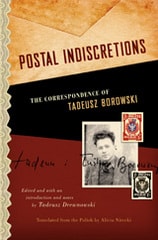
Postal Indiscretions
The Correspondence of Tadeusz BorowskiTadeusz Drewnowski
Northwestern University Press, 2007
This correspondence in this volume expands on the insights of Borowski’s published work and extends to the less-documented aftermath of the Holocaust in postwar Poland and East Germany. The volume opens with Borowski’s letter to his mother from Pawiak Prison the day after his arrest and closes with an unsigned telegram informing his parents of his suicide. The letters to and from family members, friends, and literary figures offer an indispensable picture of the world in the wake of the Nazis—and of the indelible stain that experience left upon the literature, politics, and life of Eastern Europe, in particular upon one gifted and doomed writer.
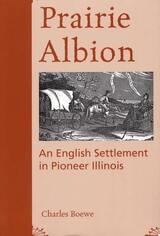
Prairie Albion
An English Settlement in Pioneer IllinoisCharles Boewe
Southern Illinois University Press, 1999
Originally published in 1962, this story of the English Settlement in pioneer Illinois is compiled from the eyewitness accounts of the participants. The founders, Morris Birkbeck and George Flower, as well as their associates and the many visitors to their prairie settlement, wrote mainly for immediate and sometimes controversial ends. Charles Boewe has selected excerpts from letters, descriptions, diaries, histories, and periodicals within a chronological framework to emphasize the implicit drama of the settlers' deeds as they searched for a suitable site, founded their colony, and augmented their forces with new arrivals from England. No less dramatic is the subsequent estrangement of the two founders, the disillusionment of many of the English settlers, the untimely death of Birkbeck, and the financial ruin of Flower.

Prater Violet
Christopher Isherwood
University of Minnesota Press, 2001

Prierias
The Life and Works of Silvestro Mazzolini Da Prierio (1456–1527)Michael Tavuzzi
Duke University Press, 1997
Tavuzzi shows that, aside from being Luther’s first opponent, Prierias played a key role in significant early-sixteenth-century controversies such as the cases of Reuchlin, Erasmus, and Pomponazzi. Drawing on previously untapped primary sources, Tavuzzi traces Prierias’s early career as preacher, professor, inquisitor, and administrator, and places him in the context of the struggles fought between unreformed and observant friars during the Renaissance. Prierias’s activities as Master of the Sacred Palace, his long-standing and bitter conflict with Cardinal Cajetan, and especially his forceful writings warning against the threat of witches and witchcraft are also described. Focusing closely on Prierias’s clash with Luther, Tavuzzi accounts for its development and illuminates the ecclesiological issues at stake. Prierias reveals the little-known world of the friars on the eve of the Reformation.
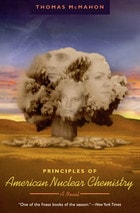
Principles of American Nuclear Chemistry
A NovelThomas McMahon
University of Chicago Press, 1970

Purged by Fire
Heresy of the CatharsDiane Bonavist
Arizona Center for Medieval and Renaissance Studies, 2000

Pushkin's Button
Serena Vitale
University of Chicago Press, 2000
"Pushkin's Button will keep all constituencies of reader fastened to their seats, as they watch Petersburg's lofty denizens leave no moment of the hurtling Pushkin scandal unrecorded or not speculated on."—Monika Greenleaf,Los Angeles Times
"[A] deliciously entertaining whydunit, a book in which every page seduces with a riddle. . . . Vivacious, seductive, original."—Michael Dirda, Washington Post
"A delightful combination of retrograde pleasures (court balls, the demise of a doomed genius) and primary sources. . . . Illuminating."—Richard Lamb, New York Times Book Review
"A book almost impossible to put down."—George Steiner, New Yorker