Results by title
71 books match the query 'Historical Events' and 3 start with p
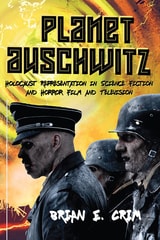
Planet Auschwitz
Holocaust Representation in Science Fiction and Horror Film and TelevisionBrian E. Crim
Rutgers University Press, 2020
Planet Auschwitz explores the diverse ways in which the Holocaust influences and shapes science fiction and horror film and television by focusing on notable contributions from the last fifty years. The supernatural and extraterrestrial are rich and complex spaces with which to examine important Holocaust themes - trauma, guilt, grief, ideological fervor and perversion, industrialized killing, and the dangerous afterlife of Nazism after World War II. Planet Auschwitz explores why the Holocaust continues to set the standard for horror in the modern era and asks if the Holocaust is imaginable here on Earth, at least by those who perpetrated it, why not in a galaxy far, far away? The pervasive use of Holocaust imagery and plotlines in horror and science fiction reflects both our preoccupation with its enduring trauma and our persistent need to “work through” its many legacies.
Planet Auschwitz website (https://planetauschwitz.com)
Planet Auschwitz website (https://planetauschwitz.com)
[more]
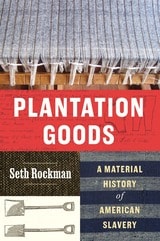
Plantation Goods
A Material History of American SlaverySeth Rockman
University of Chicago Press, 2024
A Pulitzer Prize finalist in History, this eye-opening rethinking of nineteenth-century American history reveals the interdependence of the Northern industrial economy and Southern slave labor.
The industrializing North and the agricultural South—that’s how we have been taught to think about the United States in the early nineteenth century. But in doing so, we overlook the economic ties that held the nation together before the Civil War. We miss slavery’s long reach into small New England communities, just as we fail to see the role of Northern manufacturing in shaping the terrain of human bondage in the South. Using plantation goods—the shirts, hats, hoes, shovels, shoes, axes, and whips made in the North for use in the South—historian Seth Rockman locates the biggest stories in American history in the everyday objects that stitched together the lives and livelihoods of Americans—white and Black, male and female, enslaved and free—across an expanding nation.
By following the stories of material objects, such as shoes made by Massachusetts farm women that found their way to the feet of a Mississippi slave, Rockman reveals a national economy organized by slavery—a slavery that outsourced the production of its supplies to the North, and a North that outsourced its slavery to the South. Melding business and labor history through powerful storytelling, Plantation Goods brings northern industrialists, southern slaveholders, enslaved field hands, and paid factory laborers into the same picture. In one part of the country, entrepreneurs envisioned fortunes to be made from “planter’s hoes” and rural women spent their days weaving “negro cloth” and assembling “slave brogans.” In another, enslaved people actively consumed textiles and tools imported from the North to contest their bondage. In between, merchants, marketers, storekeepers, and debt collectors laid claim to the profits of a thriving interregional trade.
Examining producers and consumers linked in economic and moral relationships across great geographic and political distances, Plantation Goods explores how people in the nineteenth century thought about complicity with slavery while showing how slavery structured life nationwide and established a modern world of entrepreneurship and exploitation. Rockman brings together lines of American history that have for too long been told separately, as slavery and capitalism converge in something as deceptively ordinary as a humble pair of shoes.
[more]
Postcolonial Disaster
Narrating Catastrophe in the Twenty-First CenturyPallavi Rastogi
Northwestern University Press, 2020
Postcolonial Disaster studies literary fiction about crises of epic proportions in contemporary South Asia and Southern Africa: the oceanic disaster in Sri Lanka, the economic disaster in Zimbabwe, the medical disaster in South Africa and Botswana, and the geopolitical disaster in India and Pakistan. Pallavi Rastogi argues that postcolonial fiction about catastrophe is underpinned by a Disaster Unconscious, a buried but mobile agenda that forces disastrous events to narrate themselves. She writes that in disaster fiction, a literary Story and its real-life Event are in constant dialectic tension. In recent disasters, Story and Event are tied together as the urgency to circulate information and rebuild in the aftermath of the disaster dictates the flow of the narrative. As the Story acquires temporal distance from the Event, such as the seventy-three years since the partition of India in 1947, it plays more with form and theme, to expand beyond a tale about an all-consuming tragedy. Story and Event are in a constant dance with each other, and the Disaster Unconscious plays the tune to which they move.
Rastogi creates a narratology for postcolonial disaster fiction and brings concepts from Disaster Studies into the realm of literary analysis.
Rastogi creates a narratology for postcolonial disaster fiction and brings concepts from Disaster Studies into the realm of literary analysis.
[more]