148 books match the query 'History, Military' and 6 start with p
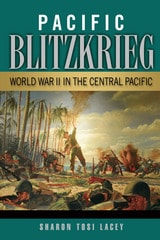
cover of Pacific Blitzkrieg: World War II in the Central Pacific

Pacific Blitzkrieg

World War II in the Central Pacific

Sharon Tosi Lacey

University of North Texas Press, 2013
[more]
cover of Pea Ridge and Prairie Grove: Scenes and Incidents fo the War in Arkansas

Pea Ridge and Prairie Grove

Scenes and Incidents fo the War in Arkansas

William Baxter

University of Arkansas Press, 2000

With the goal of sketching “at least some of the bright lights and dark shadows of the war;” William Baxter authored his regional classic, Pea Ridge and Prairie Grove, in 1864, before the actual end of the Civil War.

Primarily focusing on the civilians of the region, Baxter vividly describes their precarious and vulnerable positions during the advances and retreats of armies as Confederate and Federal forces marched across their homeland. In his account, Baxter describes skirmishes and cavalry charges outside his front door, the “firing” of his town’s buildings during a Confederate retreat, clashes between secessionist and Unionist neighbors, the feeding of hungry soldiers and the forceful appropriation of his remaining food supply, and the sickening sight of the wounded emerging from the Prairie Grove battlefield.

Since its original printing, this firsthand account has only been reprinted once, in 1957, and both editions are considered collectors’ items today. Of interest to Civil War scholars and general readers alike, Baxter’s compelling social history is rendered even more comprehensive by William Shea’s introduction. Pea Ridge and Prairie Grove is a valuable personal account of the Civil War in the Trans-Mississippi West which enables us to better comprehend the conflict as a whole and its devastating effect on the general populace of the war-torn portions of the country.
[more]
cover of Peacekeeping on the Plains: Army Operations in Bleeding Kansas

Peacekeeping on the Plains

Army Operations in Bleeding Kansas

Tony R. Mullis

University of Missouri Press, 2004
 

Historians have written on “Bleeding Kansas” and on the frontier army as a constabulary force, but little scholarship exists on how the army performed its peacekeeping operations in the 1850s. In Peacekeeping on the Plains, Tony R. Mullis is one of the first scholars to detail the military concerns associated with peace enforcement in Kansas and the trans-Missouri West.


Between 1854 and 1856, the Franklin Pierce administration called upon the U.S. Army to conduct a series of peace operations in the newly formed Kansas and Nebraska territories. The army responded to the president’s call by successfully completing a mission against the Lakota Sioux in 1855 and by aiding civil authorities in the imposition of peace among competing factions in Kansas during 1856.


Although these police duties were not always popular with the soldiers that conducted them, the purpose behind them remained constant—the maintenance of peace, order, and security. Given Americans’ misgivings about a standing army and their limited expectations for it as a domestic peacekeeper, its use in this fashion during the 1850s was a delicate proposition.


By drawing on diverse sources, including official army correspondence, personal papers of key military and political leaders, and local accounts of army activities, Mullis shows how peace operations were conducted by the U.S. Army long before the second half of the twentieth century. He alsopresents a thorough analysis of the professional dilemmas confronted by army officers, as well as the delicate command and control issues associated with the different types of peace operations.


Mullis’s assessment of the army’s peacekeeping efforts in the mid-1850s offers a full understanding of the constraints and frustrations involved. Many of the dilemmas faced by the army in Kansas parallel those encountered in various spots around the globe today. Peacekeeping on the Plains will provide any reader with a better insight into the nuances of peace operations in the 1850s and assist military historians in their understanding of these activities as they relate to the twenty-first century.
[more]
cover of Pedro de Rivera and the Military Regulations for Northern New Spain, 1724-1729: A Documentary History of His Frontier Inspection and the Reglamento de 1729

Pedro de Rivera and the Military Regulations for Northern New Spain, 1724-1729

A Documentary History of His Frontier Inspection and the Reglamento de 1729

Thomas H. Naylor

University of Arizona Press, 1989
Philip V ordered an inspection of the presidios in the northern provinces which resulted in the reglamento of 1729. The study was capably done and documented by Pedro de Rivera Villalon. Includes Rivera’s report to the Viceroy of New Spain, the Reglamento of Havana , the inspection, Alvarez Barreiro’s map and descriptions. The documents are presented in their original Spanish and in translation, provide a detailed background by which modern scholars can better assess the status and role of Spain's military outposts
[more]
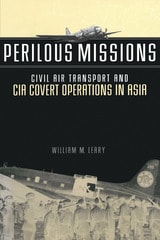
cover of Perilous Missions: Civil Air Transport and CIA Covert Operations in Asia

Perilous Missions

Civil Air Transport and CIA Covert Operations in Asia

William M. Leary

University of Alabama Press, 2005

Civil Air Transport (CAT), founded in China after World War II by Claire Chennault and Whiting Willauer, was initially a commercial carrier specializing in air freight. Its role quickly changed as CAT became first a paramilitary adjunct of the Nationalist Chinese Air Force, then the CIA's secret "air force" in Korea, then "the most shot-at airline in the world" in French Indochina, and eventually becoming reorganized as Air America at the height of the Vietnam War. William M. Leary's detailed operational history of CAT sets the story in the perspective of Asian and Cold War geopolitics and shows how CAT allowed the CIA to operate with a level of flexibility and secrecy that it would not have attained through normal military or commercial air transportation.
[more]
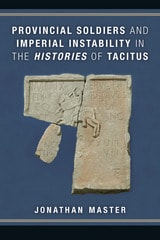
cover of Provincial Soldiers and Imperial Instability in the Histories of Tacitus

Provincial Soldiers and Imperial Instability in the Histories of Tacitus

Jonathan Master

University of Michigan Press, 2016

Tacitus’ narrative of 69 CE, the year of the four emperors, is famous for its description of a series of coups that sees one man after another crowned. Many scholars seem to read Tacitus as though he wrote only about the constricted world of imperial Rome and the machinations of emperors, courtiers, and victims of the principate; even recent work on the Histories either passes over or lightly touches upon civil unrest and revolts in the provinces. In Provincial Soldiers and Imperial Instability in the Histories of Tacitus, Jonathan Master looks beyond imperial politics and finds threats to the Empire’s stability among unassimilated foreign subjects who were made to fight in the Roman army.

Master draws on scholarship in political theory, Latin historiography, Roman history, and ethnic identity to demonstrate how Tacitus presented to his contemporary audience in Trajanic Rome the dangerous consequences of the city’s failure to reward and incorporate its provincial subjects. Master argues that Tacitus’ presentation of the Vitellian and Flavian armies, and especially the Batavian auxiliary soldiers, reflects a central lesson of the Histories: the Empire’s exploitation of provincial manpower (increasingly the majority of all soldiers under Roman banners) while offering little in return, set the stage for civil wars and ultimately the separatist Batavian revolt.

[more]